
World Cities Report 2022: Envisaging the Future of Cities (UN-Habitat, 2022).
Grimm, N. B. et al. Global change and the ecology of cities. Science 319, 756–760 (2008).
Parajuli, A. et al. Urbanization reduces transfer of diverse environmental microbiota indoors. Front. Microbiol. 9, 84 (2018).
Li, H. et al. Spatial and seasonal variation of the airborne microbiome in a rapidly developing city of China. Sci. Total Environ. 665, 61–68 (2019).
Flandroy, L. et al. The impact of human activities and lifestyles on the interlinked microbiota and health of humans and of ecosystems. Sci. Total Environ. 627, 1018–1038 (2018).
Rook, G. A. Regulation of the immune system by biodiversity from the natural environment: an ecosystem service essential to health. Proc. Natl Acad. Sci. USA 110, 18360–18367 (2013).
Mphasa, M. et al. Urban waste piles are reservoirs for human pathogenic bacteria with high levels of multidrug resistance against last resort antibiotics: a comprehensive temporal and geographic field analysis. J. Hazard. Mater. 484, 136639 (2025).
Liu, S. et al. Variation of bacterioplankton community along an urban river impacted by touristic city: with a focus on pathogen. Ecotoxicol. Environ. Saf. 165, 573–581 (2018).
Abrego, N. et al. Fungal communities decline with urbanization—more in air than in soil. ISME J. 14, 2806–2815 (2020).
Numberger, D. et al. Urbanization promotes specific bacteria in freshwater microbiomes including potential pathogens. Sci. Total Environ. 845, 157321 (2022).
Zhao, J. et al. Global airborne bacterial community—interactions with Earth’s microbiomes and anthropogenic activities. Proc. Natl Acad. Sci. USA 119, e2204465119 (2022).
Flies, E. J., Clarke, L. J., Brook, B. W. & Jones, P. Urbanisation reduces the abundance and diversity of airborne microbes – but what does that mean for our health? A systematic review. Sci. Total Environ. 738, 140337 (2020).
Barberán, A. et al. Continental-scale distributions of dust-associated bacteria and fungi. Proc. Natl Acad. Sci. USA 112, 5756–5761 (2015).
Liu, L. et al. Impact of urbanization on soil microbial diversity and composition in the megacity of Shanghai. Land Degrad. Dev. 33, 282–293 (2022).
Mills, J. G. et al. Relating urban biodiversity to human health with the ‘holobiont’ concept. Front. Microbiol. 10, 8 (2019).
Filippi-Codaccioni, O., Devictor, V., Clobert, J. & Julliard, R. Effects of age and intensity of urbanization on farmland bird communities. Biol. Conserv. 141, 2698–2707 (2008).
Danko, D. et al. A global metagenomic map of urban microbiomes and antimicrobial resistance. Cell 184, 3376–3393 (2021).
Moreno-Contreras, I. et al. Disentangling the drivers of urban bird diversity in the non-breeding season: a general synthesis. Glob. Change Biol. 30, e17421 (2024).
Frank, S. D. & Backe, K. M. Effects of urban heat islands on temperate forest trees and arthropods. Curr. For. Rep. 9, 48–57 (2023).
Liu, R. & Ochman, H. Stepwise formation of the bacterial flagellar system. Proc. Natl Acad. Sci. USA. 104, 7116–7121 (2007).
Green, E. R. & Mecsas, J. Bacterial secretion systems: an overview. Microbiol. Spectr. 4, 213–239 (2016).
Yang, S. & Song, L. Succession of bacterial community structure and metabolic function during solid waste decomposition. Bioresour. Technol. 291, 121865 (2019).
Flemming, H.-C. & Wingender, J. The biofilm matrix. Nat. Rev. Microbiol. 8, 623–633 (2010).
Brown, M. Unexplored reservoirs of pathogenic bacteria: protozoa and biofilms. Trends Microbiol. 7, 46–50 (1999).
Yao, Z. et al. Integrated succinylome and metabolome profiling reveals crucial role of S-ribosylhomocysteine lyase in quorum sensing and metabolism of Aeromonas hydrophila. Mol. Cell Proteomics 18, 200–215 (2019).
Forsyth, A. The British new towns: lessons for the world from the new-town experiment. Town Plan. Rev. 90, 239–246 (2019).
Beninde, J., Veith, M. & Hochkirch, A. Biodiversity in cities needs space: a meta-analysis of factors determining intra-urban biodiversity variation. Ecol. Lett. 18, 581–592 (2015).
Chen, X. et al. Differences in urban heat island and its driving factors between central and new urban areas of Wuhan, China. Environ. Sci. Pollut. Res. 30, 58362–58377 (2023).
Coffey, M. & Coad, A. Collection of Municipal Solid Waste in Developing Countries (UN-Habitat, 2010).
Yang, L., Wu, M., Chen, Y. & Wu, C. Examining the impact of the urban transportation system on tangible and intangible vitality at the city-block scale in Nanjing, China. Environ. Plan. B 51, 1833–1853 (2023).
Lo, A. Y. H. & Jim, C. Y. Differential community effects on perception and use of urban greenspaces. Cities 27, 430–442 (2010).
Dutt, Y. et al. The association between biofilm formation and antimicrobial resistance with possible ingenious bio-remedial approaches. Antibiotics (Basel) 11, 930 (2022).
Wu, S. et al. Quorum sensing-based interactions among drugs, microbes, and diseases. Sci. China Life Sci. 66, 137–151 (2023).
Li, Y. et al. How did the bacterial community respond to the level of urbanization along the Yangtze River?. Environ. Sci.: Processes Impacts 22, 161–172 (2020).
Cavanaugh, A. C. et al. Strangers in a strange land: mapping household and neighbourhood associations with improved wellbeing outcomes in Accra, Ghana. Cities 143, 104584 (2023).
Czech, B., Mills Busa, J. H. & Brown, R. M. Effects of economic growth on biodiversity in the United States. Nat. Resour. Forum 36, 160–166 (2012).
Schell, C. J. et al. The ecological and evolutionary consequences of systemic racism in urban environments. Science 369, 1446 (2020).
Liu, C. M. et al. Staphylococcus aureus and the ecology of the nasal microbiome. Sci. Adv. 1, e1400216 (2015).
Chen, C. et al. Progress and gaps in antimicrobial resistance research within One Health sectors in China: a systematic analysis. Sci. China Life Sci. 68, 2755–2767 (2025).
Huang, C. K., Weerasekara, A., Bond, P. L., Weynberg, K. D. & Guo, J. Characterizing the premise plumbing microbiome in both water and biofilms of a 50-year-old building. Sci. Total Environ. 798, 149225 (2021).
Wang, L. et al. The effect of greenness on ESKAPE pathogen reduction and its heterogeneity across global climate zones and urbanization gradient. Urban For. Urban Green. 87, 128048 (2023).
Agustinho, D. P. et al. Unveiling microbial diversity: harnessing long-read sequencing technology. Nat. Methods 21, 954–966 (2024).
Clagnan, E. et al. Culturomics- and metagenomics-based insights into the soil microbiome preservation and application for sustainable agriculture. Front. Microbiol. 15, 1473666 (2024).
Chen, S. Ultrafast one-pass FASTQ data preprocessing, quality control, and deduplication using fastp. iMeta 2, e107 (2023).
Nurk, S. et al. The complete sequence of a human genome. Science 376, 44–53 (2022).
Langmead, B. & Salzberg, S. L. Fast gapped-read alignment with Bowtie 2. Nat. Methods 9, 357–359 (2012).
Gihawi, A. et al. Major data analysis errors invalidate cancer microbiome findings. mBio 14, e0160723 (2023).
Wood, D. E., Lu, J. & Langmead, B. Improved metagenomic analysis with Kraken 2. Genome Biol. 20, 257 (2019).
Breitwieser, F. P., Pertea, M., Zimin, A. V. & Salzberg, S. L. Human contamination in bacterial genomes has created thousands of spurious proteins. Genome Res. 29, 954–960 (2019).
Lu, J., Breitwieser, F. P., Thielen, P. & Salzberg, S. L. Bracken: estimating species abundance in metagenomics data. PeerJ Comput. Sci. 3, e104 (2017).
Wu, J. et al. Annotating unknown species of urban microorganisms on a global scale unveils novel functional diversity and local environment association. Environ. Res. 207, 112183 (2022).
Nurk, S., Meleshko, D., Korobeynikov, A. & Pevzner, P. A. metaSPAdes: a new versatile metagenomic assembler. Genome Res. 27, 824–834 (2017).
Kang, D. D., Froula, J., Egan, R. & Wang, Z. MetaBAT, an efficient tool for accurately reconstructing single genomes from complex microbial communities. PeerJ 3, e1165 (2015).
Hyatt, D. et al. Prodigal: prokaryotic gene recognition and translation initiation site identification. BMC Bioinformatics 11, 119 (2010).
Huerta-Cepas, J. et al. eggNOG 5.0: a hierarchical, functionally and phylogenetically annotated orthology resource based on 5090 organisms and 2502 viruses. Nucleic Acids Res. 47, D309–D314 (2019).
Cantalapiedra, C. P., Hernández-Plaza, A., Letunic, I., Bork, P. & Huerta-Cepas, J. eggNOG-mapper v2: functional annotation, orthology assignments, and domain prediction at the metagenomic scale. Mol. Biol. Evol. 38, 5825–5829 (2021).
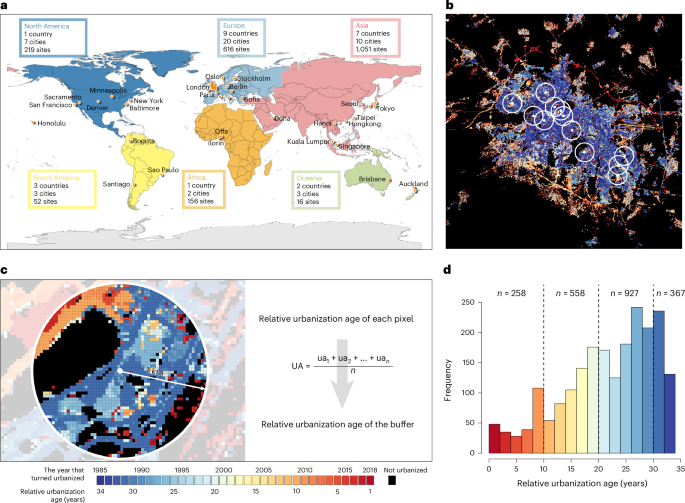
Rentschler, J. et al. Global evidence of rapid urban growth in flood zones since 1985. Nature 622, 87–92 (2023).
Gong, P. et al. Annual maps of global artificial impervious area (GAIA) between 1985 and 2018. Remote Sens. Environ. 236, 111510 (2020).
Zhao, C. et al. Neighborhood garden’s age shapes phyllosphere microbiota associated with respiratory diseases in cold seasons. Environ. Sci. Ecotechnol. 18, 100315 (2024).
Piyapong, C. et al. A predictive model of the impact of urbanization on bacterial loads in watersheds. J. Clean. Prod. 297, 126704 (2021).
Wu, J. et al. Landscape of global urban environmental resistome and its association with local socioeconomic and medical status. Sci. China Life Sci. 67, 1292–1301 (2024).
Li, X. et al. Mapping global urban boundaries from the global artificial impervious area (GAIA) data. Environ. Res. Lett. 15, 094044 (2020).
Center For International Earth Science Information Network-CIESIN-Columbia University. Gridded Population of the World, version 4 (GPWv4): population count adjusted to match 2015 revision of UN WPP country totals, revision 11. NASA Socioeconomic Data and Applications Center (SEDAC) https://doi.org/10.7927/H4PN93PB (2018).
Kummu, M., Taka, M. & Guillaume, J. H. A. Gridded global datasets for Gross Domestic Product and Human Development Index over 1990–2015. Sci. Data 5, 180004 (2018).
van Donkelaar, A. et al. Global annual PM2.5 grids from MODIS, MISR and SeaWiFS aerosol optical depth (AOD) with GWR, 1998–2016. NASA Socioeconomic Data and Applications Center (SEDAC) https://doi.org/10.7927/H4ZK5DQS (2018). (Original DOI no longer accessible; data used in this study are available at https://doi.org/10.6084/m9.figshare.24782817)
Beck, H. E. et al. Present and future Köppen–Geiger climate classification maps at 1-km resolution. Sci. Data 5, 1–12 (2018).
Dufrene, M. & Legendre, P. Species assemblages and indicator species: the need for a flexible asymmetrical approach. Ecol. Monogr. 67, 345 (1997).
Baker, M. E. & King, R. S. A new method for detecting and interpreting biodiversity and ecological community thresholds. Methods Ecol. Evol. 1, 25–37 (2010).
Wang, L., Jia, Y., Wu, J. & Shi, T. Data and code for NATSUSTAIN-23114609A-Z. figshare https://doi.org/10.6084/m9.figshare.24782817 (2026).