
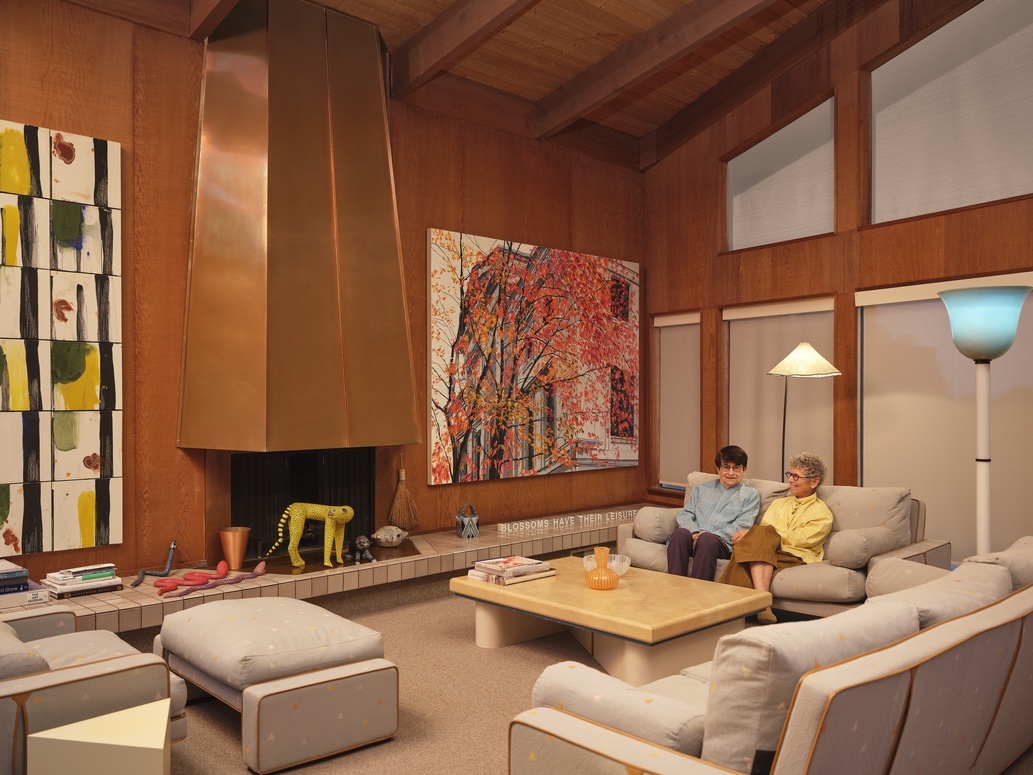
As one of the most culturally vibrant cities on the West Coast, Berkeley has always had more than its share of passionate art lovers, but few have amassed such an impressive art collection as Penny Cooper and Rena Rosenwasser. Cooper, a distinguished criminal defense attorney, and Rosenwasser, the co-founder of Kelsey Street Press, have spent half a century quietly assembling one of the Bay Area’s finest private art collections — and one of the country’s largest devoted exclusively to women artists.
“Rhapsody: Works from the Cooper Rosenwasser Collection” through June 28 at BAMPFA, 2155 Center St. Berkeley. See website for tickets and tour.
That collection has been the toast of the local art scene this spring with a new exhibition at the Berkeley Art Museum and Pacific Film Archive, which is presenting “Rhapsody: Works from the Cooper Rosenwasser Collection” through June 28. It’s the first time the collection has been displayed outside the couple’s home — and since the exhibition coincides with their donation of nearly 150 artworks to BAMPFA, it won’t be the last.
“It’s pretty overwhelming to think that what we were just collecting for ourselves is now on the walls of a museum,” said Cooper. “I’m still trying to adjust to it! We were never trying to be museum makers; we just wanted to live with art.”
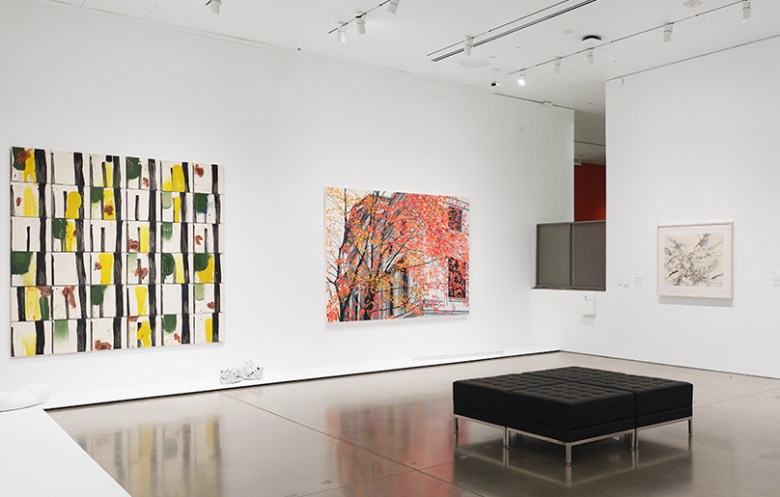 “Rhapsody: Works from the Cooper Rosenwasser Collection” shows at BAMPFA through June 28. Credit: Chris Grunder
Cooper and Rosenwasser have been living with art — and with each other — for half a century. In a romantic twist, the BAMPFA exhibition coincides with the 50th anniversary of Rosenwasser moving in to live with Cooper, then a successful young trial lawyer who had just built herself a house in the Berkeley Hills.
Both women had been immersed in art during their formative years: Cooper through a close relationship with her two brothers, who were both working artists, and Rosenwasser through her upbringing in New York City, where she regularly visited the Museum of Modern Art. From their earliest years as a couple, they knew they wanted to fill their home with art — and they got right to it.
“When I first moved in, [Penny] had just moved in herself, and she didn’t really have much furniture, and the walls of the house were bare,” recalled Rosenwasser. “The first pieces we bought to hang on the walls were prints by very well-known male artists, Robert Rauschenberg and Frank Stella.
“But we soon realized that women were really not represented in the galleries and museums we were visiting. I had been part of the founding of Kelsey Street Press, which was founded to publish poetry by women, so I was very aware of issues of underrepresentation.”
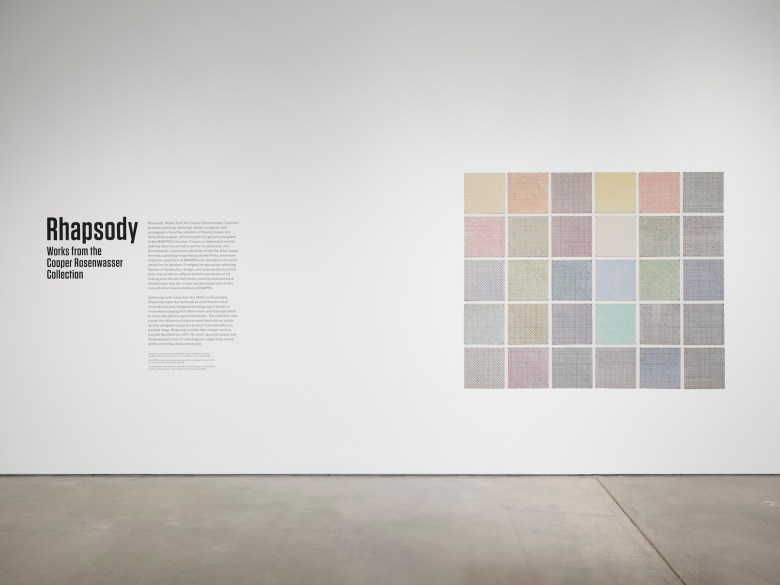 “Rhapsody: Works from the Cooper Rosenwasser Collection” shows at BAMPFA through June 28. Credit: Chris Grunder
The couple’s support of women artists accelerated with their viewing of Jennifer Bartlett’s iconic painting “Rhapsody”— the inspiration for the exhibition’s title — whose minimalist geometry would become a recurring motif in their collection. Since 1977, Cooper and Rosenwasser have collected work exclusively by women artists, and they have done so with remarkable foresight: many of the then-unknown artists whose work they acquired went on to achieve international acclaim, such as Marlene Dumas, Nicole Eisenman and Jacqueline Humphries, among many others. By championing promising young female artists on the verge of success, the couple managed to stay ahead of an art market that was then struggling to keep up with the emerging feminist movement.
“It’s really funny: Early on, when I would meet with some famous people who were collectors, and they would say to me ‘Why would you do that?’” Rosenwasser said of their focus on women artists. “Meanwhile I’d look around their rooms, and they’d have one piece out of 50 that was by a woman.”
As Cooper is quick to point out, the art world eventually started to wake up to the contributions of women artists — but inequalities linger on to this day.
“When we first started collecting, a lot of major art dealers had one woman artist, or none,” said Cooper. “Now, most of the dealers have several. But the prices are still much, much lower. When we watch the auctions, we see that the women are slowly gaining traction.”
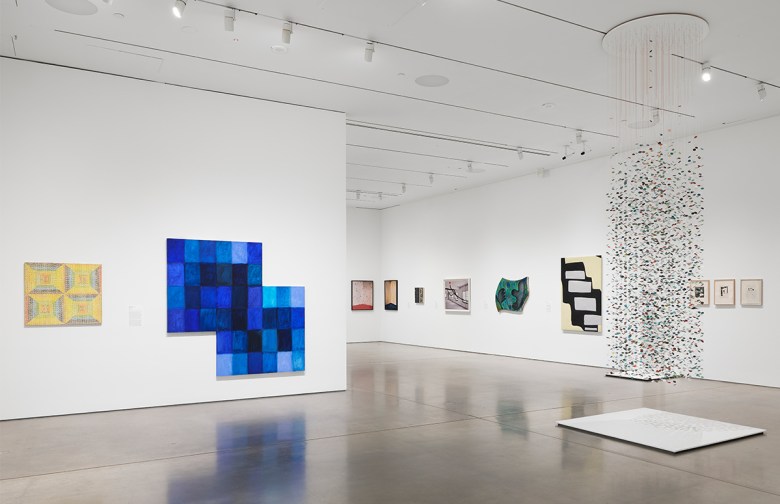 “Rhapsody: Works from the Cooper Rosenwasser Collection” shows at BAMPFA through June 28. Credit: Chris Grunder
Anyone who has visited “Rhapsody” at BAMPFA this spring won’t need convincing about the outstanding work that women artists are producing. Assembled by BAMPFA’s chief curator Margot Norton, the exhibition is an impressive tribute not just to the work of women artists but to the excellent taste of the two women who have spent a lifetime collecting them. It offers an inviting cross-section of Cooper and Rosenwasser’s artistic preoccupations — from Minimalist and Conceptualist work, like Bartlett’s “Rhapsody” painting; to craft-inspired works, such as a beautiful orange tapestry by Lenore Tawney; to provocative explorations of the female body, like Catherine Opie’s startling, sadomasochistic photography.
“We bought Catherine Opie’s self-portraits before anyone would go near them,” said Rosenwasser. The now-celebrated photographer received a Guggenheim Fellowship in 2019. “We still have some male friends who come over to our home and say, ‘We just don’t get it.’”
Though their artistic and professional pursuits have taken them around the world, Cooper and Rosenwasser have remained firmly tethered to Berkeley, where they still reside in the same hillside home that they began filling with art 50 years ago. When it came time to decide where to donate their collection, their deep roots in the city — and their lifelong support for BAMPFA — made it an easy choice.

A conversation with Penny Cooper and Rena Rosenwasser at the opening of the exhibit of their collection at BAMPFA. Courtesy of BAMPFA
Cooper, who previously served on BAMPFA’s Board of Trustees, traces her affection for the museum to her time as a law student at UC Berkeley.
“When I started law school, I felt like it was very important to me to have a broader view of life,” said Cooper. “At that time, the University Art Museum [now BAMPFA] was across the street from the law school. I would periodically take time and go across the street to the museum and forget about the law for a while.”
For Rosenwasser, it’s exciting to know that the artwork she’s loved for so many years will pass into the care of an educational institution, where it will hopefully inspire the next generation of women artists and the collectors who champion them.
“I heard there’s a class on second-wave feminism that’s going to visit the exhibition,” said Rosenwasser. “I’m going to try to drop by when they come through. I have a lot to say on that topic!”
“*” indicates required fields