
BOK cites shallow forex market, high exposure to capital outflows
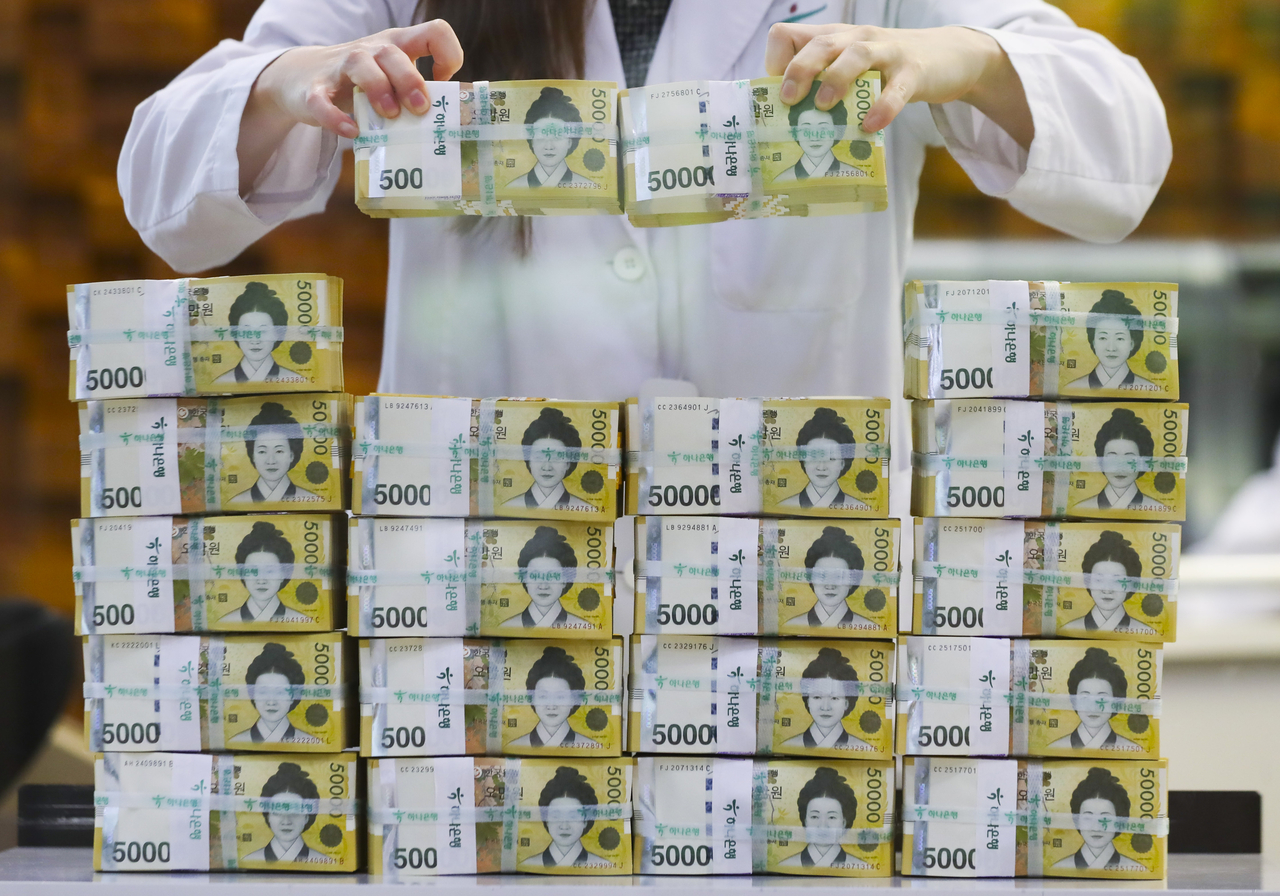 A 2023 file photo shows an employee sorting 50,000 won banknotes at the counterfeit detection center of Hana Bank in central Seoul. (Newsis)
The Korean won tends to be more volatile than major currencies due to limited depth in the foreign exchange market, or a lack of sufficient buy and sell orders across price levels, Bank of Korea economists said Thursday.
A recent central bank paper shows the won reacts more strongly to capital outflow shocks than currencies in advanced economies.
Korea’s estimated sensitivity to such shocks stands at 0.65 — slightly below the emerging market average of 0.71, but well above Japan’s 0.38 — indicating the won moves more sharply in response to similar external pressures.
“This difference appears to be linked to the depth of the forex market,” said Kim Ji-hyun, a BOK economist, pointing to relatively shallow liquidity in the won-dollar market.
Limited depth reflects lower trading volumes, with fewer participants and smaller order sizes making it harder for the market to absorb large transactions without triggering price swings.
“In this context, recent efforts to gain inclusion in major global indices such as the FTSE World Government Bond Index and an upgrade in the MSCI classification could be considered relevant,” she added.
The drivers of the won have also shifted over time. While exports were the main force behind currency appreciation until 2014, capital flows are now playing a more dominant role, Kim said.
The study also found that US assets account for 63 percent of Korea’s external securities investments, far exceeding the advanced economy average of 25 percent. This concentration increases exposure to external shocks and adds to currency volatility.
“A rising share of US assets is a natural part of development for an advanced economy,” said Kim Min, another BOK economist, adding that no single factor fully explains the trend.
silverstar@heraldcorp.com