
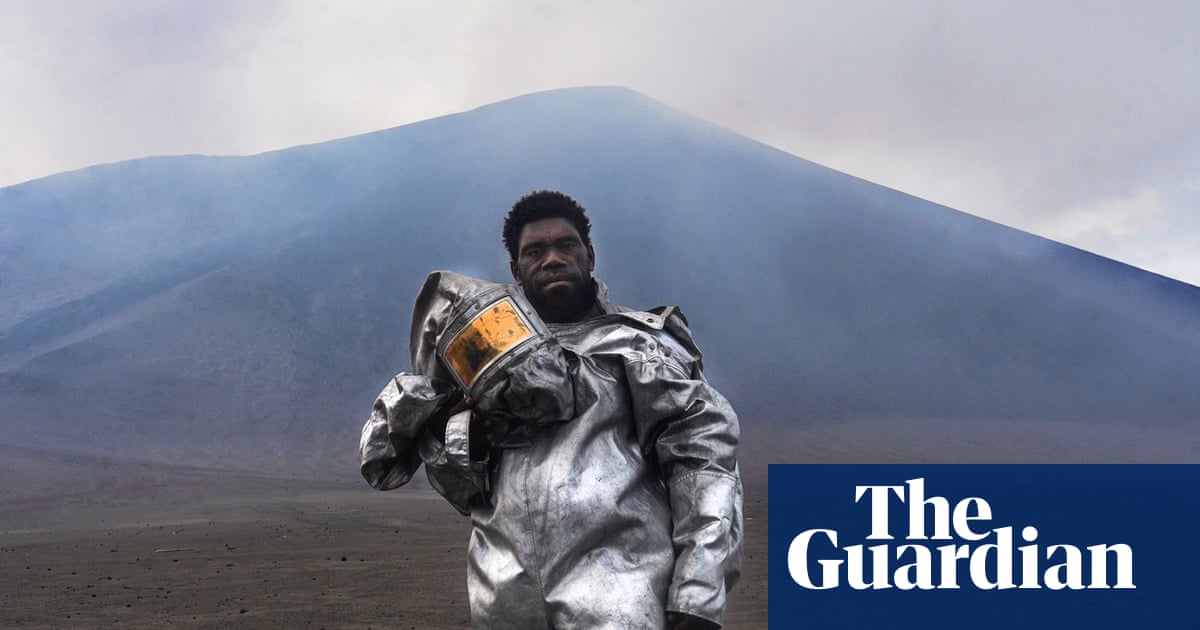
The earth was rumbling beneath Elle Leontiev’s feet, the air thick with volcanic gas and ash. Before her, Phillip Yamah stood barefoot on an exploded lava bomb. His shiny silver lava suit contrasted the dark, smouldering backdrop of Mount Yasur – one of the world’s most active volcanoes on the Vanuatu island of Tanna.
Adding tension to the scene, the Australian photographer was shooting entirely “blind”. The electricity at a nearby village had shorted her Sony A7 III screens and digital interface, forcing Leontiev to rely solely on the beep of her autofocus sensor to capture the moment.
That technical leap of faith paid off. On Thursday, the resulting surreal portrait of the “barefoot volcanologist” had Leontiev named the Open Photographer of the Year at the 2026 Sony world photography awards.
Selected from a pool of over 430,000 submissions across more than 200 countries and territories, the open category celebrates the single best image of the past year.
Speaking with the Guardian after the gala ceremony in London, Leontiev said winning the award was life-affirming, noting its true value lies in the international platform it provides for her subjects.
Photographer Elle Leontiev took her winning photo while on a documentary assignment covering women’s rights in Vanuatu and Fiji. Photograph: Elle Leontiev
“What makes it especially meaningful is the ability to elevate the stories of others,” Leontiev said. “At the heart of my work is the desire to illustrate dreamlike states and highlight social issues. This award feels like a moment where those stories are being seen and valued globally, not just my own practice.”
Sign up for the Breaking News Australia email
For Yamah, who was born and still lives at the base of Mount Yasur, that story is one of deep, lived expertise. Despite having no formal qualifications due to limited access to higher education and cost, he has spent years studying Mount Yasur.
“He proudly showed me the Haos Blong Volkeno museum he had set up for his community, including a lava suit that was gifted to him for exploration by visiting researchers,” Leontiev said. “I knew I had the opportunity for a special environmental portrait and a unique chance to elevate the story of an underdog in the world of volcano science.”
Yamah’s local knowledge is highly sought after. He has trained with renowned French volcanologist Thomas Boyer and guided numerous international research teams, National Geographic expeditions and public figures like Will Smith to the crater’s edge.
In an era increasingly dominated by artificial intelligence, Leontiev says a visual record of humanity that is grounded in reality is more crucial than ever. Photograph: Elle Leontiev
His moniker, the “barefoot volcanologist”, comes from his habit of exploring the rugged volcanic terrain without shoes, a necessity, given his size 20 feet make finding fitting footwear nearly impossible.
Leontiev’s path to capturing the award-winning shot was serendipitous. Originally on a documentary assignment covering women’s rights in Vanuatu and Fiji, she took a detour to Tanna. She spent a week immersed in the daily life of Yamah’s community, building trust and participating in local ceremonies before attempting the portrait.
“In that moment, I felt such a privilege to honour his life story,” Leontiev recalled of the shoot on the ash plains. “For me, the image is less about the spectacle of the volcano and more about the quiet authority and presence of Phillip’s relationship with it. It is about knowledge, the pursuit of dreams, coexistence, cultural knowledge, and respect for nature.”
With 15 years of experience, Leontiev describes her visual style as sitting between fine art and documentary storytelling. Photograph: Elle Leontiev
Yamah’s own dream is for his son to attend higher education and become Vanuatu’s first formally recognised volcanologist. Moved by his ambition, Leontiev teamed up with film-maker Guillaume Beaudoin to launch a crowdfunding campaign, which has already raised significant funds to help Yamah’s family realise this goal.
With 15 years of experience, Leontiev describes her visual style as sitting between fine art and documentary storytelling. In an era increasingly dominated by artificial intelligence, she says a visual record of humanity that is grounded in reality is more crucial than ever.
“As AI blurs the line between what is real and what is constructed, there is a growing value in imagery that is human, real, and rooted in lived experience, presence, and truth,” she said. “AI can reduce cost and fill certain gaps in the marketplace, but it cannot replace authenticity or our human desire to connect with others.”