

Happy Friday and welcome back to The Microdose, an independent journalism newsletter brought to you by the U.C. Berkeley Center for the Science of Psychedelics.
Scientists test if ketamine’s antidepressant effects occur under anesthesia
Stanford anesthesiologist Boris Heifets and colleagues recently published a JAMA Psychiatry report testing the neurological effects of ketamine in different states of consciousness. This paper follows previous research from Heifets’s group that found that patients experienced relief from depressive symptoms after receiving either ketamine or placebo under anesthesia. “I looked back at what some of these participants wrote about their experience and it was clear that something really happened for them, even if they were given a placebo,” Heifets told The Microdose at the time.
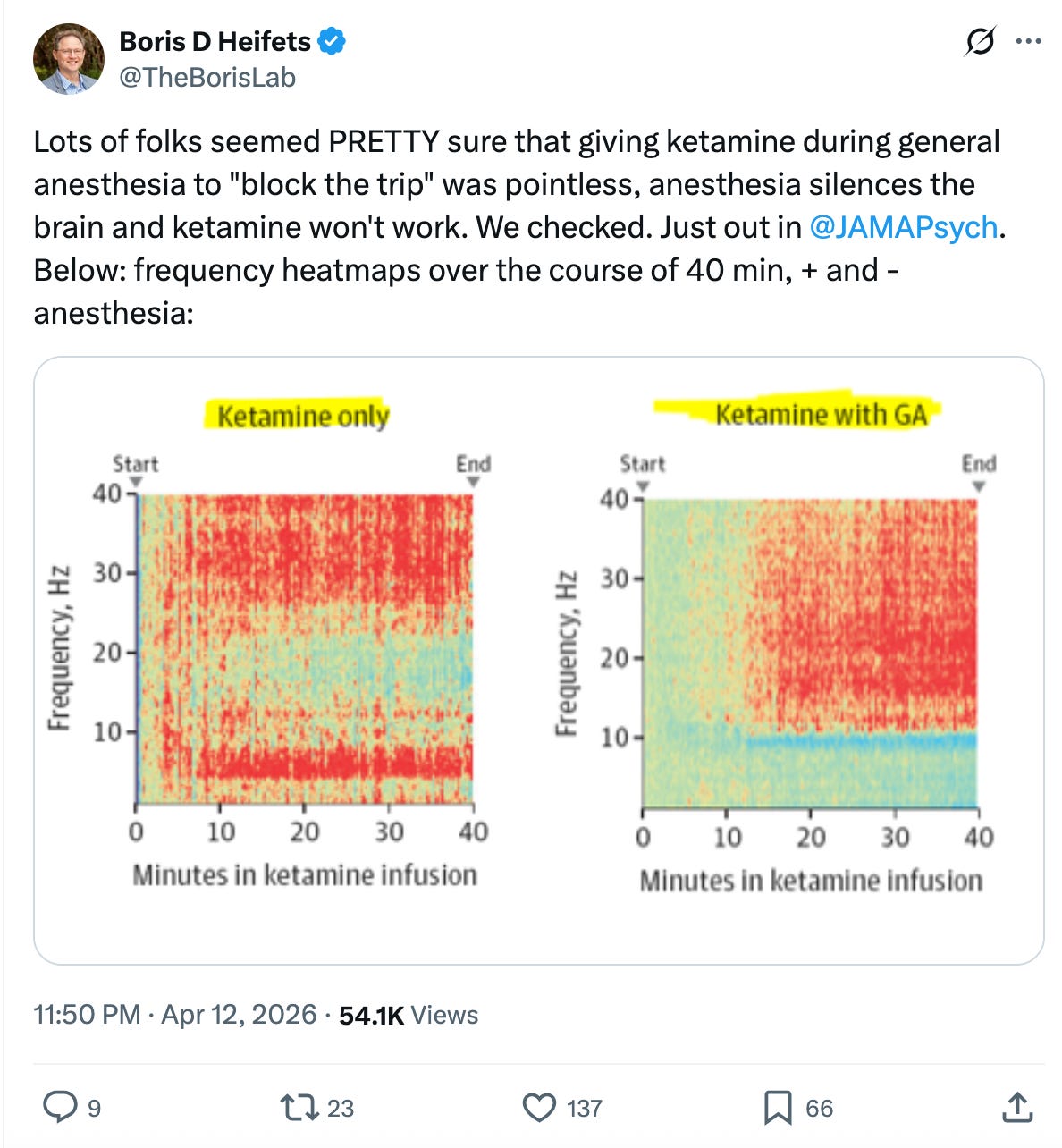
In this most recent paper, the study authors similarly examined the effects of ketamine, known for its dissociative, analgesic, and antidepressant effects, while patients were under general anesthesia. The goal was to see what brain “signatures” of ketamine’s effects were present in the absence of conscious awareness. For example, the authors posit, in electroencephalogram (EEG) readings “ketamine’s antidepressant mechanisms have been attributed to high-frequency oscillations, while its dissociative properties have been linked to low-frequency oscillations.”
The authors conducted a secondary analysis on three studies that included dozens of participants who received a 40 minute infusion of ketamine, with or without general anesthesia. Participants’ EEG data showed that ketamine paired with anesthesia modulated the low-frequency theta-band signatures of ketamine that have been linked to dissociation, but not the high-frequency beta- and gamma-band signatures that have been linked to antidepressant effects.
The authors conclude that key aspects of ketamine’s biological actions are preserved while patients are under anesthesia, and that perhaps, distinct mechanisms of action of ketamine could be targeted for therapeutic development. The results could inform research to develop antidepressant therapies without inducing dissociation, they reason.
France is the first to approve IV ketamine for severe suicidal crisis
In March, French regulators became the first to approve intravenous racemic ketamine for treating adults in severe suicidal crisis. The racemic form of ketamine contains an equal proportion of two molecular structures, known as R- and S-ketamine, which are mirror images of each other. While a nasal spray with just S-ketamine (esketamine) has been approved elsewhere for treatment of major depressive disorder, studies have shown that racemic ketamine infusions can reduce suicidal ideation in just hours.
France’s “compassionate prescription framework” requires that ketamine be administered in hospitals, with a psychiatrist’s prescription. The country’s authorization “recognises not only ketamine’s clinical potential, but also the absence of any officially approved, evidence-based, rapid-acting pharmacological alternative when suicide risk is imminent,” French researchers wrote in The Lancet on April 11.
The FDA has previously issued warnings on compounded racemic ketamine’s risk of abuse and misuse, explaining that the drug has not been approved by the FDA for the treatment of any psychiatric disorders. In an opinion piece for The Clinical Trial Vanguard, chief editor Moe Alsumidaie argues that FDA regulators may want to question their hesitancy. French regulators “made a regulatory risk-benefit call that the FDA has not made,” he writes. “One authorization does not constitute a global evidence consensus — but it does constitute a precedent, and precedents in regulatory science travel.”

Want the latest psychedelics news? Subscribe! (It’s free!)
Johns Hopkins psychedelics researchers report trip sitters are key to psychedelic experiences for patients in clinical trials. But what about for “healthy” volunteers?
It’s unclear just how much facilitators, the people who support trial participants before, during, and after a psychedelic experience, tangibly impact participants’ outcomes. The study authors set out to investigate this question by analyzing what they claim is the largest dataset of its kind, drawing from nine psilocybin studies including nearly 300 participants and 60 facilitators. They published their findings in the May 2026 issue of Psychiatry Research.
The authors compared participants’ reported psychedelic experiences and whether facilitators influenced that experience between two groups – those in clinical trial populations, with a condition like major depressive disorder or anorexia that researchers are hoping to treat, and “healthy” volunteers from other pharmacological studies. The researchers found that facilitators accounted for greater variance (over 13% of total variance) in participants’ “acute subjective effects ”(measured by the Mystical Experience Questionnaire) for clinical populations, compared to less than one percent variance accounted for in healthy volunteers. There is evidence from multiple studies suggesting that mystical-type experiences under psychedelics predict therapeutic benefits.
“For healthy volunteers, the experience was shaped almost entirely by the drug itself and individual differences, not who facilitated the session,” lead author Sean Goldy wrote on Bluesky. “Facilitators seem to have the biggest impact on psychedelic experiences when therapeutic stakes are highest.” The results should inform how clinical trials and therapies are implemented moving forward, the authors conclude.
Various state bills move to expand psychedelic research and access to the drugs
In Oklahoma, the Inter-Tribal Council of the Five Civilized Tribes unanimously passed a resolution in support of developing ibogaine as a treatment of addiction and trauma disorders, the Chickasaw Nation announced April 13. On the same day, the Oklahoma Senate Health and Human Services committee advanced HB 3834 to the Appropriations committee. The Oklahoma bill supports ibogaine clinical trials in partnership with a private drug developer, one of 13 states with similar proposals across the country.
Many states have also been considering “trigger law” bills that would change the legal status of certain psychedelics on the state level, if and when they are approved by federal regulators. Some specifically pave the way for UK-based pharmaceutical company Compass Pathways to roll out their proprietary formulation of psilocybin — “crystalline polymorph psilocybin,” also known as COMP360.
Earlier this month, Virginia’s governor signed companion bills to legalize psilocybin following FDA approval. If federal regulators decide to re-schedule a certain form of psilocybin in a healthcare setting, the legislation directs the state’s Board of Pharmacy to reschedule the same drug accordingly. COMP360 was not named specifically in this legislation. Elsewhere, Colorado’s rescheduling trigger bill, SB26-031, which would change state law if any Schedule I drug is federally approved for prescription use, was sent to the Governor on April 8 for him to sign or veto.
Lawmakers in Missouri are moving forward with HB 1717, directing the state to study psilocybin for conditions like major depression, PTSD and substance use disorder. Under the legislation, veterans and first responders could possess psilocybin for use with a facilitator, as long as they are enrolled in a therapeutic study. An amendment also directs the state Department of Health and Senior Services to award grants for ibogaine trials, and creates a “Ibogaine Intellectual Property Fund” for intellectual property revenue that may arise from drug development trials.
Connecticut Senators recently voted to expand access to the state’s psychedelics pilot program. SB 191 opens eligibility to residents 18 and over who meet clinical eligibility criteria for the state’s psychedelic-assisted therapy program, which includes MDMA and psilocybin studies. Currently, the pilot program is limited to veterans, retired first responders, and health care workers. Now, the bill is advancing to the House.
According to CBS, the White House is currently drafting an executive order to further U.S. research into ibogaine. Two anonymous sources told CBS that President Trump could sign the executive order this week.
On April 14, Compass Pathways announced plans to award up to three grants of $250,000 to U.S. organizations who apply to train healthcare providers on COMP360 psilocybin treatment and related protocols, if and when it gets regulatory approval.
Psychedelic Alpha published a patent update covering Q1 of 2026. There were dozens of patent applications, including new entries from well-known organizations such as Reunion Neuroscience, Usona Institute, AtaiBeckley and Delix Therapeutics. Still, the larger story appears to be a deceleration in patents related to psychedelics. “Filing activity across the board has declined since 2023,“ the authors write.
The Philadelphia Inquirer lab tested products marketed as psychedelic drugs in an investigation into Philadelphia’s unregulated market. These products took all sorts of forms including, candy ice cream cones and tablets and contained a wide range of ingredients such as synthetic analogs of psilocybin, a compound related to GHB (a notorious “date rape” drug), and in some cases, only THC.
Colorado’s first licensed and operating psilocybin center is suing two former employees, accusing them of stealing trade secrets as they opened their own psilocybin healing center, Westword reports.
The BBC published excerpts from a 1986 interview with Dr. Albert Hofmann recalling his historic first bike ride while tripping on LSD, commemorated by “Bicycle Day” events this weekend.
You’re all caught up! We’ll be back in your inbox on Monday with a new issue of 5 Questions.
If you know anyone who might like the latest on psychedelics in their inbox, feel free to forward this to them, or click below.
Got tips? Email us at themicrodose@berkeley.edu.