
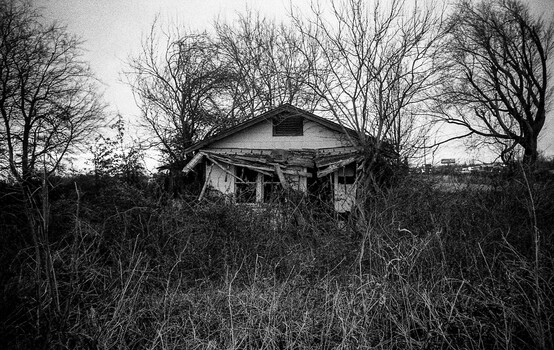
There’s a stretch of Highway 69 outside Muskogee that I’ve driven enough times to stop noticing it. You know the kind of road I mean — your brain goes into cruise control, the scenery becomes background noise, and you’re just trying to get where you’re going without getting stuck behind a log truck doing 42 in a 65.
And then one day, something snaps you out of it.
For me, it was a collapsing house half-swallowed by brush. Not “cute farmhouse” collapsing. Not “rustic texture” collapsing. I mean, it went wrong collapsing. The roofline was busted, the porch looked like it was trying to crawl away, and the windows had that black-hole stare.
Most people would file it under: ugly eyesore, keep driving.
I didn’t. I pulled over, grabbed the camera, and the second I looked through the viewfinder, I knew what it was.
That wasn’t a house.
That was a monster.
And that decision — right there, in the moment — was the difference between documenting a ruin and making a series that actually says something.
The trick isn’t better gear. It’s better intent.
We’re in an era where technical perfection is cheap. You can buy resolution, dynamic range, stabilization, autofocus that reads minds — whatever. None of that guarantees your photos have a heartbeat.
The photographers who stand out in 2026 aren’t the ones who can make a sharp file. They’re the ones who can make you feel something about a subject you’d normally ignore.
That’s what the “Monster House” series is: a reminder that the real upgrade isn’t your camera body. It’s your ability to take the ordinary and give it a role in a story.
Because here’s the truth: ruins are everywhere. But narrative is rare.
Why ‘Monster House’ Works (and Why Your Brain Can’t Unsee It)
Humans are wired to read faces into things. We do it with clouds, power outlets, the front of cars, and yes — houses. Two windows and a door? Congratulations, your brain just built a face.
That’s not some fluffy art-school concept. That’s your survival hardware.
So when you label a structure “Monster House,” you aren’t being dramatic for clicks — you’re giving the viewer a handle. A metaphor. A doorway into the image.
And once you give the viewer that handle, they don’t just look at the photo… they participate.
They start asking the same question you asked:
What is this thing?
Anthropomorphism: The Secret Sauce You’re Already Using
Let’s say it plainly: anthropomorphism is just a fancy word for “this looks alive.”
In documentary photography, that’s not a gimmick — it’s a weapon.
A ruin can be:
A monster (threat)A ghost (absence)A corpse (finality)A survivor (stubbornness)A warning (consequence)
Once you pick the role, your technical choices stop being random and start being story decisions.
Low angle? Looming.Crushed blacks? Empty sockets.Aggressive grain? Rot.Foreground brush? You shouldn’t be here.
That’s not “style.” That’s the direction.
You’re not taking a picture of a building. You’re casting a character.
There’s a moment every photographer hits — usually after you’ve made a few hundred decent frames — where you realize the problem isn’t access. It’s not a lack of locations, or a better lens, or a new preset pack with a dramatic name like “Cinematic Doom.” The problem is that your eyes keep treating the world as a list of objects rather than a cast of characters.
That’s why ruins are such a good training ground. They’re honest. They don’t pose. They don’t flatter you. And if you show up trying to “collect” a shot, the ruin will win, because it has all the texture and atmosphere and history… and you’ll still somehow walk away with a picture that says nothing.
But if you show up with intent — if you show up ready to interpret — ruins start behaving like people.
Here’s the simplest way I know to do it without getting all artsy and vague:
Ask three questions before you lift the camera:
What is the mood? Not the weather. Not the exposure. The mood. Is it hostile? Lonely? Embarrassed? Defensive? Daring you to come closer?
What is the role? Monster. Ghost. Skeleton. Survivor. Warning sign. Pick one. If you don’t pick, you’ll default to “interesting building,” and that’s where narrative goes to die.
What is the point of view? Are you a witness? A trespasser? A kid staring at something that scared him? A grown adult realizing the past doesn’t care about your comfort?
Photo created by Steven Van Worth. Shot with the Argus C44 on HP5 pushed to 3200.
The point-of-view question is where most people miss. Because the second you decide who you are in the scene, camera choices stop being technical and start being psychological.
If you’re a witness, you shoot honestly and level.If you’re trespassing, you shoot through brush, from low, half-hidden.If you’re scared, you shoot wide, close, with distortion and urgency.If you’re reverent, you step back, let it breathe, let it be what it is.
That’s how you build narrative without staging anything. You’re not manufacturing a story — you’re translating the one that’s already there.
The ‘Technical Recipe’ Isn’t a Flex. It’s the Skeleton Holding the Story Up.
Let’s get something out of the way: film people love turning simple things into a secret handshake.
I don’t.
I’ve seen too many beginners get made to feel stupid because they don’t know the sacred developer ratio, the holy agitation pattern, or the “correct” way to scan. And I’m telling you right now — none of that matters if your photos don’t land.
So here’s the no-gatekeeper version:
You choose tools that match the subject. That’s it. That’s the whole magic.
The Argus C-44: The Perfect ‘Wrong’ Camera for the Right Story
The Argus C-44 isn’t sleek. It’s not trying to impress anybody. It’s got that mechanical grit that feels appropriate when you’re photographing something that looks like it survived a fistfight with time.
That matters more than people admit.
A vintage camera forces you to slow down. It makes you commit. It makes you look longer. And in a place like this — where the mood is doing half the heavy lifting — slowing down is the whole point.
Also, that 35mm perspective is a sweet spot here. Wide enough to show the environment (the brush, the trees, the dead winter sky), but not so wide that the house becomes a tiny speck. The house still gets to be the main character.
The Canon EOS 6D ‘Sketch’ Mindset (Yes, Digital Can Help Film)
Here’s something film purists don’t like to say out loud: digital can be the notebook that helps you write the final sentence in film.
If you’re working fast — pulling off the highway, light changing, trying angles — digital lets you “sketch” the scene. You can test where the monster looks biggest, where the roofline bites hardest, and where the brush feels like a barrier.
Then you switch to film and make the real version.
That’s not cheating. That’s working like a pro.
Pushing Ilford HP5 Plus to 3200: The ‘Monster House’ Look Is Baked In, Not Pasted On
Photo created by Steven Van Worth. Shot with the Argus C44 on HP5 pushed to 3200.
This series doesn’t feel creepy because you slapped a filter on it. It feels creepy because the process matches the story.
Pushing Ilford HP5 Plus hard does a few things that fit the “monster” metaphor perfectly:
1) The shadows turn into voids. Those window openings stop being “dark rooms” and start being nothingness. You don’t see inside. You can’t solve it. It stares back.
2) The grain becomes texture, not noise. At normal speed, grain can be polite. Pushed hard, it gets ugly — in the best way. It makes the whole frame feel like it has skin. Like the ruin isn’t smooth and dead, but rough and present.
3) Contrast makes the roofline a silhouette. A jagged roof against a pale sky is basically a horror poster. You’re letting the architecture become a shape with intent.
And the funniest part? This is exactly what people mean when they say “film has character” — but they never explain how to use that character on purpose.
This is how.
Now let’s talk about what nobody says out loud when they’re hyping pushed film: it doesn’t just make your photos “gritty.” It also punishes you if you don’t respect what it’s doing.
When you push HP5 Plus that hard, you’re basically telling the film, “Hey, I’m going to starve you of light… and then I’m going to ask you to still give me a complete sentence.” Sometimes it does. Sometimes it spits back a scream.
That’s why the Monster House series works — the subject can handle the brutality.
A ruin like this has:
Deep shadows you want to go blackMessy midtones where grain can liveHard lines (roofline, windows, branches) that hold shape even when contrast jumps
In other words, this is the right subject for the wrong exposure.
And that’s a big lesson for 2026, especially if you’re building a personal style. Style isn’t just a look. Style is choosing subjects that don’t fall apart under your process.
A clean portrait in perfect light? Pushed film can turn it into a sandpaper nightmare. A quiet, foggy landscape? Push too hard, and you’ll chew up the mood. But an abandoned house that already looks like it’s fighting the world? Pushing makes it feel like the photograph is fighting too.
That’s what people mean when they say “match the technique to the story,” but nobody explains what that actually looks like in real life:
If the story is uncomfortable, your process can be uncomfortable.
If the story is gentle, your process should stop trying to be a tough guy.
And for anyone reading who’s new and already feeling the gatekeeper energy creeping in — relax. This isn’t about memorizing sacred formulas. This is about understanding the direction you’re pushing the image emotionally.
Even if you never push film in your life, the principle holds: don’t pick a look and then force it onto everything. Pick a subject that naturally belongs inside that look.
Visual Dialogue: The Unspoken Conversation Happening in Your Frame
If you want to elevate your work this year, stop asking, “Is it sharp?” and start asking, “What is the image saying?”
That’s visual dialogue — the silent back-and-forth between you and the viewer.
In this series, the dialogue goes something like:
You: “This house isn’t dead.”
Viewer: “Why does it feel like it’s watching me?”
You: “Because I photographed it like a portrait, not a property listing.”
The ‘Loom’ Is Built With Camera Height
Photo created by Steven Van Worth. Taken with the Argus C44 on HP5 pushed to 3200.
Low camera height is a cheat code for dominance. It’s cinematic language. You look up at something, and it becomes bigger than you.
And once the house becomes bigger than you, the viewer becomes vulnerable.
That’s the whole point of the monster metaphor: a thing that shouldn’t have power suddenly does.
The Brush Is Doing Narrative Work, Too
Foreground brush is not just a “mess.” It’s tension.
It says:
You’re not supposed to be here.The house is protected by neglect.The story is partially hidden.
Foreground clutter can be a mistake — unless you use it as a barrier on purpose.
Here, it reads like trespassing.
Want More ‘Monster House’ Energy? Use Archetypes.
The monster is one way to tell a story. It’s not the only way. If you want to build a whole year of stronger work, start assigning archetypes to ordinary subjects.
Here are two that work especially well in rural ruins:
1) The Ghost (Nostalgia, Absence)
This is when the ruin isn’t threatening — it’s sad.
How you shoot it: eye level, not low; softer contrast; details that hint at life (curtain scraps, a doorway, a forgotten chair).
What it says: “This place used to hold someone.”
2) The Skeleton (Structural Failure, Industrial Tragedy)
This is the ruin as evidence.
How you shoot it: wide and honest; flatter light; emphasize beams, broken supports, the “ribs” of it.
What it says: “This is what happens when things get left behind.”
Same subject. Different story. Different choices.
The Real Lesson: Don’t Just Document — Interpret
Photo created by Steven Van Worth. Shot with the Argus C44 on HP5 pushed to 3200.
A lot of photographers shoot something interesting, pick the best single frame, post it, and call it a day. That’s fine. But a series has pacing. It has escalation. It has breathing room. It has a beginning that invites you in and an ending that doesn’t let you off easy.
If you want your work to level up this year, start sequencing like this:
Establishing frame (context). Show me where the thing lives. Give me the trees, the brush, the sky. Let me understand the stage before the monster steps forward.
The portrait (identity). This is the frame where the ruin becomes a character. Front-on or slightly off-center. Strong lines. Windows like eyes. Door like a mouth. This is the “meeting.”
The threat angle (emotion). Low angle. Closer. Crooked horizon if it fits. Anything that makes the viewer feel small.
The detail (proof). Rotting wood. Broken beams. A window frame splintered like teeth. This is where the viewer stops thinking “cool composition” and starts thinking “this place is real.”
The release (aftermath). Pull back. Let the scene breathe. Let the monster sit back into the landscape like it was never anything special — until you noticed it.
That last frame is important. It’s the quiet ending that makes the viewer rethink the first frame. It’s where the series stops being just spooky and starts being human.
Because the real creepiness isn’t that the house is a monster.
The real creepiness is that you’ve driven past it a hundred times and never saw it… until now.
That Muskogee house on Highway 69 is just wood and nails until you decide it’s something else.
The photographer’s job isn’t to prove a place exists. Google Maps can do that.
The job is to make the viewer feel like they’ve encountered something. Like they’re standing in front of a thing that has a personality, a past, or a threat.
So here’s my challenge for you, the next time you pass something “ordinary”:
Don’t ask what the light is doing. Ask what the subject is doing.
Don’t ask if it’s a good composition. Ask what role the subject is playing.
And if you find a ruin that makes your stomach tighten just a little?
Congratulations.
You didn’t find an eyesore.
You found a character.