
The 7km upgrade between the Links Rd/Pākōwhai Rd interchange and Taradale Rd includes a duplicate two-lane overpass at Meeanee Rd, a duplicate two-lane overpass at Kennedy Rd, a duplicate two-lane bridge over the Tutaekuri River, and a four-lane grade-separated interchange at Links Rd/Pākōwhai Rd.
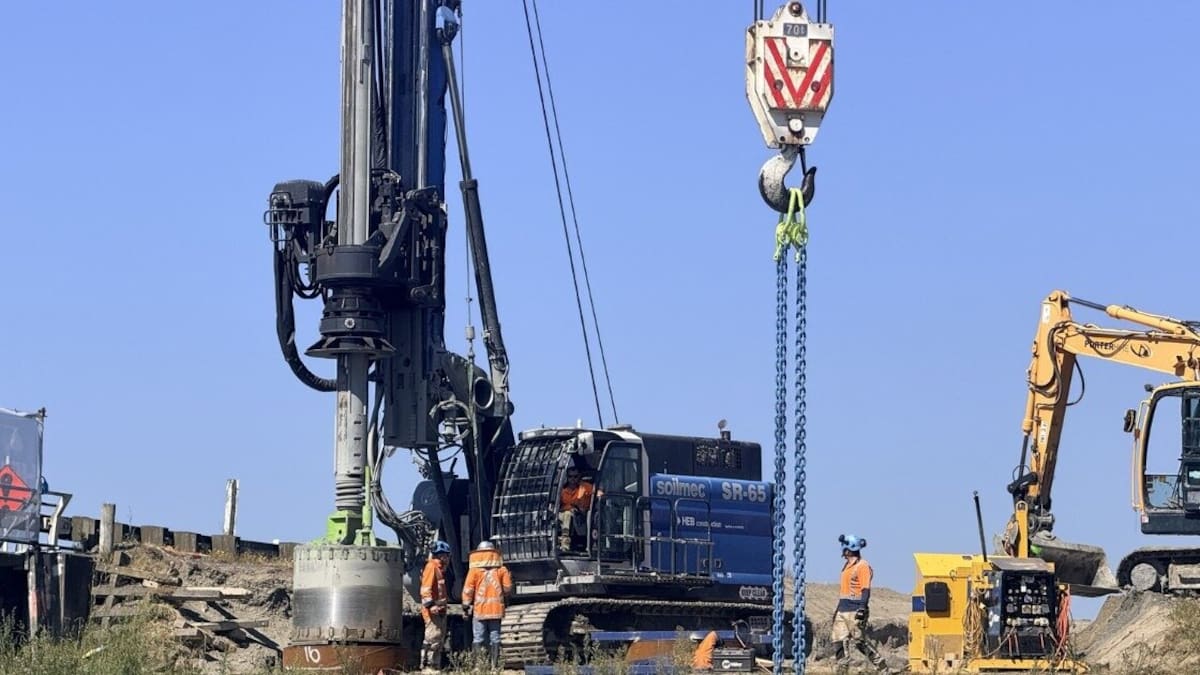
Workers at the Tūtaekurī River Bridge working on the Hawke’s Bay Expressway expansion.
The Meeanee Rd and Kennedy Rd structures began at the start of 2026, with the interchange starting later in the year.
The full project is expected to finish in 2029.
HEB Construction had been at the Tūtaekurī River site since October.
The site had dropped column moulds into the ground as the expanded bridge started to take shape.
A temporary bridge had been built next to the expressway to provide easy access for crews.
The construction manager at the site, Luke Tomalin, said there were a few challenges in building the access bridge as the team had to use shorter piles around the river’s aquifers.
“After a few goes, we managed to get there,” he said.
Under the bridges, the river’s water remained clear and shags could be seen hunting for fish.
“It’s a fantastic place to work alongside a beautiful area like this,” Tomalin said.
“We take pride in looking after it.”
Silt from Cyclone Gabrielle was used to preload the embankments and approaches around the bridge, saving money on the project.
The silt had to be put through a screen before it was used, where bits of homes and cars were removed.
NZ Transport Agency Waka Kotahi’s principal project manager, Jacob Laird, said this was saving money.
“That silt was available, and instead of the taxpayer and the ratepayer having to bury it elsewhere, we took it and placed it here and saved them both some money on the job.”
Laird said the silt had settled and crews were building on top of it.
Silt from Gabrielle was also being used at the Kennedy Rd project.
Tomalin said three months of enabling work on the bridge started in mid-October but a “small hold-up” on the casings for the foundations arriving had delayed the job.
“But so far, we’ve brought that time back up on piling and we’re back on schedule,” he said.
He said all 24 piles for the bridge expansion had started and would be completed in the next month or so.
At that stage, the project will move on to the bridge’s superstructure.
The entire structure had a due date of March 2027.
Tomalin was confident the crews could finish the project by then.
“We’ve hit a few good milestones and continue to push to hold that,” he said.
“I look forward to telling the kids as I drive across, I built that one.”
Despite rising fuel and diesel prices, Tomalin said the project was continuing as normal, but the company was very mindful of the climbing prices.
“We’ll just have to keep on going and see what comes around the corner.”
The Meeanee Rd site of the Hawke’s Bay Expressway expansion.
Brian Perry Civil managed the site further along the expressway at the Meeanee Rd interchange.
Laird said having two companies manage different sites of the expansion allowed for efficiency.
Downer was also involved with the project on traffic management.
“It just allows these guys to get stuck into it,” Laird said.
The Meeanee Rd site’s stakeholder manager, Tu Maea, said his team were putting piles in the ground and dropping beams on top for the expansion.
As part of his role, Maea was liaising with the nearby community on sound levels and said there was a good relationship between his crew and the site’s neighbours.
Further down the expressway, a large transformer-like machine sits on the road. It can pave a metre of concrete a minute.
The concrete paver being used as part of the Hawke’s Bay Expressway expansion. Photo / Jack Riddell
The eight-wheeled, multi-armed concrete paver takes wet concrete, vibrates and screeds it on to the road before a broom finish is applied.
Laird said traditionally, concrete roads were hand-paved, which required a lot of time and people.
“When you’ve got machines like this, you’ve got two operators, you’ve got a concrete truck driver and you’ve removed a lot of risk from people potentially getting caught in the hazards of construction.”
Jack Riddell is a multimedia journalist with Hawke’s Bay Today and has worked in radio and media in the UK, Germany, and New Zealand.