
Researchers at Seoul National University have developed an artificial muscle that can change shape during operation, repair damage, and be reused, potentially opening a new path for adaptive robots and next-generation flexible devices.
The team created a new dielectric elastomer actuator, or DEA, using a phase-transitional ferrofluid material that behaves like a solid at room temperature but becomes fluid-like when exposed to heat or magnetic fields.
This allows the actuator’s internal electrode structure to be reshaped even after fabrication.
DEAs are soft devices that convert electrical energy into motion and are often described as artificial muscles because they can move quickly and precisely.
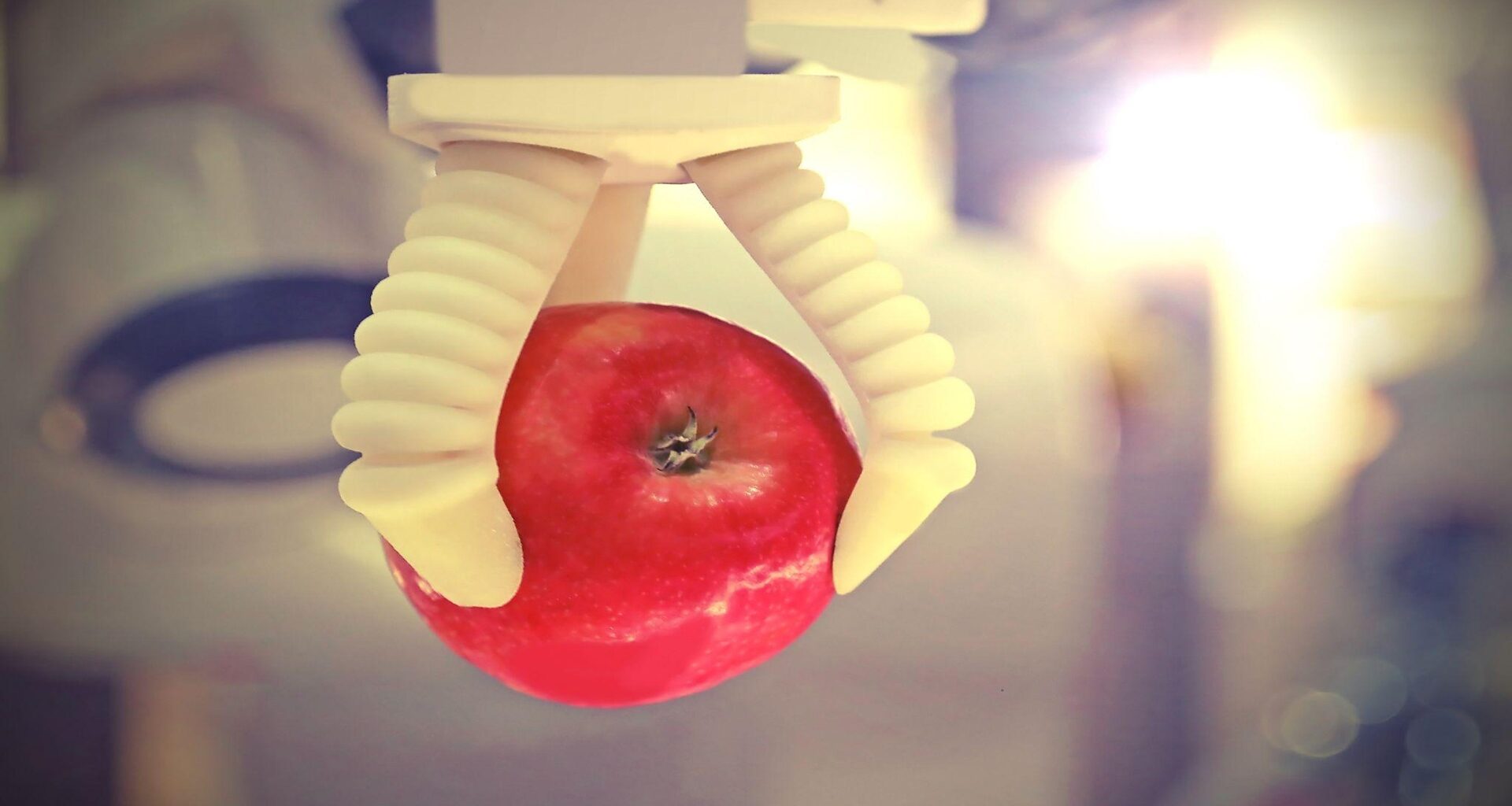
They are already used in areas such as haptic feedback systems, wearable devices, and soft robotic grippers for handling delicate items.
Conventional versions, however, are limited by fixed electrode patterns printed during manufacturing.
Once built, they can only perform one preset motion, forcing engineers to redesign hardware for new tasks or changing environments.
Robots that rewire
The new system solves that limitation by allowing electrodes to split, merge, and move in three-dimensional space while the device is operating.
Researchers say a single actuator can switch functions in real time, performing different motions such as bending, expansion, or circuit bridging.
The phase-transitional ferrofluid electrode can be melted into a liquid state and repositioned with magnetic fields.
It can also be divided into multiple sections, enabling one soft robotic component to carry out multiple functions without redesign.
That could help reduce manufacturing complexity in soft robotics, where many devices today are built for narrow, single-use tasks.
Instead of replacing components, future robots may be able to reconfigure themselves as jobs change.
Prof. Jeong-Yun Sun said, “This study represents a breakthrough in transforming traditionally static and passive electrodes into ‘living, programmable elements’ through innovations in particle and polymer design. This self-healing and shape-reconfigurable electrode technology will serve as a key foundation for sustainable next-generation soft robotics.”
Damage no longer fatal
The researchers also designed the actuator to recover after cuts or electrical failure. If part of the electrode is damaged, nearby material can be converted into liquid form to reconnect broken pathways or bypass failed sections.
This means the robotic system can continue functioning after incidents that would normally disable conventional soft actuators. That feature could be useful in harsh industrial environments where machines face wear, impacts, or electrical stress.
The team also demonstrated recyclability. At the end of a device’s service life, the electrode material can be extracted in liquid form and injected into a new system. Even after repeated reuse cycles, the researchers reported about 91 percent recovery with stable performance.
Prof. Ho-Young Kim added, “From a mechanical engineering perspective, achieving high degrees of freedom in soft robots, similar to human muscles, requires structural flexibility. Through interdisciplinary integration with materials engineering, we demonstrated that a single robotic structure can generate virtually limitless modes of motion.”
Possible future uses include robotic hands with more natural movement, self-repairing machines, morphing displays, and flexible electronics that can be rebuilt instead of discarded.
The work highlights growing efforts to make robots more adaptable, durable, and sustainable by combining materials science with mechanical engineering.
The study was published in Science Advances.