
Dunedin’s mayor has hit back after a government minister accused the city of dragging its feet over solving South Dunedin’s wastewater problems.
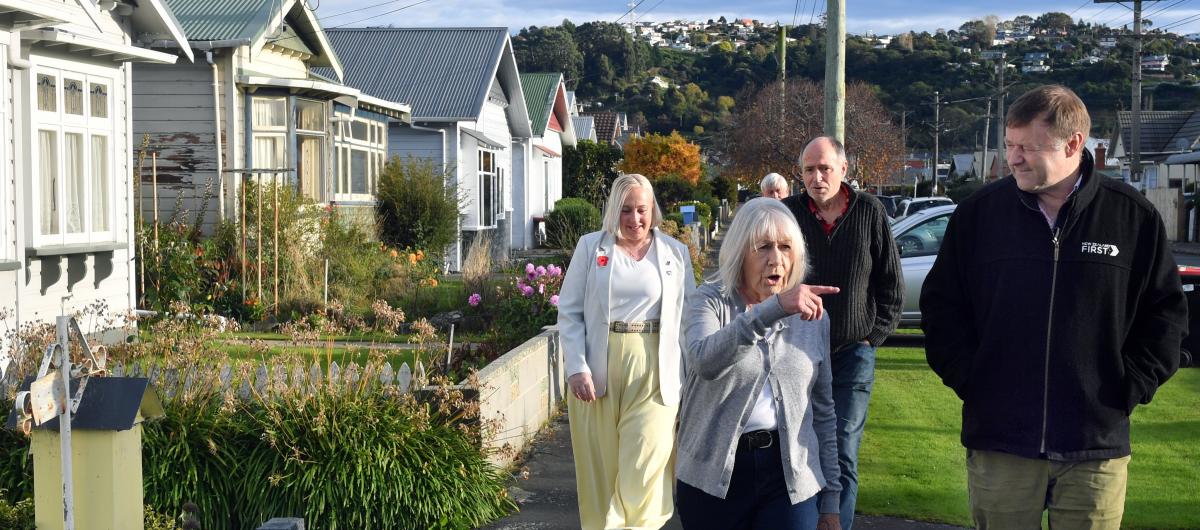
New Zealand First MP Mark Patterson waded into the debate yesterday morning when he met members of the Surrey Street Flood Action Group to discuss their concerns about the city council’s response to wet weather overflows.
The minister said work so far had been ‘‘very little, very late’’ and he thought South Dunedin had fallen afoul of ‘‘some social inequity’’ in the response.
Dunedin Mayor Sophie Barker disputed his comments and pointed to the Dunedin City Council’s schedule of short- and medium-term work in the area.
‘‘It’s disappointing to hear Minister Patterson has made these comments, and I reject his suggestion South Dunedin is being treated differently than other suburbs.
‘‘In fact, we are investing hugely in South Dunedin to ensure it has a strong, resilient future.’’
Mr Patterson was shown around Surrey St, including work on short-term improvements to reduce overflows, by group convener Lynne Newell.
For years, residents have flagged problems with contaminated water, occasionally accompanied by toilet paper and sanitary products, seeping from manhole covers during periods of heavy rain.
The council must stop discharge of wastewater in the street and surrounds by June next year under an abatement notice issued by the Otago Regional Council in November.
During discussion with Ms Newell and group members, Mr Patterson described decision-making on infrastructure in the area as ‘‘paralysis by analysis’’.
While he was pleased to see work happening in the street, it was ‘‘very low-hanging fruit’’, and changes would have been in place much soon if a suburb of higher socioeconomic status was affected.
‘‘Politicians will be eviscerated, both local and central government, if another flood comes through here and nothing’s happened since 2015 … we’ve got to get some urgency in there.’’
He suggested central government’s Regional Infrastructure Fund could support work, such as redevelopment of Forbury Park, to alleviate flooding, and believed it could be included in his party’s manifesto ahead of the general election.
Ms Barker said she and senior council staff had a positive meeting with Mr Patterson yesterday which included discussing Surrey St and ‘‘the need for a joint approach that avoids the issues there becoming a political football’’.
Councils would appreciate support from central government on infrastructure investment before crises emerged.
She was heartened by Mr Patterson’s idea on infrastructure funding.
‘‘We’d like to see what political parties are willing to put on the table to help communities like South Dunedin.’’
The council completely understood the community’s frustration, particularly those affected by previous floods, and it was ‘‘working hard on solutions’’.
‘‘We are the council that is delivering on pipes in the ground and engineering solutions.’’
She acknowledged late councillor Jules Radich’s work towards solutions in Surrey St and on plans for the future of the wider area.
The solutions were complex but city-wide wastewater network improvements to reduce overflows, including Surrey St, were budgeted at $60million in the council’s nine-year-plan.
A preferred option was expected to be selected by mid-year.
A $29.2m package of short-term South Dunedin flood alleviation projects was also in the plan while pipe replacement work elsewhere in Dunedin would ensure capacity was used as intended.
This funding, plus hundreds of thousands of dollars spent on planning, was not ‘‘very little’’ — it was a significant part of the council’s city-wide capital budget, Ms Barker said.
The work was in addition to the South Dunedin Future programme — joint work between the city and regional councils to develop a long-term climate adaptation master plan for the area.
Infrastructure portfolio councillor Brent Weatherall said it was a pity Mr Patterson had shown no urgency in lobbying the government for assistance in mitigating flooding and erosion in South Dunedin since entering Parliament in 2017.
‘‘Dunedin’s ratepayers simply can’t afford to carry all the cost.
‘‘Mr Patterson should be praising the fact this council has begun the task to alleviate water infrastructure pressure in that area.’’
By-election candidate Jo Galer also attended the group’s meeting, at Ms Newell’s request.