
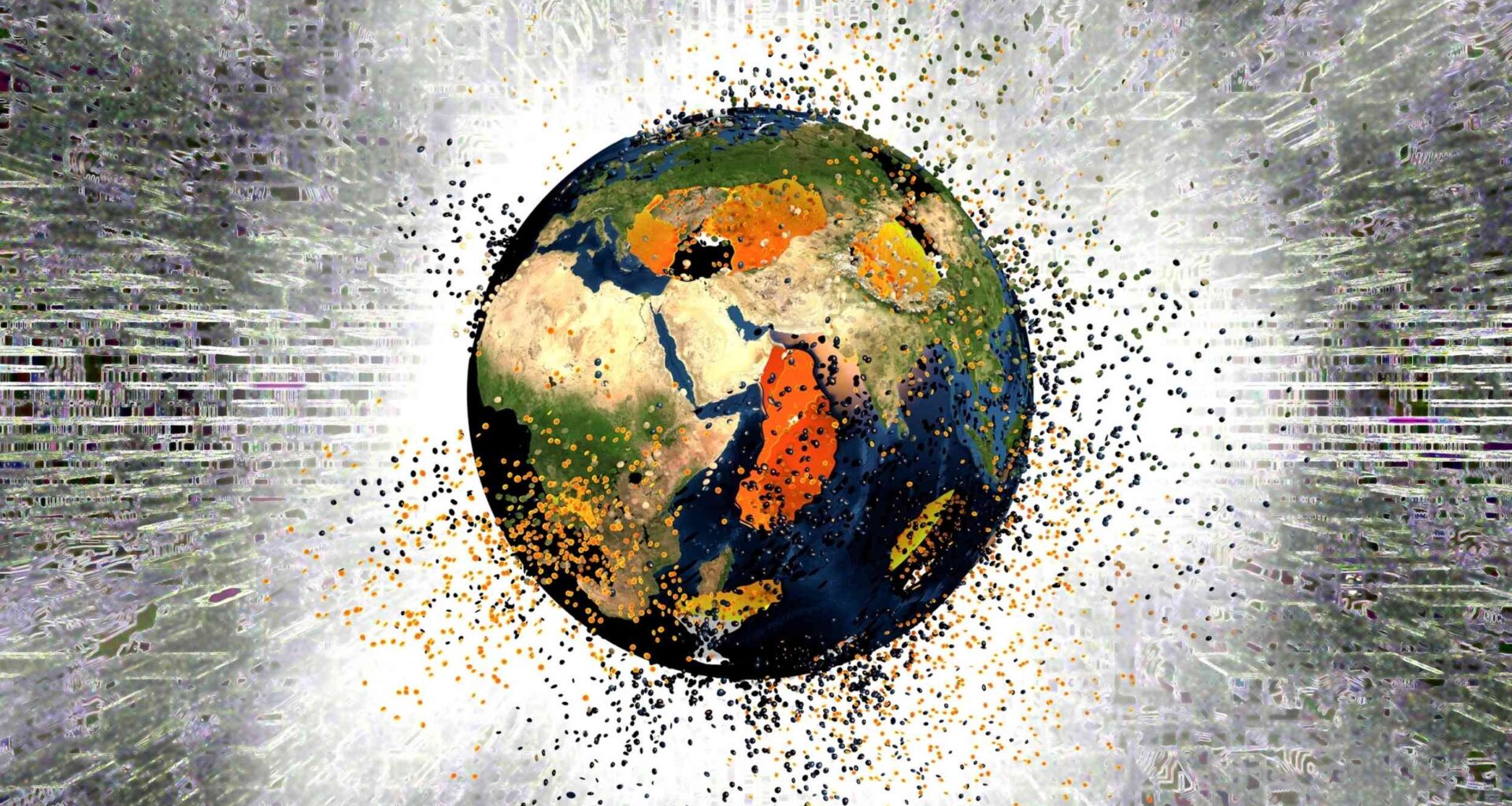
Researchers have found that Earth formed within an unusually narrow range of oxygen conditions that kept both phosphorus and nitrogen available for life.
That constraint reframes habitability as a chemical outcome of planetary formation rather than a simple question of water or location.
Chemistry at birth

Inside young Earth’s ocean of molten rock, iron sank, lighter rock stayed above, and life’s key ingredients split apart.
From that evidence, Craig Walton, a postdoctoral researcher at ETH Zurich showed that a narrow oxygen balance kept both elements above the core.
That balance seems to have held about 4.6 billion years ago, while Earth was still sorting metal from rock.
Push the chemistry a little either way, and one element dropped out of reach before life ever had a chance.
Key elements for life
Phosphorus matters because cells use it to build DNA and RNA and to move energy from one reaction to another.
Nitrogen matters just as much because proteins need it, and those proteins give cells structure and help reactions run.
When either element becomes scarce, prebiotic chemistry – the reactions that can build life’s starting ingredients – runs into an early wall.
That is why a planet can sit in a water-friendly orbit and still miss the basic chemical stockpile life needs.
A narrow oxygen window
During core formation, too little oxygen pulled phosphorus into metal, while too much oxygen pushed nitrogen toward escape.
Researchers describe that balance with oxygen fugacity, a measure of how strongly oxygen can react in a forming planet.
In the model, strongly reducing worlds trapped phosphorus below, while strongly oxidizing worlds allowed nitrogen to escape more easily.
Earth landed between those two failures, which makes its chemical starting point look less ordinary than its size suggests.
What Mars tells us
Mars seems to have formed outside that middle range, keeping more phosphorus in its mantle but less nitrogen than Earth.
That mix did not rule out all chemistry, but it created a harder starting point for Earth-like life.
The comparison shows that nearby rocky planets can look similar while hiding very different nutrient budgets.
Planetary habitability becomes less about one simple checklist and more about how a world was assembled.
Water is not enough
For decades, many life-hunting efforts started with liquid water, because water helps chemistry react and keep temperatures stable.
Walton’s team argues that water alone can mislead, since a wet planet may still lock away the nutrients life requires.
A world that fails this chemical test might never feed a biosphere, even if rivers, clouds, and oceans later appear.
That idea widens the search from surface conditions to the much older history written inside a planet.
Clues from host stars
Astronomers now track more than 6,000 confirmed exoplanets, yet most remain too distant for direct tests of deep chemistry.
Because planets grow from much of the same material as their stars, stellar chemistry can hint at planetary oxygen conditions.
“This makes searching for life on other planets a lot more specific. We should look for solar systems with stars that resemble our own Sun,” said Walton.
That advice does not guarantee life, but it gives telescope surveys a sharper place to start.
Rare chemistry of Earth
Earth’s raw supply of phosphorus and nitrogen looks fairly average across star systems, yet its chemistry did not.
“Our models clearly show that the Earth is precisely within this range. If we had had just a little more or a little less oxygen during core formation, there would not have been enough phosphorus or nitrogen for the development of life,” Walton said.
What seems unusual is specific: not a richer inventory, but better odds of keeping nutrients accessible.
That turns rarity into a chemical problem, not just an orbital one, and sharpens the odds against easy success.
Where the model breaks
The authors did not claim this one model settles everything, because nitrogen can still move or escape after core formation.
Earth’s nitrogen budget remains uncertain, and earlier work suggests accretion and late impacts also helped determine where that element ended up.
Icy places can also follow other rules: Saturn’s moon Enceladus shows phosphate in its ocean plume today.
Those exceptions matter because a rule for rocky Earth-like planets is not automatically a rule for every wet world.
New filters for life
Even small drops in phosphorus or nitrogen could cap how much life a planet supports and what gases it releases.
This affects biosignatures – chemical signs of life – because weaker biospheres produce weaker atmospheric signals.
Future missions will need better estimates of stellar chemistry and planetary interiors before reading a distant atmosphere too confidently.
A promising world may still lack basic nutrients, and telescopes will have to learn that difference.
Why Earth worked
Earth did not just sit in the right orbit; it formed with a chemical balance that kept two elements life depends on.
That result points the search inward as much as outward, toward the buried chemistry of planets that only seem inviting.
The study is published in Nature.
—–
Like what you read? Subscribe to our newsletter for engaging articles, exclusive content, and the latest updates.
Check us out on EarthSnap, a free app brought to you by Eric Ralls and Earth.com.
—–