
Stars are far from calm; they erupt in powerful bursts of energy known as solar flares, sending shockwaves through space. While sympathetic flaring, a secondary flare triggered by an initial eruption, has long been observed on our Sun, it was thought to be a rare phenomenon. However, a groundbreaking study published in The Astrophysical Journal has revealed that sympathetic flares occur on over 16,000 stars, suggesting a hidden, universal mechanism at work across the galaxy.
The Mystery of Sympathetic Flares Revealed
The concept of sympathetic flares, secondary outbursts that follow a primary flare, has been a curious phenomenon for astronomers studying our Sun. These events, though rare, have been known to occur when one flare’s eruption triggers another, creating a ripple effect across the Sun’s surface. For years, scientists could only speculate about the cause of this chain reaction, with the understanding largely confined to our solar system.
But in a surprising turn of events, a team of researchers from Tufts University has confirmed that sympathetic flaring is not exclusive to our Sun. In fact, the discovery has been made across a wide range of stars, from the familiar Sun-like giants to the small and cool M dwarfs, the most common stars in the Milky Way. This breakthrough, recently reported in The Astrophysical Journal, marks a significant leap in our understanding of stellar phenomena.
David Martin, assistant professor of astronomy and physics at Tufts, who worked on the study, emphasized the importance of this observation:
“This is the first time that an effect well-known on the sun—sympathetic flaring—has been seen on other stars,” he remarked.
his discovery sheds new light on how stars behave in ways that were previously unimaginable.
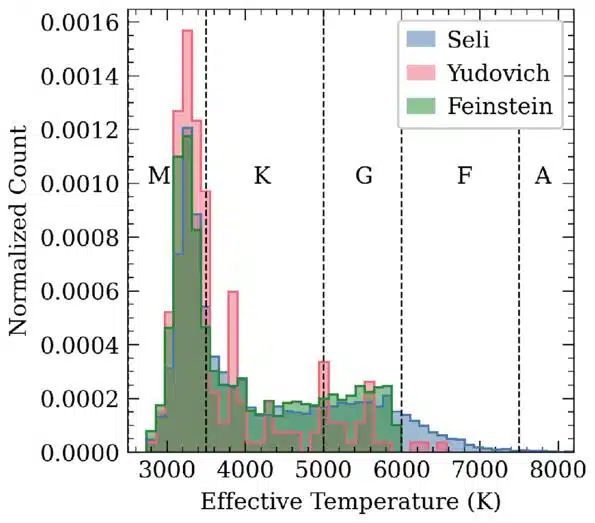 Normalized distribution of the temperatures of the stars across our three samples. The temperatures were taken from the TESS Input Catalog v8.2 M. Paegert et al. (2022). The ranges of each stellar subtype are shown via the dashed black lines.
Credit: The Astrophysical Journal
Unraveling the Mechanism of Stellar Flares
The process of sympathetic flaring occurs when one flare’s intensity triggers another flare within a short period. This phenomenon is difficult to detect due to the overlapping nature of the flares. As one flare dims, the other rises, creating an illusion of the star blinking on and off. According to Veronica Pratt, a doctoral student at Tufts and lead author of the study, “Flares begin very quickly, but they take a while for their brightness to fade. While one flare is fading, another one—related or not—can occur.”
This sequence of events, Pratt explained, can easily confound traditional flare-detection algorithms, which struggle to distinguish between flares occurring in rapid succession. “That sequence makes it look like the star got brighter, a little dimmer, and then brighter again. That can be really hard for some traditional flare-detection algorithms to detect.” To tackle this challenge, the research team developed a novel algorithm, TOFFEE (Threshold-Optimized Flare Finding and Energy Estimation), to parse through over 200,000 flares across 16,000 stars.
This complex algorithm was crucial in helping the researchers distinguish between unrelated flares and those that were indeed triggered by a prior flare. As Martin further explained, the process can be likened to a chain reaction:
“It is analogous to someone yawning and then someone else in the room yawning right afterwards—was this a response mechanism or were they simply both tired?”
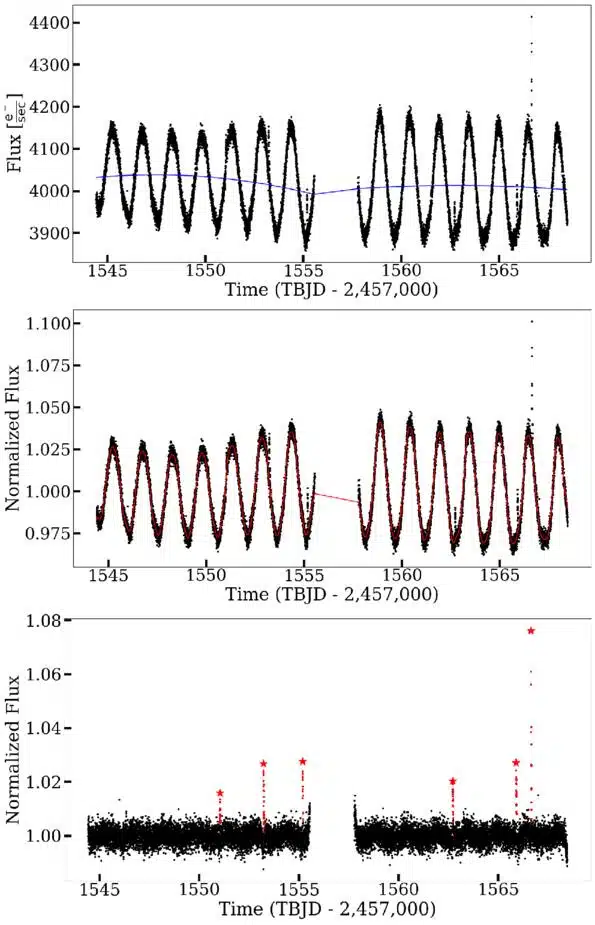 Detrending and flare search process from raw lightcurve (top) to final flattened curve (bottom). Top shows the raw time resolved brightness of the star in black points with the quadratic trend coming from the orbit of the TESS telescope in blue. Middle shows the quadratic subtracted lightcurve overlaid with the trend found by wotan
in red. The lightcurve shown in bottom is the final flattened lightcurve in black and the detected flares. Primary flares are colored in red with the peaks labeled as red stars and the secondaries labeled in blue with a blue star representing its peak. We also add an inset zoom-in around the secondary flare to show its morphology. Residual signal of the spot modulation is seen in the final lightcurve shown in bottom which leads us to consider the global spread of the points to calculate the flux threshold as opposed to the photometric error. We also note that cutting 100 cadences on either side of a break prevents classifying detrending artifacts as flares as seen in the orbit break of this lightcurve.
Credit:The Astrophysical Journal
Surprising Findings from M Dwarfs
One of the most unexpected results of the study was the high rate of sympathetic flares found on M dwarfs. These stars, while abundant, are much smaller and cooler than the Sun, making them vastly different from the stars traditionally studied for flare activity. M dwarfs are known for being highly active, emitting more radiation than their size would suggest.
Pratt noted the surprising discovery:
“M dwarfs, which made up the bulk of the sample, are so different from the Sun. They’re substantially smaller, half as warm, and substantially more active.”
Despite these stark differences, the sympathetic flaring phenomenon occurred on M dwarfs with the same frequency observed on the Sun—around 4% to 9% of the time.
The study’s results suggest that the underlying mechanism of sympathetic flaring is not restricted to a specific type of star but is a universal feature across stellar systems. Pratt theorized, “That implies to us that there’s a common mechanism across all stars that leads to sympathetic flaring. No one is sure exactly what that mechanism is yet, but it has to be something that is present on all kinds of stars, with different kinds of magnetic fields.”