
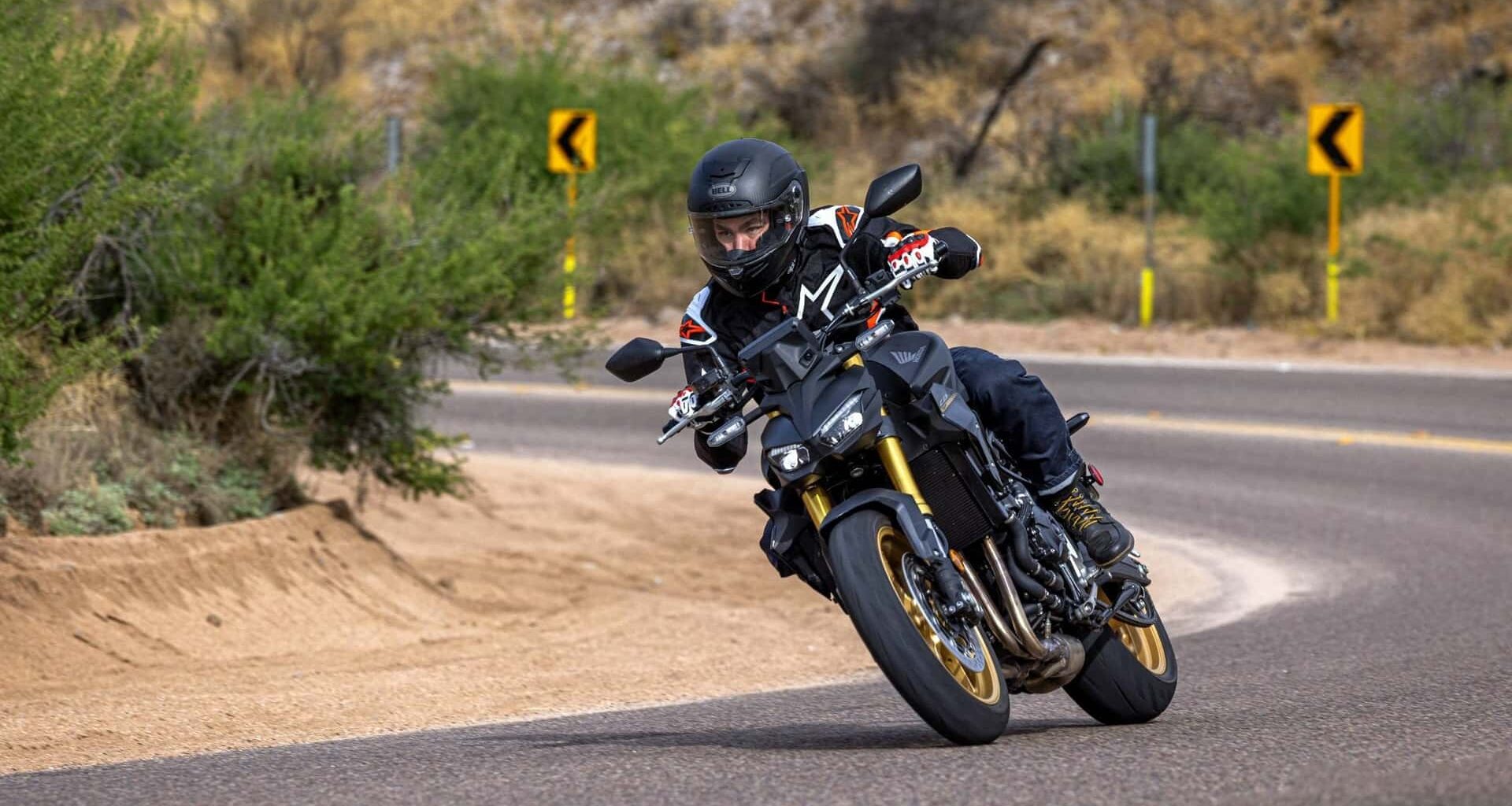
“This thing looks like a big, angry Grom.” That was the first thing Matthew McNulty, my friend and fellow photographer, said when I pulled up in front of his house in Scottsdale, Arizona. And you know what, McNulty, you’re not wrong…
I hadn’t looked at it that way, though, the 2026 Honda CB1000 Hornet SP that’s been in my garage for the last few weeks. It’s black, mostly, has an alien bug headlight that seems so popular these days, especially on upright naked Japanese bikes, and a giant, almost comically large exhaust.
What I saw was a mixture of top-shelf ingredients—fully adjustable Showa suspension, Brembo brakes, quick-shifter, a CBR1000RR-derived engine—cooked into a stew that could use some salt, and definitely a little more spice. But the Hornet isn’t a head-turner. At least it wouldn’t snap my neck around if one rode by on the street. It’s quiet, the byproduct of that giant canister affixed to the throttle side of the bike. Ao much so that at idle it almost feels like I’m on an electric bike.
And while the gold accents tell you this is the SP model, they don’t say much else.

Photo by: WESTx1000
There are some aero features on the front, adjacent to the alien eyeball headlight on either side, but we’ll get to their functionality later. Aesthetically, they’re alright. Likely giving the Hornet the “angry” part of McNulty’s initial impression.
But looks can be deceiving, and you should always try the stew before adding any salt…
Powering the Hornet SP is a 1000cc liquid-cooled inline-four-twin engine sourced from the 2017 CBR1000RR that produces a claimed 155 horsepower at 11,000 rpm and 80 lb-ft of torque at 9,000 rpm. The Programmed Fuel Injection (PGM-FI) means the SP is snappy on the throttle, with the motor tuned to deliver a decent punch in the low-to-midrange, followed by a rush of power in the higher rpm spectrum.
The six-speed transmission is mated to the CBR1000RR powerplant, with the first five gears optimized for acceleration, while the sixth gear allows for relaxed highway cruising, according to Honda. Gears are changed with help from a slipper clutch, which reduces lever effort and also helps manage rear-wheel hop under rapid downshifts and braking. And speaking of rapid downshifts, the Hornet SP is outfitted with a three-level adjustable quick-shifter that provides full-throttle, clutch-less upshifts, along with clutch-less downshifting aided by an auto-blip function.
The Hornet SP is a direct descendant of the CB600F Hornet, a wildly popular model in Europe that inspired the U.K.’s ‘Hornet Cup’ spec road racing series, and the CB900F Hornet, both of which came to the United States in 2002 and 2004, sold as the 599 and 919, respectively.
A visit with Uncle Google taught me that the concept for the Hornet dates back to a 1994 design study by American Honda’s R&D department in cooperation with Cycle World magazine of all outlets.
Photo by: WESTx1000
The idea was to build a streetfighter-like one-off custom based on the Honda CBR900RR. What we now call a naked bike, or hypernaked in the case of KTM’s latest Super Duke, the Hornet, or rather the 599 and 919, provided performance and comfort somewhere between a typical sport bike and a traditional standard. So, it seems that the 2026 CB1000 Hornet SP is somewhat of a throwback. To a bike that was last sold to US riders in 2007, replaced thereafter by the CB1000R, which itself has since been replaced by the Hornet.
Full circle we’ve gone.
History lesson concluded, I’d like to address the bouncy bits on this bike, as they’re the thing that stood out most after my ride. Suspending the Hornet SP is a 41mm Showa SFF-BP inverted front fork, which is adjustable for spring preload and both rebound and compression damping. That’s pretty typical stuff for Honda, but top-shelf ingredients nonetheless. At the other end, though, is a Pro-Link Öhlins single rear shock with 5.5-inch travel and can be adjusted for preload via a hydraulic knob (compression and rebound damping are also fully adjustable).
Photo by: WESTx1000
But wait, Öhlins on a Honda?! The Japanese manufacturer has historically utilized Showa components on their motorcycles, so much so that the Honda Racing Corporation once accounted for more than 50% of Showa’s business. So, to see a gold Öhlins unit affixed to the frame of the Hornet SP was surprising, and exciting.
There aren’t a lot of twisty roads in or around Phoenix, Arizona. McNulty is a native, though, and much of his misspent youth was defined by driving an SCCA Solo-prepped Subaru BRZ on anything that came with a corner. So, we headed north toward Cave Creek, knocking down a handful of highway miles before linking up with a road that leads out to Bartlett Reservoir. There we found elevation change, sweeping corners, a few hairpins, and enough room to get myself in trouble.
Allegedly.
On the Interstate, the Hornet SP is comfortable enough. The lack of a windscreen did not go unnoticed, though, especially as speeds went to the posted 75. It wicks itself to that number rapidly, though, the midrange roll on power giving way to that ‘VTEC kicking in’ feeling in the upper RPM range. Above 6,000 rpm, the Hornet SP comes alive, a swelling of power suddenly released, sliding your ass back in the saddle, your hands gripping the handlebars like a college kid holding the harness of a mechanical bull at Mardi Gras. The sheer acceleration is impressive, like stuffing a lightning bolt in a corked bottle.
Photo by: WESTx1000
The Hornet SP tips the scales at 465 pounds. That’s with 4.5 gallons of fuel onboard, which I found enough to collect more than 200 miles, much of which was augmented by excessive overtaking on the Interstate and back-and-forth bombing runs on Bartlett Dam Road, where McNulty made some pictures. The 31.9-in seat height is approachable, although the seat itself lacked a little in the comfort department, especially as I neared that 200-mile mark.
There’s a 5.5-inch TFT display affixed to the handlebar that provides all of the essential information, including access to Honda RoadSync, which allows iOS/Android smartphone connectivity, while a simple toggle switch adjacent to the hand grip allows you to switch between ride modes (Standard, Sport, Rain and two Custom) on the fly. Honda Selectable Torque Control, or HSTC, means the back wheel won’t break loose under heavy right wrist rotation, while the radial-mounted Brembo Stylema four-piston calipers can cut the fun down real quick.
According to Honda, weight distribution on the Hornet SP is 50.9% and 49.1% front and rear, respectively. And while I am not a scientist, I concur. The bike feels light, nimble, and a lot smaller than it seems. Turn in is sharp, and the Hornet just wants to hang, tipped over in a corner, all day long. The quick-shifter is the kind of drug they warn the kids about in school. Gear changes are seamless, sharp and allowed me to tap my way through the gearbox while accelerating, without the worry of upsetting the chassis, or missing a shift entirely.
We made quick work of that one twisty road, making passes in either direction for a few hours to collect the attached imagery. On the two-lane surface streets and in the congestion of city traffic, the Hornet is a confident companion. The chassis feels glued to the ground, the Brembo brakes being more than adequate, and the mix of Showa and Öhlins suspension a surprisingly delightful cocktail.
Photo by: WESTx1000
But what about some spice in this stew of parts that Honda has cooked up? Sure, Brembo and Öhlins and Showa are big names, and the motor is derived from a beloved Superbike, but when I parked the Hornet SP at Big Earl’s Greasy Eats to grab a burger before heading back into the Phoenix Valley, the bike didn’t draw my eyes back to it. The styling is just, well, meh.
Honda describes it as “aggressive and pure,” saying that the model’s “stripped-back style is an expression of non-decorative aggression.” I guess? The winglets affixed to the fuel tank did little to keep the front wheel from feeling light around 100 mph (again, allegedly), and the “stinger” style headlight just looks weird. The gold accents – fork tubes, wheels, and a bit of badging – are the only things that sort of stand out. And while I love the four-into-one exhaust header, reminiscent of the old 919 model, the massive canister is an eyesore.
The 2026 Honda CB1000 Hornet SP carries an MSRP of just $10,999. It’s a parts bin naked bike with ingredients taken from the top shelf of the cupboard. The suspension is a standout, as well as the power delivery and overall attitude of the motorcycle. It’s easy to ride, and even easier to ride in anger. And while the aesthetic isn’t for me, I can’t argue that what Honda has cooked up is something we didn’t just want, but something we honestly needed.
A motorcycle that can do most things well, comprised of quality parts, is approachable for most people in terms of ergonomics, and comes with a price tag that’s more Campbell’s Soup than it is fancy French Onion.
We want your opinion!
What would you like to see on Rideapart.com?
– The RideApart Team