
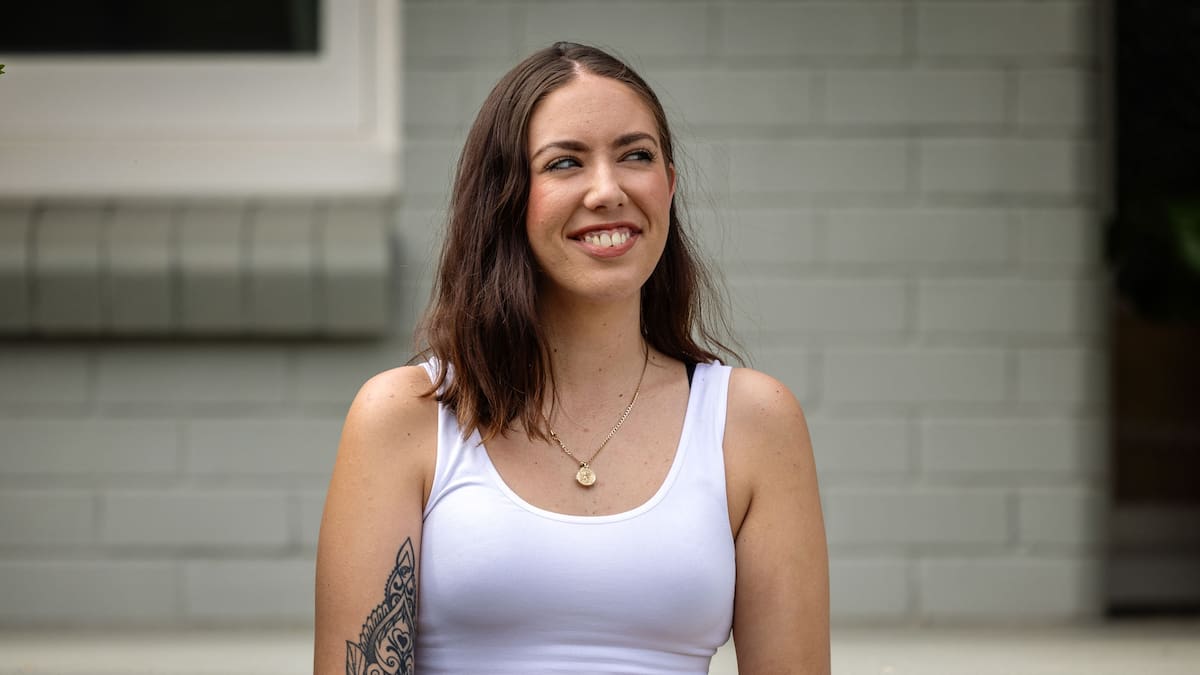
A deep breath. Chin up. A smile – forced, practised.
The pair step inside.
Three generations fill the room but it is the youngest who is being lost. Paige Suisted is a fighter – but not all battles can be won.
“I’m not airing it to get sympathy. I’m airing it to show people what it’s like.” Photo / Mike Scott
The Herald first met Paige in late 2024 and she was a surprise.
The then 26‑year‑old Waikato woman was tall, striking, brash and a bit pissed off.
She had been lumbered with a terminal brain cancer diagnosis, which was reason enough for anger, but Paige was clear about one thing – the message she wanted to share wasn’t simply that she had cancer.
She believed her experience should serve a purpose and decided to tell her story so others might better understand what lay ahead and how to live with it.
As the interview progressed, the cameras rolled and Paige filled the lens. Mum Rachel and grandmother Sheryl sat quietly to one side, out of view, listening.
Tears ran down Rachel’s face. They weren’t just from sadness but pride, as Paige spoke about medical missteps, a delayed diagnosis and how anyone needs to fight to be heard in the medical system.
She talked about the loss of movement in her arm and leg, the grind of day‑to‑day radiation treatment and chemotherapy and the unfortunate loss of her long, dark hair.
And then there was the part Paige wanted people to remember most – her plan to make memories.
“It’s my story. No matter what, this is what I’m going through,” Paige told the Herald.
“I’m not airing it to get sympathy. I’m airing it to show people what it’s like.
“I hope they can see that it’s not the end.”
Paige’s positive attitude had made the family – her mum, dad and two siblings, plus her grandparents – more resilient and stronger, Rachel explained at the time.
“Her strength rubs off not just on me. It rubs off on everyone.
“Paige said to me, ‘The world’s toughest battles go to the world’s toughest soldiers’. She’s one of the world’s toughest soldiers.”
She promised her daughter that “she will never do this on her own”.
But washing through Rachel’s tears of pride was fear as well.
“I can’t bury my daughter,” she would tell the Herald. “I can’t do that. I don’t want to do that.”
Paige Suisted is cared for by grandmother Sheryl (left) and mother Rachel Raven in Hospice Waikato. Photo / Mike Scott
At Hospice Waikato, Rachel and Sheryl, mother and grandmother, move quietly around Paige’s chair, cooing softly, brushing her hair back, placing kisses on her forehead.
Paige’s eyes open from time to time. Recognition of the people surrounding her comes sparingly.
Less than a month earlier, she had been still active and out in the world. In the weeks since, the cancer has been aggressively unforgiving.
It makes the past year and what Paige chose to do with it impressive.
Her colourful social media tells the story of a bucket list with many ticks – European travel and the long‑held dream of visiting Paris, concerts, car racing, balloon rides and much more. Threaded through it all are special family moments.
Paige Suisted ticked many items off her bucket list in the past year.
Paige became an ambassador for the Cancer Society Daffodil Day 2025 campaign, telling her story to ever more people through videos, words and public appearances.
Her messages were always honest and unfiltered.
The ongoing treatments and therapy were intense, her hair continued to fall out, and life was often taxing.
Yet, against expectations, there was great news in late 2025. Scans showed the brain tumour had diminished to the point it could no longer be detected.
Paige’s oncologist could not explain why. He was “completely dumbfounded”, Rachel said.
The Herald got in touch in early February for a follow-up.
Paige was an ambassador for the Cancer Society Daffodil Day 2025 campaign. Photo / Tim Pierce / The Beards
“You were expecting a good news story, weren’t you?” Paige said at the end of the interview. “Sorry about that.”
Over the previous hour, sitting beside her mother, Paige had spoken plainly about what cancer had already taken from her – mobility, independence and a sense of self – told with the familiar raw honesty.
A recent head knock and concussion – difficult for anyone but much tougher for someone with brain cancer – meant she was struggling to find words. Rachel would step in to help.
The tumour had indeed gone, surprising numerous medical specialists.
“The question we had was, if that’s the case, is she cancer-free? And he [Paige’s oncologist] said, ‘No, you still have stage four terminal brain cancer’,” Rachel explained.
“There’s still cancer fragments in her brain, and when they get angry, then they form into a tumour,” she said.
“So, at the moment, the tumour is blasted but the fragments are all still there.
“So, it was really hard to hear that.”
Even with the cancer diminished to the point it could no longer be detected, it still left Paige with the physical impairment – the loss of movement in an arm and weakness in her leg on one side of her body.
Despite daily gym sessions, her balance remained unreliable and her strength uneven. Simple tasks that once required no thought – driving, doing her hair, walking on sand, carrying objects – demanded effort and time or were even impossible.
“I know people are on chemo or have cancer and we’re all the same – we’re all going through major challenges and troubles with everything.
“But I’ve never seen anyone who doesn’t have a working hand and a working leg. So, I get upset because I’m like, ‘Why did it have to be me?’”
The worst part was the stares. For a young woman who prided herself on her appearance, the wobbly “stroke” walk to get a coffee near her home was excruciating.
“I put my head down, but I can see people are looking and it makes me upset.”
Paige Suisted, pictured in 2024. Her brain tumour left her with lasting impairment to her arm and leg. Photo / Mike Scott
Alongside the physical toll was the constant effort of trying to understand what external support existed. Much of it had to be uncovered along the way.
“They don’t tell you unless you figure it out,” Rachel said.
Support came in pieces, learning about them in chance conversations with other patients or by persistent questioning.
For Paige and her mum, it meant navigating treatment and services – such as in-home aid, wig funding and getting a disability transport card – without a single point of information to explain what was available or how to access them.
Their talk was of fighting once more – the constant, exhausting fight to be noticed and heard within the maze of cancer care.
Exhausting … and depressing.
“I’m going to be honest and tell you this,” Paige said before twisting on the sofa to look at Rachel, “And mum’s probably gonna get upset.
“I made a thing when I was asleep with my Pepper [Paige’s cat], and I actually said, ‘I’d rather this cancer and me be out now’.
“I don’t want to have to deal with it – I’m kind of over it. Like, I want to be out because what the f*** am I doing?
“This is hard not being able to do what I used to do, and I don’t want to get to another year and another year and another year being like this.”
Paige Suisted’s mum, Rachel Raven (right), has supported her daughter throughout her cancer journey. Photo / Mike Scott
Paige doesn’t want to die. Rachel knows that.
Soon after the February interview, the worst news was delivered. Those cancer fragments had become angry, and the tumour was back with vengeance.
The family headed to the Gold Coast, a favourite place for Paige, making final memories.
One night near the end of the trip, when it had become obvious the cancer was wreaking havoc, Paige did not want to sleep.
“She was just laying there … and she just simply said, ‘I’m just too scared to go to sleep because I know I’m going to die’,” Rachel said.
“She was scared, really scared.”
After returning from Australia, Paige was placed in hospice care, and that’s where Rachel spoke to the Herald last week.
“I’ve got this really stupid dance and I call it my chicken dance. And that’s my little thing I do daily to try and get a spark out of Paige and it would always make her laugh.
“Over the last two weeks my chicken dance hasn’t been doing anything unfortunately, so that kind of breaks my heart … and I miss that.
“And I miss her. She’s not even gone and I miss her.”
Rachel said she was finishing her daughter’s story because that’s what Paige would wish for.
“She’s always wanted people to be aware of what’s going on for her, and she’s always been that sort of person who wants to make sure she can do something to help somebody else out or for someone else to understand.”
After a wide-ranging chat covering the recent prognosis, the tiring speed of decline and reiterating the need to speak out and ask questions of the medical fraternity, Rachel summed up what was important.
“The journey is exhausting, heartbreaking, and extremely emotional.
“But be surrounded with those that matter and those that care.
“Don’t ever worry about what anyone else thinks. Live life to the fullest and make those memories last a lifetime.”
Paige would approve.
Mike Scott is an award-winning visual journalist with more than two decades of experience telling stories across multiple media platforms.
Sign up to The Daily H, a free newsletter curated by our editors and delivered straight to your inbox every weekday.