
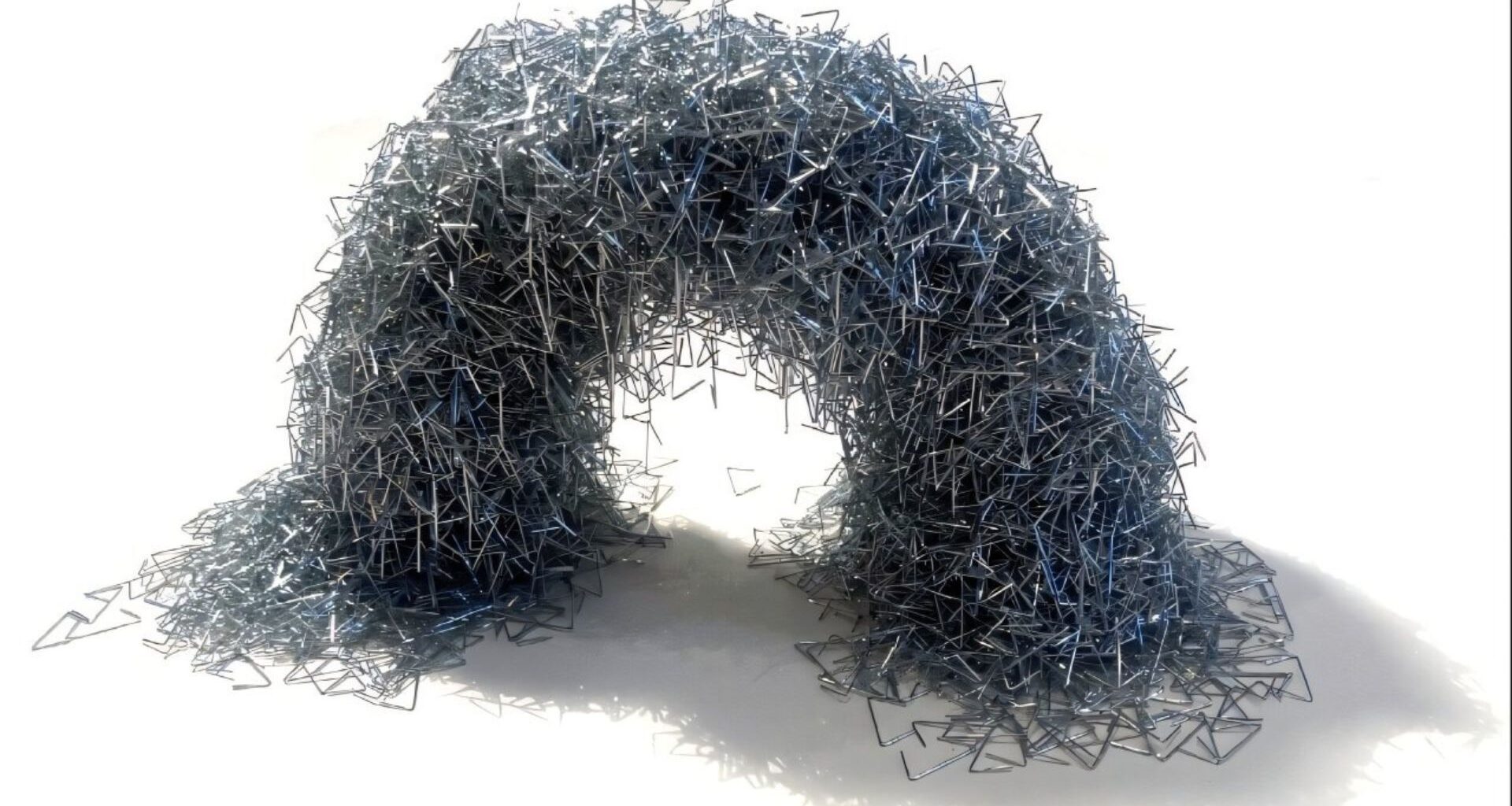
Researchers at the University of Colorado Boulder are developing a new class of “entangled materials” inspired by the surprising strength of a tangled ball of office staples.
Much like a bird’s nest or a burr, a cluster of staples gains its strength from geometric interlocking rather than chemical bonds. But it retains the ability to instantaneously transition back into a loose piece through targeted vibration.
“We’ve been playing around with the idea of building blocks and geometry for many years, but we started looking at interlocking, entangled particles only recently,” said Professor Francois Barthelat, the leader of the Laboratory for Advanced Materials and Bioinspiration.
“We are excited about the combination of properties we can get out of these systems, and we believe this technology has the potential to go in many directions,” Barthelat added.
Geometry of grip
The work centers around “entanglement.” Through this, researchers are mimicking natural structures, such as bird nests and bone minerals, to create ultra-strong manufactured materials.
Particle shape is key in this. As compared to smooth grains of sand that slide apart, specialized geometries allow individual pieces to physically intertwine.
This mechanical locking creates a cohesive link that provides structural integrity without the need for adhesives.
“Let’s take sand as an example. Sand is smooth and convex-shaped, meaning it cannot interlock from grain to grain,” Youhan Sohn, Ph.D. student, said.
“However, we found that if we change the shape of a grain of sand, we can drastically affect its behavior and mechanical properties, including the particle’s ability to link with other particles,” Sohn explained.
For the study, Monte Carlo simulations were used to analyze particle geometry. and identified that “two-legged” staple shapes provide the most effective mechanical interlocking.
Instead of stacking loosely, these U-shaped particles hook and weave into a singular mass that stubbornly resists being pulled apart.
Physical testing revealed that these entangled particles possess a rare dual advantage, maintaining simultaneous tensile strength and exceptional toughness.
Use of vibration
The real power of this material is in its response to a simple buzz.
Standard materials are permanent. For instance, a concrete bridge is there forever until it is smashed into dust. But Barthelat’s entangled particles are different.
The material’s standout feature is its capacity for rapid, reversible assembly controlled by vibrational patterns.
Interestingly, the entanglement levels can be modulated on demand through these vibrations. Gentle frequencies can lock particles into a rigid structure, whereas more intense vibrations trigger the complete unraveling of the mass.
“It’s a strange material because it’s obviously not a liquid. However, it’s also not quite solid. This opens new and intriguing engineering possibilities,” Barthelat said. “Handling a bundle of these entangled particles feels very remote and exotic.”
Entangled materials offer potential for sustainability and advanced technology, particularly in civil engineering and robotics.
It could enable large-scale structures, such as bridges, to be “unzipped” and recycled rather than demolished. Eventually, this technology could support a circular economy.
Furthermore, it could advance swarm robotics, allowing fleets of small machines to interlock into functional tools and later disentangle to navigate tight spaces — a real-world parallel to the shape-shifting capabilities of cinematic sci-fi.
“Yes, kind of like that liquid metal T-1000 in Terminator 2, who can change shape to slide under a door and then transform back to a human’s size on the other side,” added Barthelat.
The researchers are currently pushing the boundaries of their work by testing multi-legged particle shapes modeled after high-grip plant burrs to achieve even more powerful entanglement.
The study was published in the Journal of Applied Physics.