
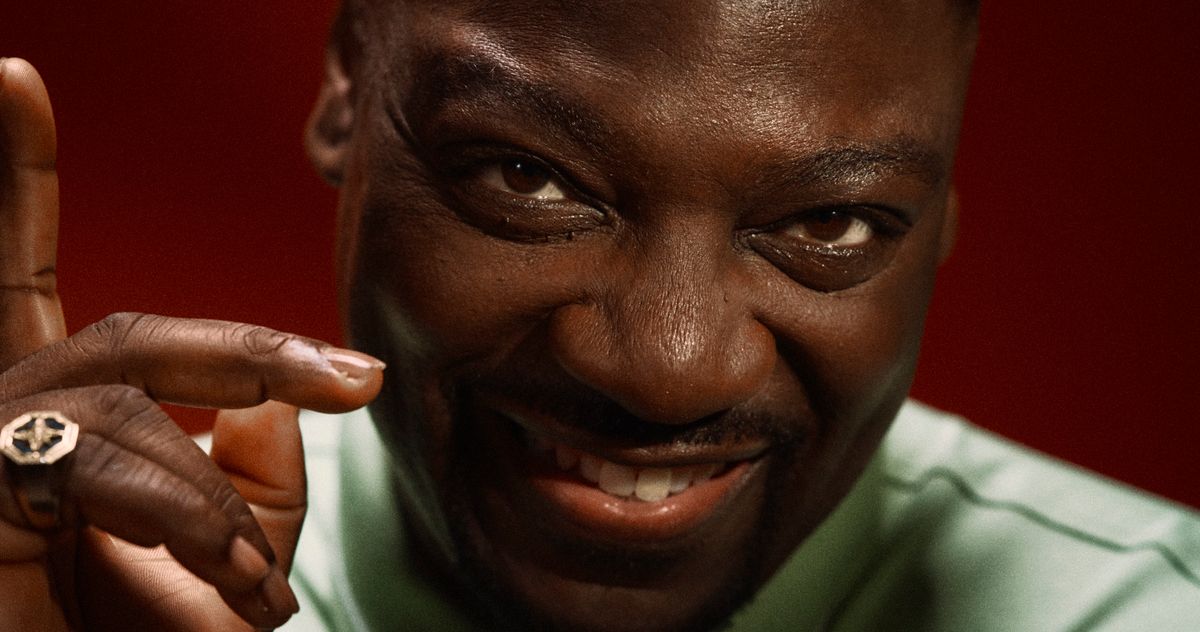
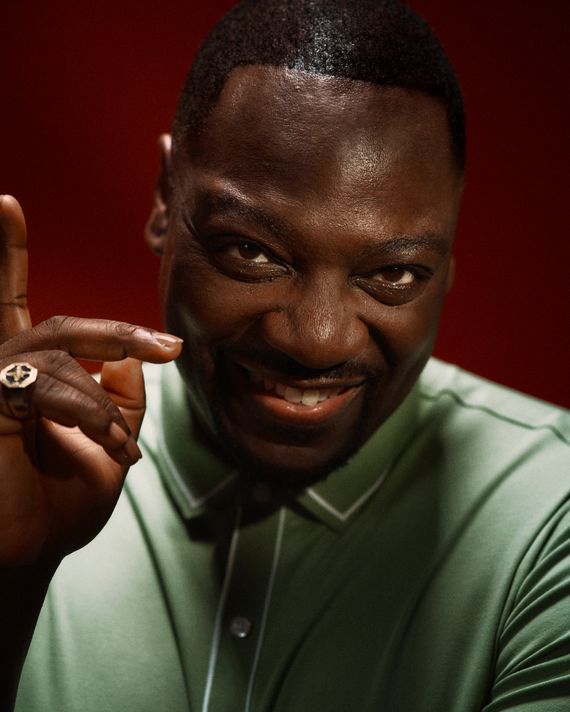
Photo: Devin Oktar Yalkin
The 58-year-old actor Adewale Akinnuoye-Agbaje had never worn a cowboy hat, ridden a horse, or seen more than a couple episodes of Euphoria before being offered the part of cowboy crime lord Alamo Brown. “I did love wearing the hat,” he recalls from a restaurant patio on L.A.’s Westside. Akinnuoye-Agbaje is tall and handsome and has a lilting accent he describes as “North London tinged with a hint of Cockney.” He’s a jarring contrast to his character on Euphoria, a California strip-club magnate who hires Zendaya’s character, Rue, to manage the adult talent, deal drugs at his clubs, and sell guns and ammo. The wayward high-schoolers of the HBO series are now young adults, encountering the difficulties that come with entering the real world and trying to establish themselves. In the first onscreen interaction between them, Rue, now working as a drug mule for a dealer named Laurie (Martha Kelly), wends her way through a labyrinthine house party before meeting Alamo, sitting in a hot tub, flanked by four strippers, and wearing a Speedo and a cowboy hat. They suss out each other’s motives. “He has to seduce Zendaya and the audience,” Akinnuoye-Agbaje tells me. Before each take, creator and showrunner Sam Levinson would make a hand gesture like a slithering snake — Akinnuoye-Agbaje demonstrates it — to evoke the energy Alamo should have.
Toward the end of the episode, Alamo and Rue engage in a high-stakes version of Russian roulette after he blames her for one of his strippers’ fatal overdose. “So you believe in God?” he asks her menacingly. “Let’s see if he believes in you.” And he takes her to the windy summit of his estate, places an apple on top of her head, and shoots it.
“It was on top of a hill in Palmdale at one o’clock in the morning, and it was freezing cold, the wrong time to be in cowboy boots and Speedos,” Akinnuoye-Agbaje recalls. “When you’re on the set and it’s that cold, they normally give you hand warmers in between takes, and the crew would turn it around very quickly. They were aware it was very cold. Of course, the hand warmers were far more useful inside my Speedo, if you get my drift.”
The scene kicks off the start of their business relationship. “What is really cool about these two characters is they’re completely different generations,” says Akinnuoye-Agbaje. “Zendaya’s Rue is representative of Gen Z, and Alamo is an old-school, frontier kind of criminal. But there’s something in there that could almost be father and daughter.” There’s a kinship between them, and it serves as one of the third season’s emotional anchors.
Euphoria’s casting director, Mary Vernieu, has known and worked with Akinnuoye-Agbaje since 2012, when she cast him in the movie Bullet to the Head and later in the film Concussion. She suggested him for the role, and he sent in a self-taped audition from London in 2024. “The character had to be both scary and incredibly charming and mysterious. He’s a different kind of guy. He’s a cowboy,” Vernieu says. “So he had this bigger-than-life persona that we needed to capture, and we knew that it had to be somebody who would go toe-to-toe with Zendaya.”
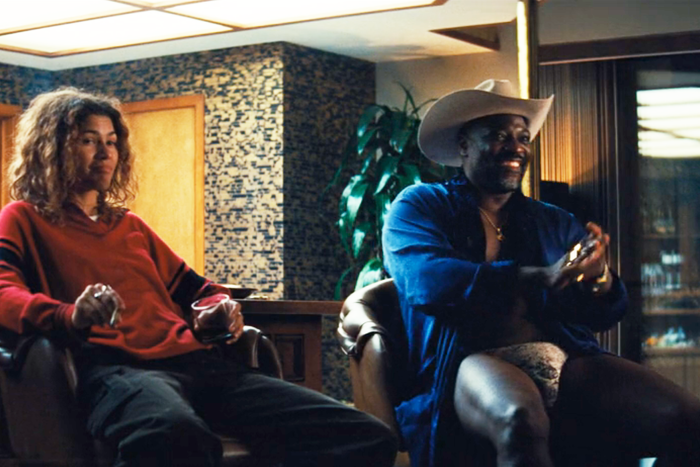
With Zendaya in Euphoria.
Photo: HBO
He was asked to read for Levinson and Vernieu. The former football player turned actor Marshawn Lynch was also up for the role, and they rehearsed together once Akinnuoye-Agbaje got the part. (Lynch ended up playing one of Alamo’s lackeys.)
The third season of Euphoria arrives in a much different TV landscape from when the show began in 2019. Its young stars are now A-listers. Offscreen tragedy, including the deaths of key executive producer Kevin Turen and actor Angus Cloud, who played the affable drug dealer Fezco, and reports of long shooting times and hasty rewrites made the prospect of a third season seem up in the air for years. It’s premiered to mixed critical reviews, but viewers are tuning in anyway to see the stylish, star-driven spectacle. More than 8 million people in the U.S. watched episode one in the first three days.
Akinnuoye-Agbaje is a veteran TV actor, best known for his breakout roles as the sinister Simon Adebisi in HBO’s Oz and the priest Mr. Eko in ABC’s Lost. He began his acting career in the early ’90s after being scouted as a model and appearing in music videos for Mary J. Blige and En Vogue. Born in London to Nigerian-immigrant parents, he spent part of his youth being raised by a white working-class family in a now-discontinued practice known in the U.K. as “farming.” Between the ’60s and the ’90s, Nigerian immigrants in England would send their children to live with white foster families while they worked and studied. Akinnuoye-Agbaje was farmed out at 6 weeks old while his father prepared to become a barrister and his mother an accountant; he reunited with his biological family at 16, and they now spend summer holidays together in Nigeria. “There are examples of farming where it was good for some people, but there were many instances where it was traumatic because it was a period in England’s history when there was quite a backlash against the immigrant influx,” says Akinnuoye-Agbaje. “And that took the form of skinhead gangs raging the streets and politicians and their jargon about ‘Keep Britain White.’ It was very ICE. ‘Get them out.’ It was real to the point that you’d get attacked on the streets and stuff like that.”
He initially harbored a lot of resentment toward his biological parents but reconciled with them before his father died. He was only able to begin processing the experience by making art about it. Through programs at the Sundance Institute Labs, he made a short film that he eventually adapted into the 2018 feature Farming, starring Damson Idris. “My mother was supportive of the film because obviously in order to make it, I had to get her consent and she had to read the script,” Akinnuoye-Agbaje says. “And as disturbing as it was for her, she really supported it. I was really grateful to her for that. It was only once that film was completed that I could actually exhale and find true happiness, because up until that point, I realized, the trauma and the angst, the bitterness really, was eroding me.”
Akinnuoye-Agbaje’s first movie role was in 1995’s adaptation of Michael Crichton’s Congo as Kahega, the head of the team leading a gorilla expedition. He was inspired by Delroy Lindo, who played Captain Wanta, the leader of a local militia: “I saw a scene that he did that we were all in, and he was absolutely magnificent. I just knew from that point that’s the type of acting that I wanted to do.” On set, he also met co-star Tim Curry, a fellow Brit, and struck up conversation. “I had no theatrical agent,” he says, “and he saw something in me and got me with his agent. So there were some really fortuitous moments in my career where people have just seen something in me and given me a chance.” Another lucky moment came when director Steve Oedekerk happened to be on the lot at the same time and invited him to audition for the role of a security guard named Hitu in 1995’s Ace Ventura: When Nature Calls.
“There were a spate of African-themed movies that were happening in Hollywood. And I just happened to be there at the right time. Obviously, I’m African, and I looked the part. I could do the accent and knew the culture,” he says of his earlier breaks. “But then as always, Hollywood moves on, and after that it was just dead. It was crickets.” He decided to expand his range by working on his American accent.
When he made his way to television, it was in the pre-Sopranos period when the medium was still widely considered a step down from film. But Oz, the gritty HBO prison drama, premiering in 1997, on which Akinnuoye-Agbaje did a four-year stint, was a precursor to the golden era of TV. It also just happened to be produced by Sam Levinson’s father. “Sam had told me how much he loved that show,” Akinnuoye-Agbaje tells me. “And I’m like, ‘You were watching that? How old were you? You should not have been watching that.’”
The character was originally written as an American, and Akinnuoye-Agbaje auditioned with an American accent, but then threw in a “British, Jamaican, and Nigerian” accent as well. “I was desperate to get the role to work,” says Akinnuoye-Agbaje. “And Alexa Fogel, the wonderful casting director, literally took me from the audition in a taxi to creator Tom Fontana’s office, and she said, ‘Do for him what you just did for me,’ exactly like that. And he didn’t even look up at me; he was just typing. And he said, ‘You’ve got two minutes.’” He did the variations, and Fontana liked his Nigerian accent. He helped come up with his character’s last name: Adebisi is a combination of his first name and that of a friend of Fontana’s, a Nigerian named Bisi. Fontana would write dialogue for the character in American vernacular, and Akinnuoye-Agbaje would translate it into Nigerian pidgin.
He enjoyed that kind of creative latitude again as the sage, violent-only-when-necessary priest Mr. Eko on Lost, a role he was told was written for him. He had been reluctant to return to television, but coming off his turn as 50 Cent’s psychopathic drug-kingpin mentor, Majestic, in 2005’s Get Rich or Die Tryin’, “the prospect of going to lay on an island for nine months made sense.” He chose his character’s name and quickly became a fan favorite. But he asked to be written off the show after a little more than one season following the deaths of his foster parents. “I had to honor them in the right way,” he says.
Akinnuoye-Agbaje has played a wide array of roles, but he is perhaps best known for his portrayals of heavies. Asked if he worries about being typecast, he is thoughtful. “I’ve never looked at them as bad guys, just guys who are trying to make the best of a circumstance. And I’ll leave the audience to judge them. And also, there’s a certain amount of freedom in playing guys that have no boundaries, as opposed to a guy that is kind of restricted by morality and justice and good.”
The kind of acting he does usually calls for full commitment. “From the moment I arrived in L.A., I’d asked Sam to please call me Alamo Brown. And I stayed in the accent because I’ve noticed that if I dip in and out, the consistency erodes, and I didn’t want that,” he explains. He would on occasion suggest lines of dialogue for his character. In episode two, Laurie and Alamo have a heated exchange over the phone, and one of her lackeys calls him the N-word and she calls him a “pig.” Later on, Alamo seems to stew over that latter insult as opposed to the racial slur, which seems slightly unbelievable, especially since a white man wrote the script. “I really worked hard in understanding why pig was such an insult to him, worse than the N-word,” says Akinnuoye-Agbaje. “He’s a man who’s pulled himself up from his bootstraps, and he’s tried to seek validation through his material accomplishments. And it just triggered his self-worth. And more than that, it was about this notion that a pig is an animal that eats his own feces. And so it was so disgusting to him.” (He’s also got a few horror stories to share about the pig-defecation scene at the club later in the episode. One of the three pigs used for the scene not only defecated but urinated on the carpet: “And I don’t know if you’ve ever seen a pig urinate, but it’s like a big old hose coming out of an elephant. It went everywhere. And the squeals and the screams that you hear on the camera were real from all the strippers.”)
The immersive approach Akinnuoye-Agbaje brings to his roles can take its toll. “I didn’t go to the RADAs,” he says, referring to the Royal Academy of Dramatic Art, one of the U.K.’s oldest drama schools. “My RADA was the rough-and-dirty academy, and so all I knew was that I had to immerse myself in these characters and make it real. I took that very seriously, to the point of it almost harming me psychologically. So I hadn’t at that point learned the ON and OFF button.” He discovered Buddhism around 2001, after he’d achieved career success but still felt unfulfilled. “It took me years to really figure out how to transition and make that switch,” he says.
Since getting into the entertainment business in the ’90s, he has seen its capricious nature firsthand. But he maintains a bright outlook, particularly for Black actors, because he has seen things shift within his own lifetime. “When I first started, we were all fighting for the one Black role in the movie that died in the first 15 minutes. That’s where it was at,” he says. “And now young actors are walking in and leading shows and movies after being in the business for a year. I’m really happy to see that.”
Production Credits
Photograph by
Devin Oktar Yalkin
Barbering by
Stacey Green
Grooming by
Janice Kinjo
Thank you for subscribing and supporting our journalism.
If you prefer to read in print, you can also find this article in the April 20, 2026, issue of
New York Magazine.
Want more stories like this one? Subscribe now
to support our journalism and get unlimited access to our coverage.
If you prefer to read in print, you can also find this article in the April 20, 2026, issue of
New York Magazine.