
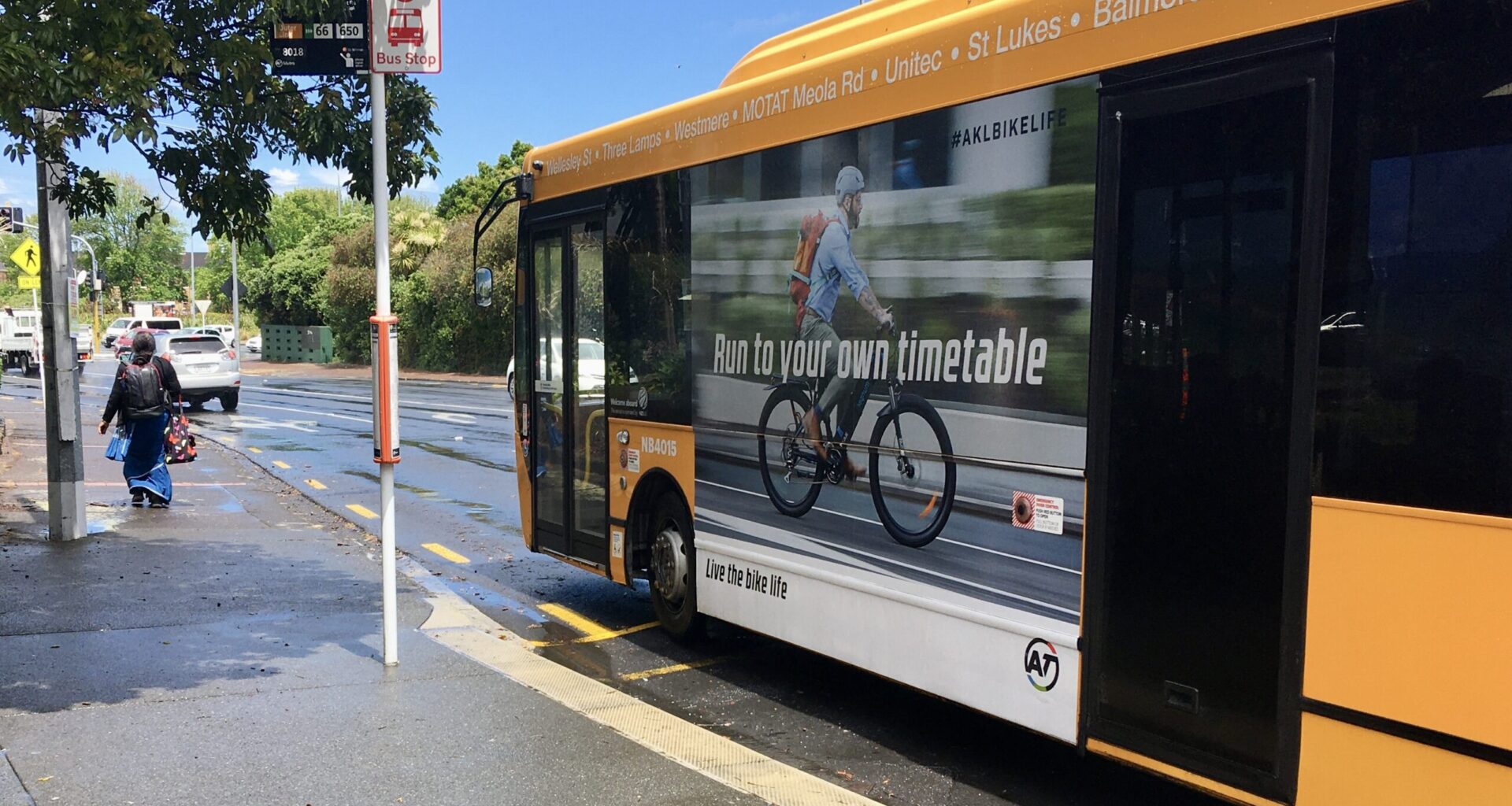
Letting trucks use bus lanes – currently being proposed as a fuel crisis measure – might sound like a sensible solution, but it risks undermining broader goals around our transport system.
At the end of last week saw a few interesting comments from Mainfreight CEO Don Braid, and a swift response from Mayor Wayne Brown.
Mainfreight’s chief executive says he is “frustrated” at KiwiRail and Auckland Transport, and that the agencies could be doing more as the Middle East conflict sends fuel prices up.
…..
Don Braid told Morning Report moving freight via rail was more efficient than by truck, “yet we haven’t seen KiwiRail stand up to offer additional services”.
“They’re missing in action at the moment, and we would like to see them stand up to help the industry.”
…..
Mainfreight had been speaking to KiwiRail but was failing to get action, he said.
“We are trying, but [we’re] frustrated to be perfectly honest.”
KiwiRail chief executive Peter Reidy said in a statement to RNZ: “KiwiRail is sharply focused on helping New Zealand get through this.
“We are working around the clock to save fuel and working with our customers every day, sometimes multiple times a day, to take some of their volume where we have capacity.
“We’ve already made 100s of containers available, representing 1000s of cubic metres, and are confident we can do more.”
I agree with Braid that now is exactly the time we should be putting more freight onto trains. It’s good that KiwiRail has added some additional capacity, but I wonder if we’re seeing a couple of issues combining here:
One of the consequences of decades of trying to force rail to operate as a commercial entity rather than valuing the wider economic impact it provides is that KiwiRail probably doesn’t have a lot of capacity just sitting idle that they can turn to, whether that be that locomotives, wagons or staff to operate them.I could be reading it wrong, but the comment from Reidy that they’re “working around the clock to save fuel” suggests that KiwiRail is focused on managing their own costs – which is understandable. But I wonder if this is one of the consequences of the current government’s hands-off, let’s-pretend-nothing’s-wrong approach to this fuel crisis. It’s better for NZ as a whole if we shift more freight to rail to move it more efficiently – but doing so means KiwiRail might have to run more trains, which means their fuel costs would go up. A more hands-on government might require – or at least assist with – better industry coordination, so rail can more quickly play a bigger part in mitigating the impacts of fuel supply interruptions.
Braid also has aimed at Auckland Transport, which Mayor Wayne Brown quickly responded to:
Braid said other organisations, like Auckland Transport, also needed to make adjustments to make diesel usage more efficient.
It should reconsider its position on the idea of allowing freight vehicles to use bus lanes, Braid said.
“Think about the amount of diesel idling that goes on because we can’t use a bus lane.
But Auckland Mayor Wayne Brown was not fond of the idea, saying it would just cause more congestion.
He told Nine to Noon a better alternative would be to have trucks operating at night.
“Get the trucks on the road at night … it’s a lot cheaper to pick up a container at night than the daytime,” Brown said.
He said the warehouse companies were obstructing that change, and that if truck companies passed on their increased fuel costs to the storage companies, they would start opening at night.
Brown said crowded bus lanes were already a problem.
“We already have trouble with buses crowding themselves … the buses have to stop, and the next thing will be the truck will be stuck behind the bus idling.”
The mayor is right that many of the bus lanes, especially those closest to the city centre, are already very crowded. Solving this ‘bus sausage’ problem is of course the original reason why light rail was proposed, particularly through the heart of the isthmus.
An example of ‘bus sausage’ just before 5 pm on a Wednesday at Stop A, Westfield Newmarket (between Mortimer St and Morrow St).
However, even putting that aside, the issue isn’t just the potential for trucks to hold up buses, but the reverse applies too. Adding other vehicles to bus lanes increases the chances that a bus (or truck) will be in a queue such that they will miss the green phase on a traffic light, with knock-on and cumulative delays across everyone’s timetables.
There are also issues for other road users too. Many of our bus lanes are the only place to cycle on the busy arterials that are the most direct route, for example. And it’s not particularly pleasant for people standing waiting for a bus to have even large trucks passing close by, especially at 50kmh which is the speed limit on many of the arterials with bus lanes.
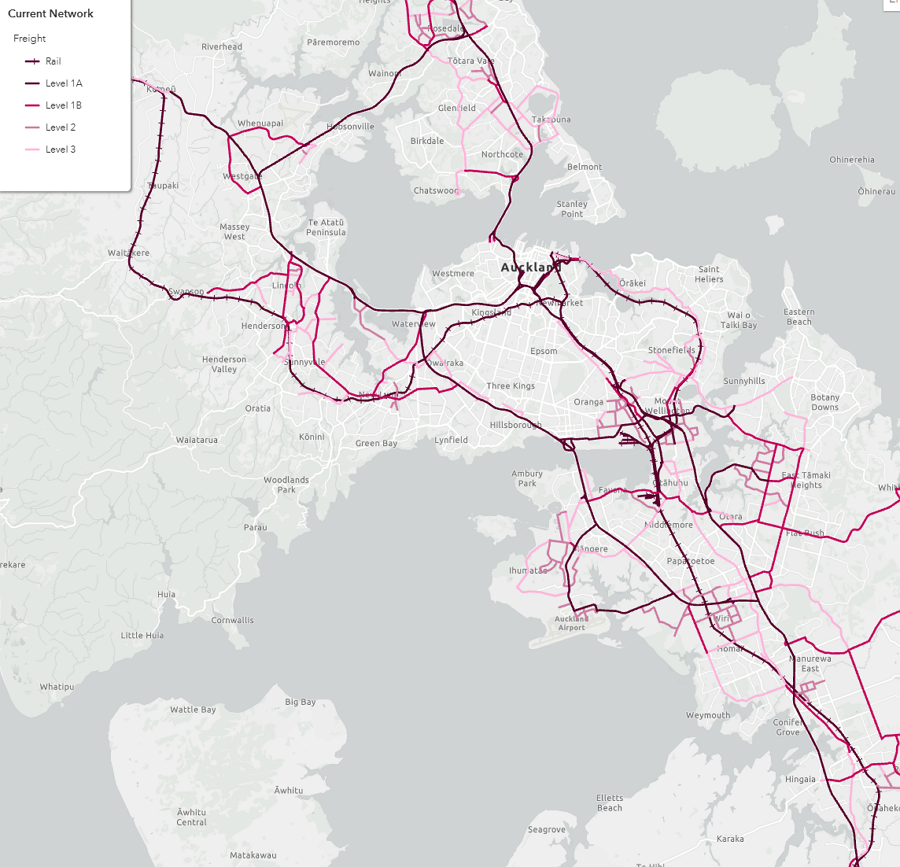
Perhaps an even bigger problem with the suggestion is there simply isn’t much of an overlap between key freight routes and dedicated bus lanes. Below is what Auckland Transport have determined as their Strategic Freight Network:
 Now compare that to the network of bus and transit lanes:
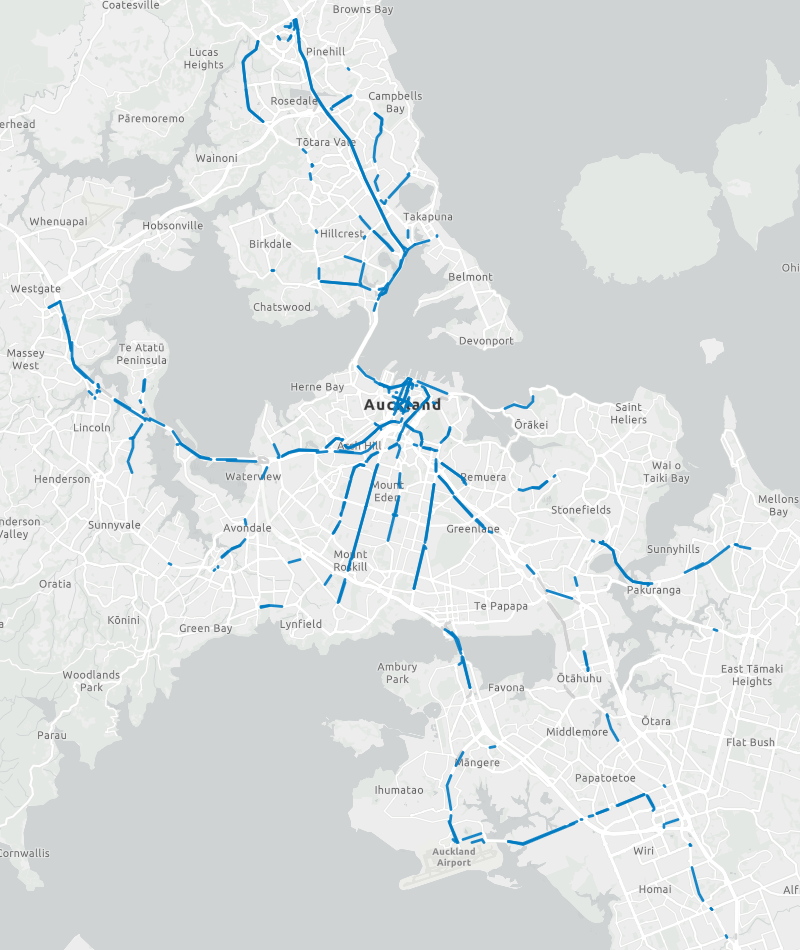 As you can see, other than the state highways, there’s really just not that much cross-over between the two.
That said, perhaps there is an opportunity here: not for using existing bus lanes, but for setting up new bus and truck lanes to improve travel through the areas that currently don’t have any bus priority.
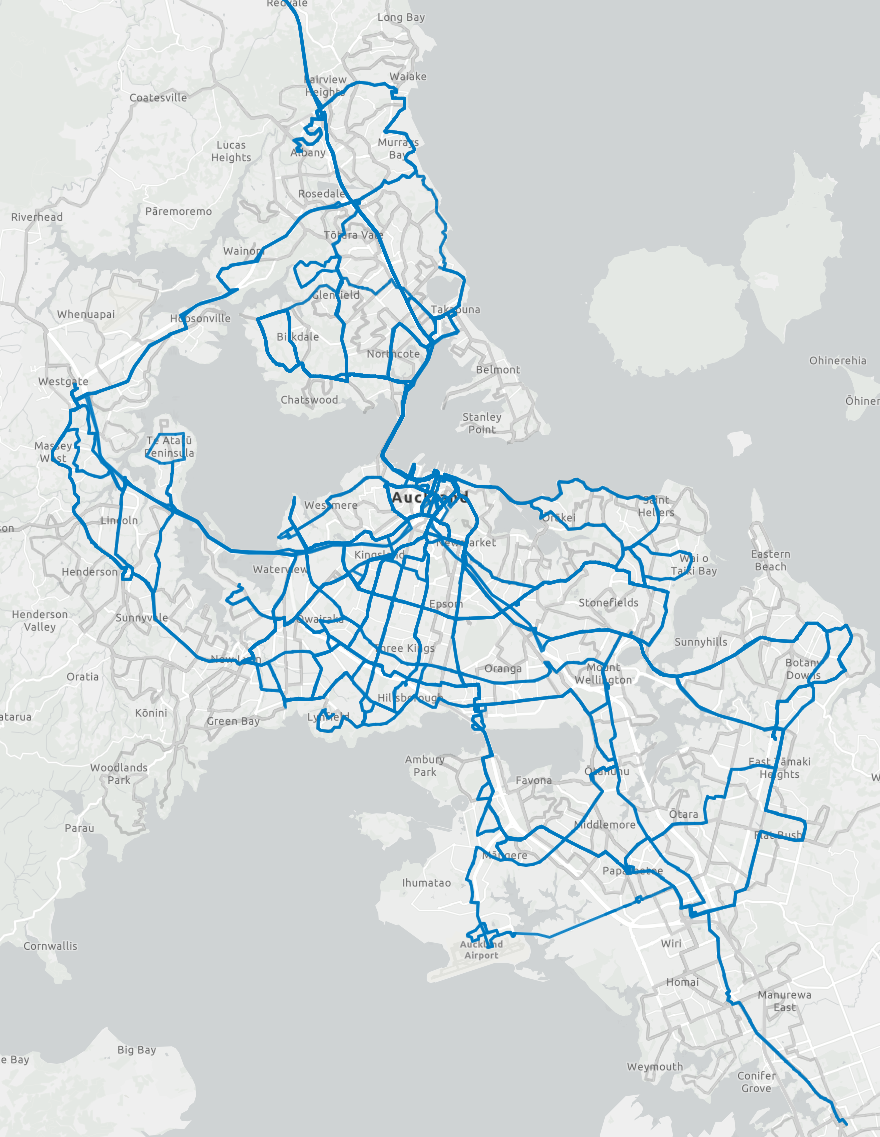
The map below shows all current frequent bus routes. As you can see, the existing bus lanes cover only a small proportion of them. So perhaps AT could quickly expand the network of dedicated lanes, firstly to make buses faster and more reliable (especially now a lot more people are seeking to use the bus for daily travels), and let trucks use these new bus lanes too, as a trade-off for quick implementation.
Mayor Brown had a few other interesting comments on his Nine to Noon interview. When asked about the possibility of ramping up the frequency of services he responded:
I think we need to ramp up occupancy most of all. The frequency is pretty good and we’ve also got City Rail Link starting later this year which will also have an impact of this.
We will not let the fuel price crisis opportunity pass without big strong moves to make better use of our public transport … it’s a good service you know.
He was also critical of the government giving some families $50 a week to keep driving, when for the same price they could get unlimited public transport travel.
We’ve steadily been having a huge investment in electric buses for a long long time and that’s good, now we want to get more people on them ….. you don’t encourage that by giving people $50 a week to keep driving on the motorway.
….
Any time costs go up it forces people to think how do you reduce your costs and get more income, so we want more people on everything, more people on public transport, so you want anything to make it less attractive. I think the government’s $50 to keep people driving down the motorway is just a dumb idea.
In typically frank fashion, he added:
Public transport options are getting better and better, we just got to encourage New Zealanders to make that terrific step of getting out of the car, subsidising the buggers to stay in there is not clever.
On the concerning side, he noted that AT’s fuel bill is likely to go up by around $50 million as a result of the current fuel prices, adding:
“Most of our diesel is in the ferries actually. The ferry situation is going to come under a severely close look. Some of those over-subsidised ferry services are under threat really – they were marginal as it stood.”
He then went on to say that many of the ferry routes go to places that can be served by bus, and people might have to learn to do that shortly.
Finally, he had a few comments on government priorities and the new City Deal, which he says requires the government to talk to Auckland before making big calls.
So some of their pet projects might die on the vine, because they just don’t make economic sense, you can only do what you can afford sensibly. There’s pressure on us, we don’t want to keep increasing rates, but the surest way to increase rates is to promise things you can’t fund.
The silliness we’ve got now, we’ve got people rushing around thinking oh shit, this road will get me elected so that goes on the list. That’s not a way to do it.
Beware of simplistic answers to complicated questions.
Greater Auckland’s work is made possible by generous donations from our readers and fans. If you’d like to support our work you can join our circle of supporters here.
Share this