
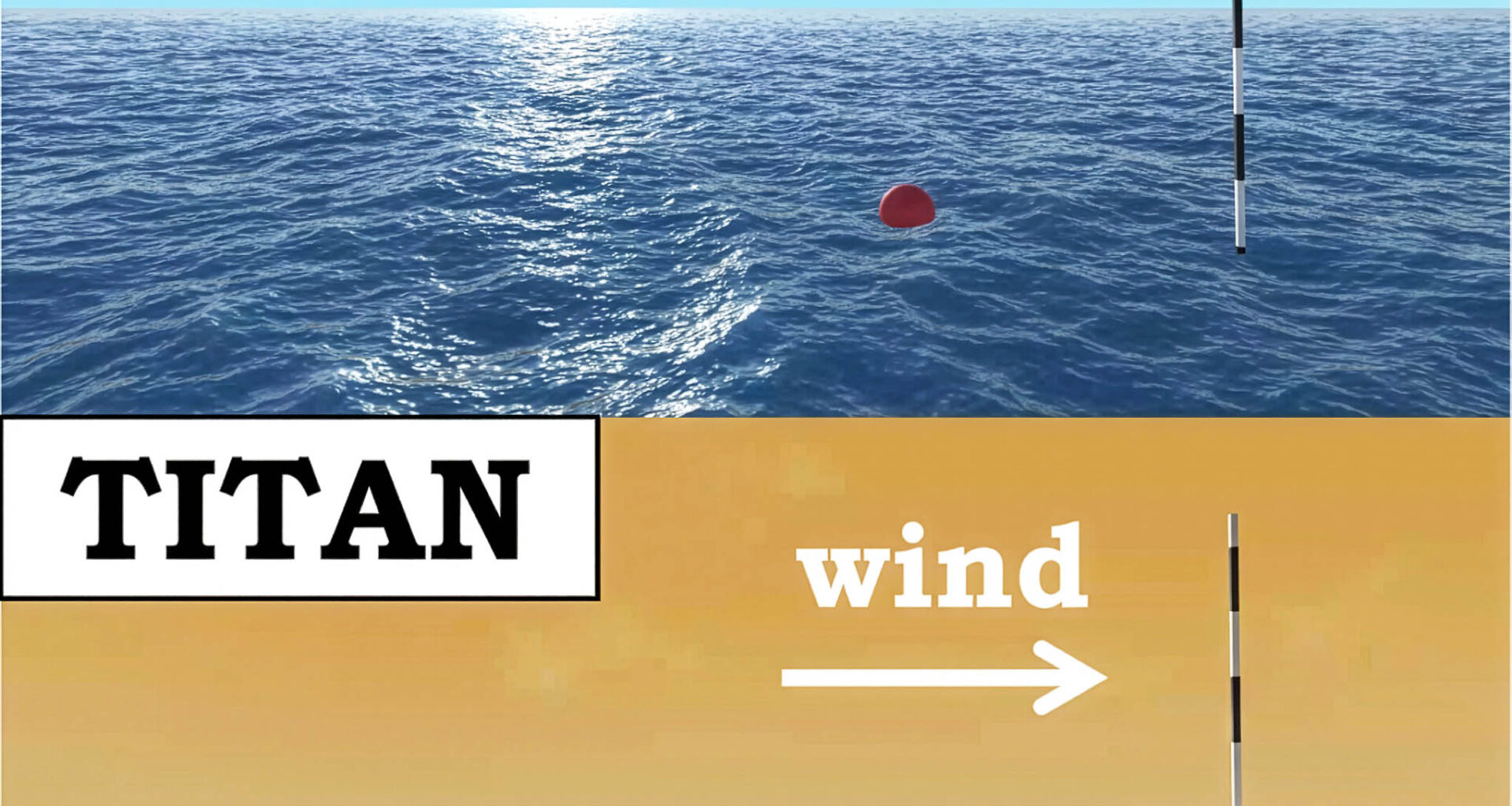
Waves on Earth usually need a decent push to rise. A calm breeze barely disturbs a lake. The surface ripples, maybe shimmers a little, and that’s it. But waves on other planets are much different.
On Titan, Saturn’s largest moon, that same kind of breeze could build waves as tall as a one-story building. It sounds strange, but it comes down to how different worlds play by different rules.

Scientists have been trying to understand those rules for a long time. Waves may seem simple, but they depend on a mix of factors like gravity, air pressure, and what the ocean liquid is made of. Change any of those, and the behavior shifts in ways that can surprise even experts.
Predicting waves on alien planets
Researchers recently built a model that pulls all those factors together. They call it PlanetWaves, and it’s the first tool that can fully simulate how waves form and grow on different planets.
It doesn’t just look at gravity. It also considers the thickness of the atmosphere and the properties of the liquid itself, including how dense or sticky it is.
“On Earth, we get accustomed to certain wave dynamics,” said study author Andrew Ashton, associate scientist at the Woods Hole Oceanographic Institution (WHOI) and faculty member of the MIT-WHOI Joint Program.
“But with this model, we can see how waves behave on planets with different liquids, atmospheres, and gravity, which can kind of challenge our intuition.”
The work, led by graduate student Una Schneck and colleagues at MIT, opens a window into places we can’t yet visit. It also helps explain features we’ve already seen but don’t fully understand.
Waves shape more than water
Waves do more than move water around. Over time, they shape coastlines, move sediment, and even change the layout of entire regions. On Earth, they help carve beaches and build deltas where rivers meet the sea.
“There have been attempts in the past to predict how gravity will affect waves on other planets,” Schneck said. “But they don’t quantify other factors such as the composition of the liquid that is making waves. That was the big leap with this project.”
The team wanted to know what starts a wave in the first place. “Imagine a completely still lake,” Ashton said. “We’re trying to figure out the first puff that will make those first little tiny ripples, on up to a full ocean wave.”
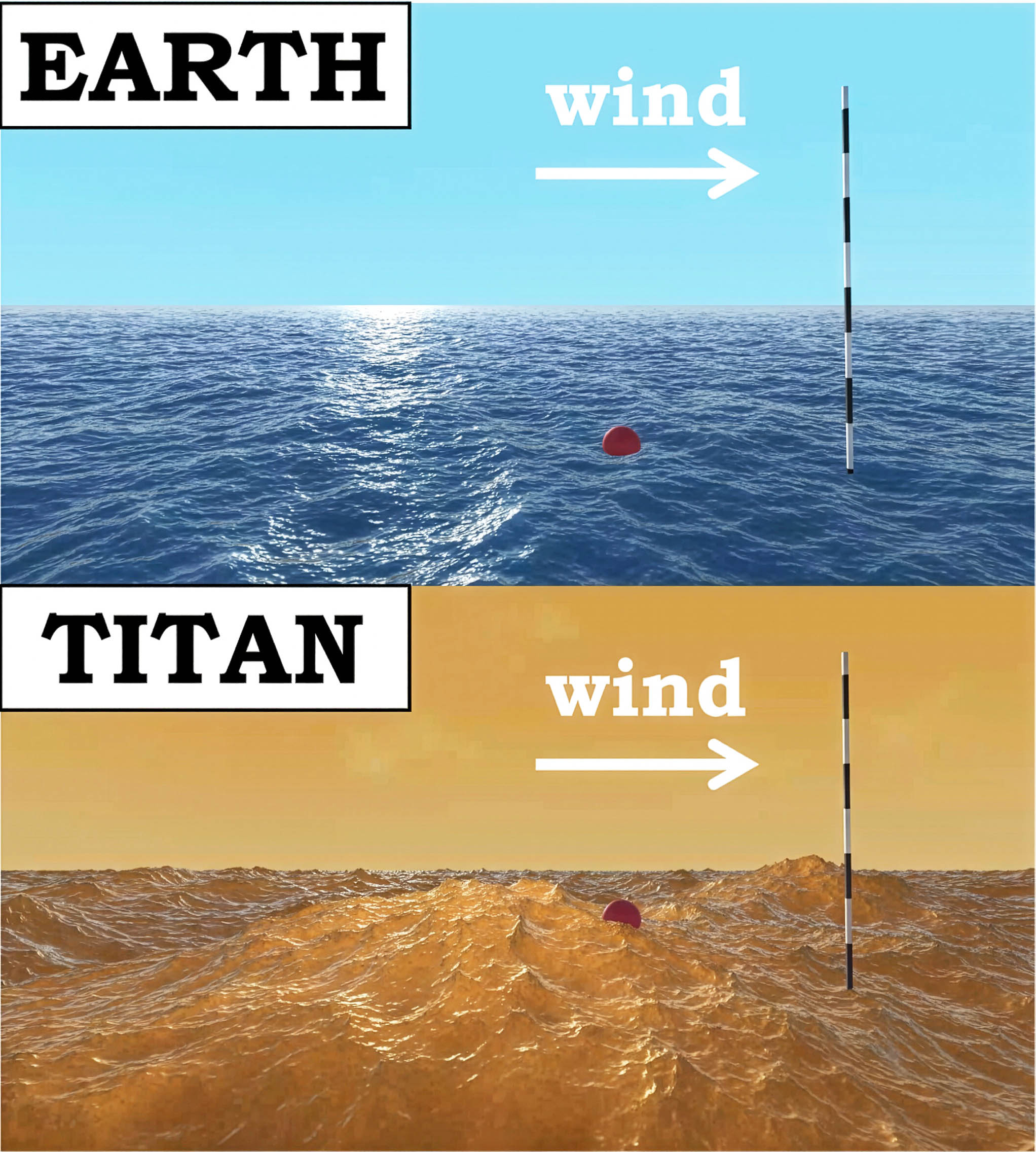 The same gentle wind that would create small ripples on a lake in Earth (right) would make large waves on Saturn’s largest moon Titan (left). In these renderings, the marker is measured in meters. Credits: MIT. Click image to enlarge.Titan’s slow giant waves
Titan stands out because it’s the only place besides Earth known to have stable liquid on its surface right now. But its lakes aren’t made of water. They’re filled with methane and ethane, which behave very differently.
“Anywhere there’s a liquid surface with wind moving over it, there’s potential to make waves,” said Taylor Perron, a professor of Earth, Atmospheric and Planetary Sciences at MIT.
“For Titan, the tantalizing thing is that we don’t have any direct observation of what these lakes look like. So we don’t know for sure what kind of waves might exist there. Now this model gives us an idea.”
The model shows that Titan’s low gravity and lighter liquids make it easy for waves to grow. Even a soft wind can create waves up to about 10 feet high.
They don’t crash quickly like ocean waves on Earth. Instead, they move more slowly, almost as if time has stretched out.
“It kind of looks like tall waves moving in slow motion,” Schneck said. “If you were standing on the shore of this lake, you might feel only a soft breeze, but you would see these enormous waves flowing toward you, which is not what we would expect on Earth.”
Planning for rough alien seas
These findings are not just about curiosity. They could shape how we explore other worlds. If a spacecraft ever lands on Titan’s lakes, it will need to handle those large, slow-moving ocean waves.
“You would want to build something that can withstand the energy of the waves,” said Schneck. “So it’s important to know what kind of waves these instruments would be up against.”
Designing for those conditions could mean stronger materials or different shapes to keep probes stable on the surface.
From Mars to distant lava worlds
The model doesn’t stop at Titan. It also looks back in time at Mars, where large basins may have once held water. As the planet lost its atmosphere, the air pressure dropped.
That change made it harder for winds to create waves, meaning stronger winds would have been needed to stir the surface.
Beyond our solar system, the differences get even more extreme. On a large planet like LHS 1140 b, stronger gravity keeps waves smaller, even with the same wind strength as Earth. On a Venus-like world with thick, dense liquids, waves struggle to form at all.
Then there’s 55 Cancri e, a planet thought to have oceans of molten rock. There, even winds blowing at about 80 miles per hour would barely create ripples. The liquid is just too thick and heavy to move easily.
Rethinking alien coastlines
This kind of modeling could help answer questions that have puzzled scientists for years. One example is Titan’s coastline. Unlike Earth, it has very few delta formations, even though rivers flow into its lakes.
“Unlike on Earth where there is often a delta where a river meets the coast, on Titan there are very few things that look like deltas, even though there are plenty of rivers and coasts. Could waves be responsible for this?” Perron said. “These are the kinds of mysteries that this model will help us solve.”
Understanding ocean waves on other worlds may seem like a small step. But it adds up. Each insight helps build a clearer picture of how planets evolve and how they differ from the one we know best.
The full study was published in the journal Journal of Geophysical Research: Planets.
—–
Like what you read? Subscribe to our newsletter for engaging articles, exclusive content, and the latest updates.
Check us out on EarthSnap, a free app brought to you by Eric Ralls and Earth.com.
—–