
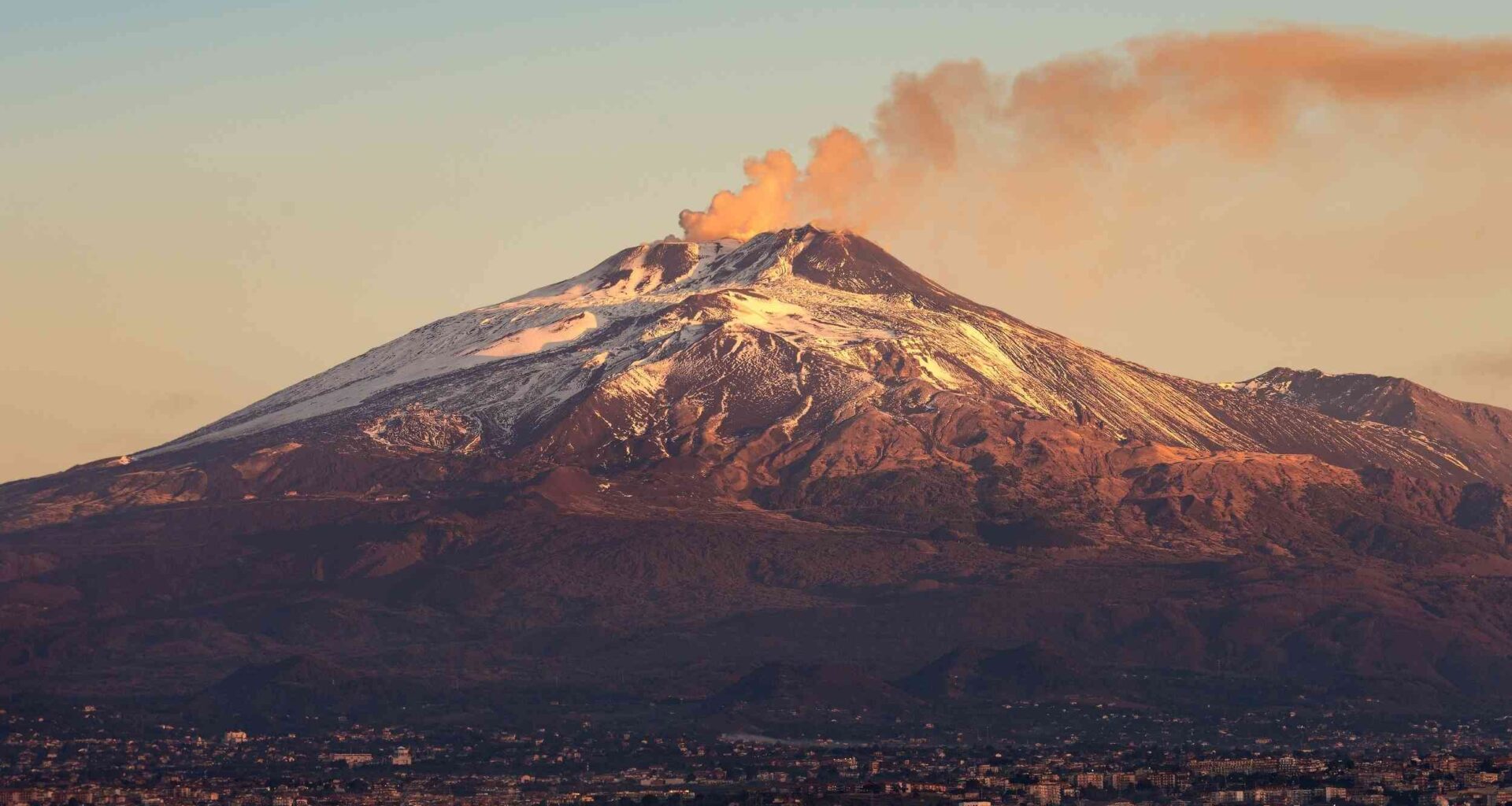
Researchers have found that Mount Etna, a volcano on the Italian island of Sicily, draws magma from a long-lived reservoir about 50 miles (80 kilometers) underground, rather than generating it shortly before each eruption.
That hidden source reframes how one of the world’s most active volcanoes forms and explains why it behaves unlike any known volcanic system.
Clues in lava

Across layers of lava built up over roughly 500,000 years on Mount Etna, the same deep source continues to feed the volcano’s eruptions.
By tracing those deposits, Sebastien Pilet at the University of Lausanne (UNIL) showed that the magma originates from a stable reservoir already present far below the surface.
Even as the volcano expanded into a 9,800-foot stratovolcano, that underlying source remained remarkably consistent over time.
This persistence suggests that Etna’s eruptions depend less on newly generated magma and more on how tectonic forces release what is already stored deep below.
Why Etna stands apart
Most volcanoes fall into three familiar families, but Etna has long refused to sit neatly in any one.
Some grow where plates pull apart, others where one plate sinks, and others over hot plumes such as Hawaii.
Etna stands near a subduction zone, where one tectonic plate dives under another, yet its lava chemistry resembles eruptions far away.
That mismatch is why researchers started asking whether Etna belongs to a fourth volcanic class rather than a strange exception.
A hidden reservoir
About 50 miles (80 kilometers) beneath the volcano, the team places the source in the Low Velocity Zone, a weak layer atop the mantle.
Similar melt-rich layers have turned up beneath other subducting plates in geophysical studies, strengthening the idea that such storage zones are real.
Instead of forming right before an eruption, Etna’s magma may wait deep underground until plate motion helps it escape.
“Etna may have formed through a mechanism similar to the one that generates petit-spot submarine volcanoes,” said Pilet.
Bending frees magma
What frees that deep melt is not a column of rising hot mantle but the bending of Earth’s crust as the African plate pushes beneath the Eurasian plate.
As the slab flexes near Sicily, fractures open and pressure changes, giving stored magma a path toward the surface.
That process resembles petit-spot volcanoes, small eruptions above bending ocean plates, although Etna is vastly larger than those seafloor examples.
The comparison matters because it ties Etna’s growth to crustal stress and plate shape, not only to unusually hot mantle.
How magma evolved
Early in Etna’s history, smaller eruptions gave way to alkaline lava – magma unusually rich in sodium and potassium – that later dominated the volcano.
During a melt-rock reaction, magma chemically changes the surrounding mantle as it rises, and the lava can take on Etna’s earliest chemistry.
Those interactions likely helped carve more porous pathways, so later batches of deeper magma could move upward with less chemical scrambling.
The result fits a volcano that started with modest output and then ramped up without needing a brand-new magma source.
What stayed steady
Across 85 rock samples from East Sicily, the chemistry after Etna’s early phase remained steady for most of its life.
That pattern suggests plate movement mainly controlled how much magma escaped, while the source itself changed very little.
Over roughly 60,000 years, Etna produced about 83 cubic miles (346 cubic kilometers) of alkaline lava without a matching overhaul in composition.
Explaining that combination is hard if each increase came from fresh melting deep below the volcano.
Older Sicilian clues
South of Etna, older lavas from the Hyblean Plateau, a volcanic region in southeastern Sicily, hint that this deep process may have been working earlier.
Those scattered eruptions were much smaller, but their chemistry links them to the same deep store of low-degree melt.
Some of that older magma seems to have stalled, cooled, and altered the surrounding mantle before later eruptions remobilized related material.
Linking both volcanic episodes into one longer story makes Etna look less like an outlier and more like an exposed process.
Risk on Etna slopes
That deeper model could sharpen monitoring on Europe’s most active volcano, a mountain that erupts several times a year near towns.
Since 1986, the summit craters have produced more than 240 paroxysmal episodes, sudden bursts of lava fountaining and ash.
If tectonic stress helps decide when melt escapes, tracking faults and ground movement could become even more important.
Such work would not predict exact eruptions, but it could improve where scientists focus the most urgent warning signs.
Why Etna differs
No known volcano of Etna’s size has been convincingly tied to this mechanism before, which is why the claim stands out.
Earlier examples involved tiny submarine cones only a few hundred feet tall, not a giant cone volcano above sea level.
The case still rests on chemistry, tectonic history, and geophysical clues rather than a direct view of molten pockets 50 miles (80 kilometers) down.
Even with that limit, the model offers a clean answer to why Etna looks ordinary on the surface and odd at depth.
Rethinking volcano systems
Etna now looks like a place where stored, gas-rich melt at the base of a plate can reach the surface at an unusual scale.
If that picture holds, scientists may use Sicily to test how deep melt lubricates plate motion and feeds volcanoes elsewhere.
The study is published in the Journal of Geophysical Research: Solid Earth.
—–
Like what you read? Subscribe to our newsletter for engaging articles, exclusive content, and the latest updates.
Check us out on EarthSnap, a free app brought to you by Eric Ralls and Earth.com.
—–