
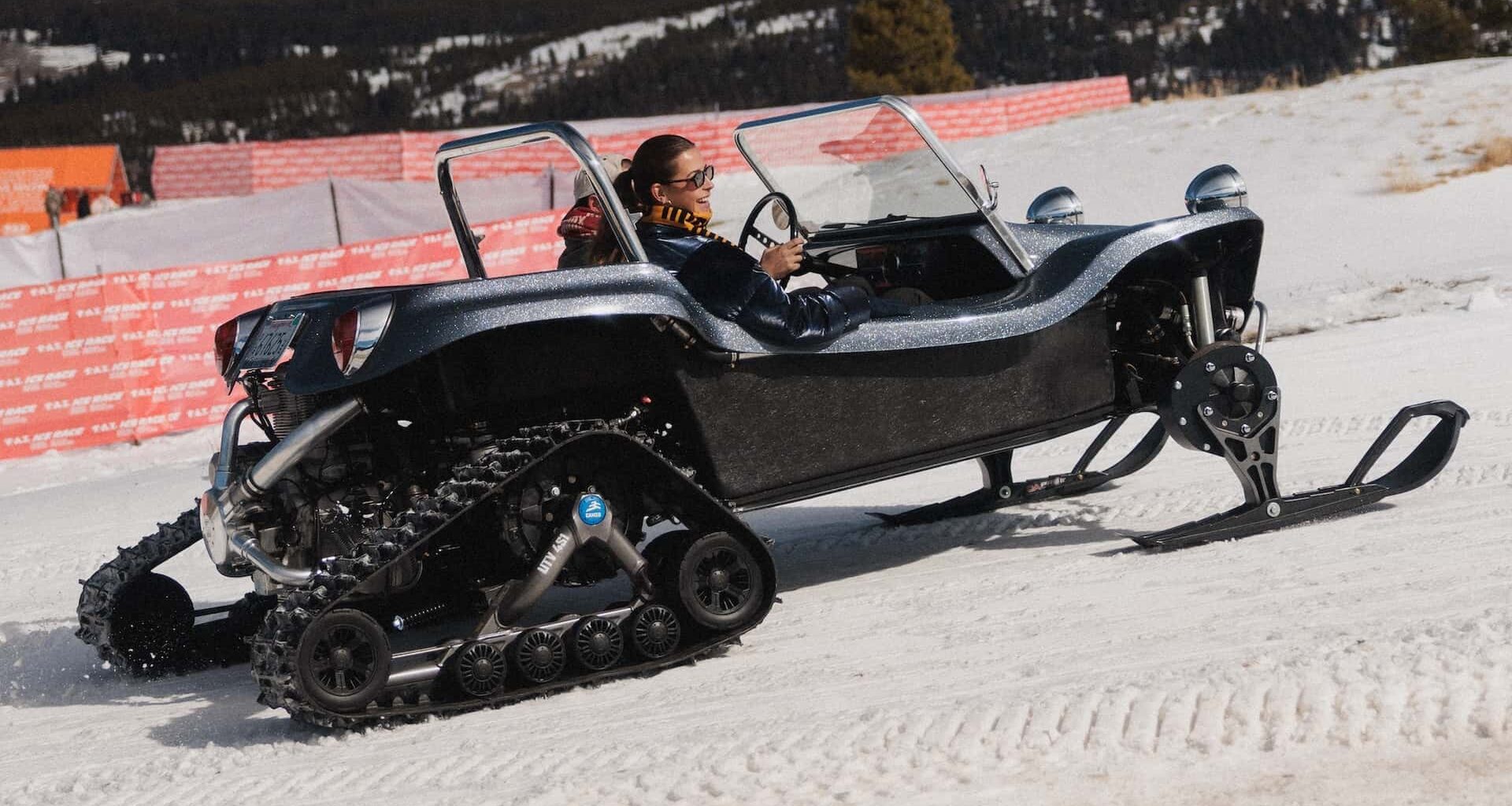
Strolling through the paddock of the FAT Ice Race Big Sky, I couldn’t help but feel like I was in a Forza Horizon garage come to life. A Ferrari 250 GTO and Enzo sit just down the way from a rally-prepped Toyota Corolla and Nissan Patrol. A Ford GT occupies a stall near a Ford Raptor Trophy Truck. A lifted Porsche 944 sitting on 35s rolls onto the track shortly after a Porsche 911 GT3 Cup Car finishes its laps.
At first pass, you’d be forgiven for thinking there was no cohesive theme uniting the vehicles at this event. However, the group of Meyers Manx buggies on hand—including one with treads in the rear and skis up front—makes the through line abundantly clear: just have fun.

Photo by: Hagop Kalaidjian
The Manx Experience
That mantra was certainly at the front of my mind when I got the chance to take one of the brand’s own buggies for a few laps around the frozen course in the shadow of Big Sky Resort.
Powering my Manx was a three-cylinder creation dubbed the Radial Motion from Australia’s Bespoke Motors. Not rotary. Radial. The kind of combustion architecture last seen doing serious work in the nose cones of vintage warbirds, cylinders fanned outward from a central triangular crankcase like spokes on a wheel, each one reinforcing that an offbeat vehicle deserves an equally offbeat engine.
Photos by: Hagop Kalaidjian
Photos by: Hagop Kalaidjian
The radiator is tucked into a widened rear bulkhead just above the engine bay, drawing breath through interior vents via twin electric fans. Dry-sump lubrication keeps oil exactly where physics demands it, while a scavenging pump, manually activated by a smartly applied aviation-style start control, purges pooled oil from the lower cylinder heads just before ignition.
There’s no coughing, no sputtering to life with puffs of blue smoke—just a throaty announcement that the engine is ready to entertain.
A MoTeC electronic control unit manages throttle-by-wire with quiet authority, its readout fed to a multi-page digital display that coexists cleanly with an aviation-inspired analog speedometer / tachometer. Dig deeper into the unexpected configuration, and something wonderfully familiar emerges. The pistons, connecting rods, and overhead valves trace their lineage directly to one of America’s most celebrated engines: GM’s LS series.
There’s no coughing, no sputtering to life with puffs of blue smoke—just a throaty announcement that the engine is ready to entertain.
Married here to custom cylinder jugs—styled with period-correct cooling fins despite being water-cooled—and arranged in an utterly alien configuration, the LS-derived internals point to Manx’s pragmatism. It’s a grounding force in an otherwise gloriously weird setup.
The result is a lively 2.0-liter unit that has character to spare. Yes, power is modest—just 120 horsepower near the 6,500-rpm redline and a crisp 100 pound-feet of torque. But when the vehicle is a fiberglass-bodied two-seat buggy, that’s plenty, as I quickly found out on the course. If one were well and truly addicted to needing more, forced induction will bump the figure up to around 260 hp. While I’d like to know how a boosted Manx drives like just for the hell of it, I honestly can’t imagine it improving the overall experience.
A Different Kind Of Car Show
Unless you’re a well-studied student of late 20th-century motorsport history, chances are you’re unfamiliar with FAT International. What was a European logistics company sponsoring racing teams in the 1980s and 1990s (their claim to fame is an overall victory at the 24 Hours of Le Mans in 1994 with the Dauer 962 LM), is now a brand that puts on events like FAT Ice Race, hosts gatherings at FAT Mankei and is on a mission to democratize access to karting with FAT Karting League.
FAT International also makes highly sought-after and perpetually sold-out apparel. Having now been to two FAT events (the first FAT Ice Race in the US was held in Aspen in 2024), I understand the appeal of wanting to represent the new iteration of the brand. There is a rebellious spirit baked into everything they’re doing, and it registers as wholly authentic when you’re there.
Photo by: Hagop Kalaidjian
The people behind the rebirth of FAT International are passionate about motorsport, but they don’t overlook the ways people are drawn to it beyond the technical and competitive aspects either. The cultural success FAT International has garnered with events like FAT Ice Race is due largely to engaging the casual enthusiast who appreciates design and experiences as much as the cars themselves. FAT International may have a “core” history, but its current appeal is far broader.
Bearing that in mind certainly helps explain how the brand ended up hosting the second stateside iteration of FAT Ice Race at Moonlight Basin in Big Sky, Montana. Trucking in tons of snow to allow for the creation of an ice course in an unseasonably warm and dry winter in the western United States is a massive undertaking. Ask any of the thousands of spectators who came out to watch racing during the two-day event, and they’d surely say they appreciate the commitment. I certainly did.
Cold Track, Hot Start
I’ve only driven a Manx on two occasions before driving the radial-engined Manx on the frozen course at FAT Big Sky. The first was a restored original that involved mostly being stuck in traffic during Monterey Car Week, and the second was for a 30-minute photoshoot in Aspen.
The context is important, because having previous experience with the Manx isn’t at all necessary to make the most of driving it on snow. All you really need is quick hands, the ability to operate a manual transmission, and a basic understanding of weight transfer in a rear-engined vehicle. A “just-go-for-it” attitude also helps when you’ve got an owner in front of you (Matt Farrah) and a decorated professional racing driver behind you (Patrick Long).
Photo by: Hagop Kalaidjian
After a short wait in the queue to enter the course, during which I had a front row seat to watch Lia Block do exhibition laps in the No.199 Bentley SuperSports, it was our turn. Having given the radial engine plenty of time to warm up, I was ready to send it once the track marshall gave me the thumbs up. After watching Matt get on his way in his personal radial-engined Manx, I dumped the clutch and set about finding out how the Manx fares in snow instead of sand.
Anybody who’s driven on snow knows that every input is a negotiation between driver and surface. In a Manx, the intensity is dialed up even more, but then again, so is the reward. It’s quite simple, really—assume you’re going to spin and work backward from there.
It’s quite simple, really—assume you’re going to spin and work backward from there.
The first lap was mostly course reconnaissance, with some degree of getting to know how much angle the Manx would accept before going ‘round. Having found that threshold at the hairpin turn, somehow preventing a full rotation, the next couple of laps were pure joy behind the wheel.
Between the sound of the three-cylinder radial and counter-steering to my heart’s delight, I can’t think of a time I’ve had more fun behind the wheel in my adult life. It’s the closest I’ve come to my dad letting me slide around in empty ski area parking lots. When it comes to maximizing fun on four wheels, there’s no substitute for a loose surface. Combine that with the joy a Manx naturally brings to the party, and that’s a recipe for a permanent ear-to-ear grin.
Sideways Radial Perfection
From the dunes of Baja in the ‘60s to the mountains of Montana in 2026, the Meyers Manx continues to delight just by existing. Even when sitting alongside exotics, priceless vintage models, resto-mods, and race cars, the lithe buggy stands out. You simply can’t not be charmed by the look of these things, and once you’ve driven it, you’ll find yourself thinking about the experience often.
I’ve always maintained that the best vehicles stay on your mind long after you’ve driven them. If you’re able to close your eyes and conjure up feelings of how it puts power down and handles from memory, that’s as good as it gets in my opinion. With that in mind, the low six-figure price tag for a radial engine Manx seems like a deal to me.
Photos by: Hagop Kalaidjian
Photos by: Hagop Kalaidjian
What you have to spend on a performance vehicle to get nearly the same feeling of joy offered by a Manx is ridiculous these days. Knowing that these are small-batch vehicles with a loyal fan base also means there’s a strong argument as to the long-term value, too.
Considering where FAT International is positioned as a brand and what FAT Ice Race is as an event, the Meyers Manx is perfectly suited as a companion to both. I’m glad that the sun was beaming down in Big Sky as I was able to drive wearing a light sweater and without gloves. Still, if it should be a more typical scene next winter with frigid temps and plenty of snow falling, I’d be all too happy to layer up and get back behind the wheel.
Until then, I’ll be thinking about those 1st to 2nd gear shifts with the rear end fishtailing all over the place.
We want your opinion!
What would you like to see on Motor1.com?
– The Motor1.com Team