
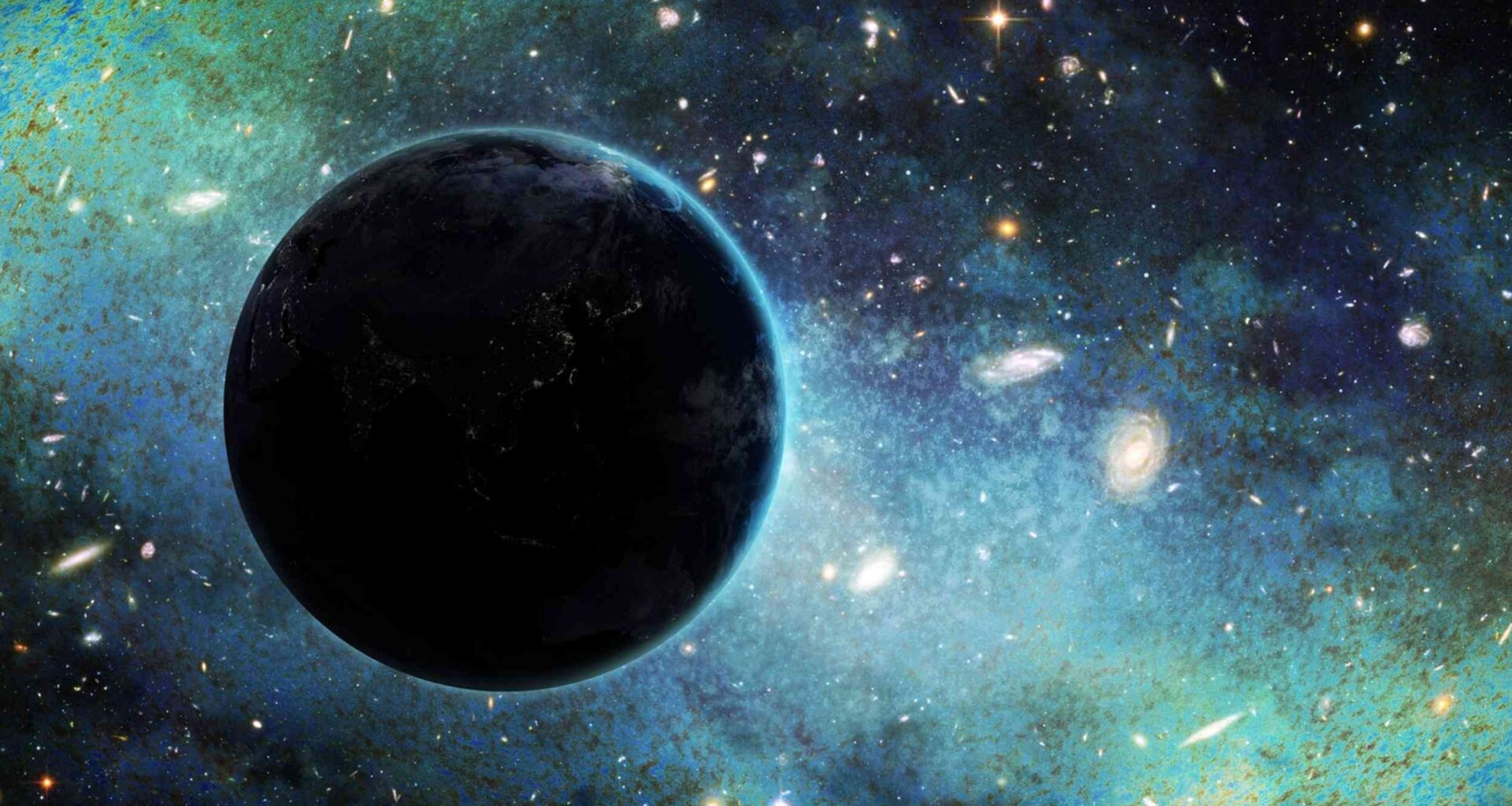
A new analysis has found that gravity follows Newton’s inverse-square law across hundreds of millions of light-years, even when tested using 300,000 galaxies.
That result leaves little room for alternatives that weaken gravity at large distances. It also sharpens the case for unseen mass shaping cosmic motion.
Across cosmic distances

Maps from the Atacama Cosmology Telescope (ACT) and galaxy records capture clusters separated by vast distances where gravity’s reach can be tested directly.
Working with those observations, physicist Patricio A. Gallardo at the University of Pennsylvania linked the motions of distant systems to how strongly gravity pulls across space.
Across separations stretching hundreds of millions of light-years, that pull weakened almost exactly as Newton’s rule predicts, matching expectations even under extreme conditions.
Such close agreement leaves little space for competing explanations and sets up the deeper question of what unseen mass accounts for the excess motion.
Why motions clashed
Far from galactic centers, stars and whole galaxies often move faster than visible matter alone should allow.
Many physicists call the extra pull dark matter – matter that does not emit or absorb light.
“Astrophysics has been plagued by a massive discrepancy in the cosmic ledger,” said Gallardo.
That mismatch became the reason to test gravity directly instead of arguing from missing mass alone.
Light from beginnings
To test the force directly, the team used the cosmic microwave background (CMB), the leftover light from the young universe.
Released about 380,000 years after the Big Bang, that glow has crossed space ever since and still carries ancient information.
When moving clusters sit in its path, the passing radiation picks up a minute change that reveals their motion.
Those tiny changes turned old light into a way to measure how strongly distant structures pull on one another.
Motion in the signal
That disturbance is the kinematic Sunyaev-Zeldovich effect, a tiny mark left when cluster gas scatters background light.
Alongside the telescope maps, a Sloan Digital Sky Survey catalog supplied the galaxy systems whose separations could be compared.
By matching pairs spaced roughly 100 million to 750 million light-years apart, the researchers tracked how the pull faded.
Because acceleration changes speed over time, those pairings turned motion into a direct test of gravity’s reach.
Results support Newton
After all that matching, gravity followed the inverse-square law, weakening with the square of distance.
Instead of fading more slowly, gravity weakened almost exactly at the rate scientists expected.
“It is remarkable that the law of the inverse of the squares, proposed by Newton in the 17th century and then incorporated by Einstein’s theory of general relativity, is still holding its ground in the 21st century,” said Gallardo.
That near miss from the exact value of two was small enough to keep Newton’s old rule firmly in place.
Modified gravity shrinks
One rival idea, Modified Newtonian Dynamics (MOND), tries to explain fast motions by altering gravity itself.
In that picture, the pull should fade more slowly than Newton’s rule predicts when systems get very far apart.
Here, a slower fade would have shown up as a smaller exponent than two, but the measurement stayed near Newton.
That outcome did not kill every variant, yet it left much less room for gravity-only explanations on these scales.
Missing mass remains
Once gravity stayed ordinary, the missing pull had to come from matter that still hides from telescopes.
Dark matter remains the leading answer because extra mass strengthens gravity and keeps fast-moving systems bound together.
“This study strengthens the evidence that the universe contains a component of dark matter,” said Gallardo.
That statement also marks the limit of the result, because the measurement says nothing about what that component is.
Bigger surveys ahead
Better maps and larger galaxy catalogs should let this method test gravity with much finer precision in coming years.
“We used around 300,000 galaxies for this measurement, but the technique should work with samples of 10 million or more,” said Gallardo.
With samples that large, future surveys could rule out a much flatter rule for gravity with far more confidence.
That would turn today’s strong consistency check into a much harsher stress test for any theory that bends gravity.
What still remains
Even so, the result does not reveal the particle behind dark matter or settle every cosmic disagreement.
It asks a narrower question – whether gravity changes across giant separations – and answers that one with unusual clarity.
Future teams can reuse the same approach on richer surveys, different cluster samples, and cleaner maps of ancient light.
For now, the oldest light in the universe says the familiar rule still governs the largest known structures.
Gravity holds for now
Across every section of this result, from old light to cluster motions, the same message keeps appearing: gravity behaves normally.
That leaves cosmologists chasing the harder problems: what dark matter is, how far these tests can sharpen, and whether smaller cracks still wait.
The study is published in Physical Review Letters.
—–
Like what you read? Subscribe to our newsletter for engaging articles, exclusive content, and the latest updates.
Check us out on EarthSnap, a free app brought to you by Eric Ralls and Earth.com.
—–