
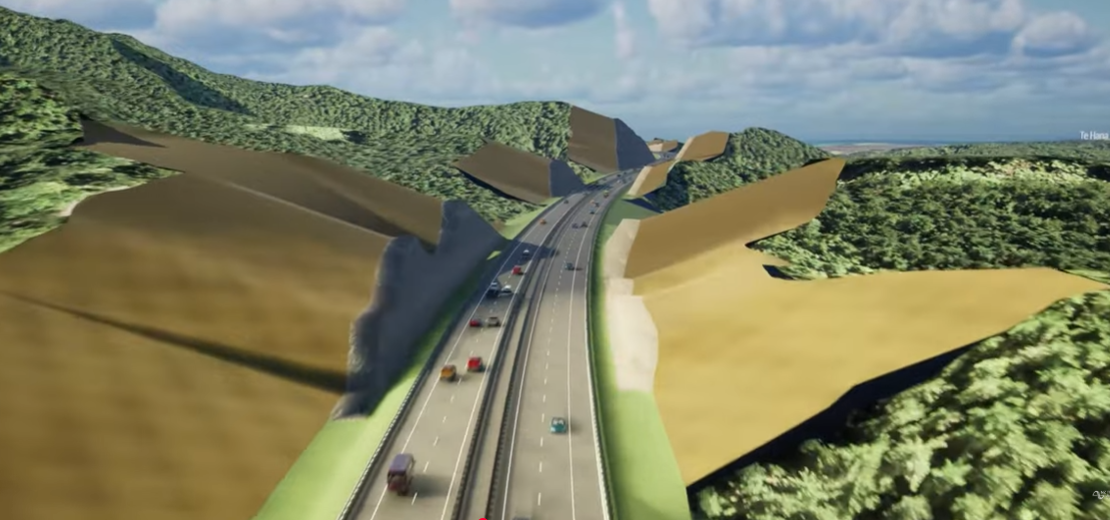
There have been a couple of pieces this week about a few parts of the Northland Motorway that show reality is starting to bubble up – but will it reach the surface in time?
On Monday there was an op-ed in the Northern Advocate, from Whangārei Mayor Ken Couper. It starts out fact- free and a bit hyperbolic about the Warkworth to Te Hana section of the expressway:
The future of connectivity of Northland is tied to one critical piece of infrastructure: a safe, reliable four-lane highway between Warkworth and Te Hana.
…..
There is no question the Warkworth to Te Hana highway is essential. It is Northland’s primary connection to Auckland, supporting access to employment, education, specialist health services, freight movement and our visitor economy.
This is not a discretionary route. I want to acknowledge and thank the Government for its commitment to delivering it. Northland has waited a long time for this investment, and it matters.
To be clear: saving 7-10 minutes (NZTA’s estimation of the travel time savings between Warkworth and Te Hana) is not going to move the needle on Northland’s future.
In fact, spending the potentially $4 billion on a range of safety, resilience and localised capacity upgrades all across Northland is bound to provide much better overall outcomes – especially if you used it to actually address the problematic parts of Northland’s connections, like the Brynderwyns.
But then Couper gets to the heart of the piece, which is about affordability:
What is genuinely eye-watering, however, is the total cost currently being discussed for building the Warkworth to Brynderwyn corridor.
That level of cost demands a constructive review of how major roads are planned, costed, and delivered in New Zealand.
NZ Transport Agency Waka Kotahi (NZTA) has a central role in this. The way business cases are developed, the time it takes projects to move from concept to construction, and the efficiency of delivery all directly influence the final pricetag.
We also need to ask whether we are striking the right balance between safety, resilience and cost. In some cases, there may be opportunities to deliver fit-for-purpose infrastructure more efficiently without compromising outcomes.
Time is money, and delays and inefficiencies inevitably drive up costs for communities and taxpayers alike.
This matters because the cost of building the road flows directly into how it is funded. If tolls are part of the solution, then getting the build cost right is essential.
Affordability matters at both ends. High construction costs place pressure on funding models, and that pressure flows through to tolls that Northland communities may struggle to absorb.
With no realistic alternative routes, tolling here is a necessity, and that reality must be reflected in how it is designed.
It seems reality is finally hitting home, that the whole Auckland-Whāngarei corridor looks set to cost as much as $22 billion.
The investment case shows that the various components of this “Road of National Significance” will be some of the most expensive projects New Zealand has ever built – and will have significant impact on our national infrastructure budget as a whole. Especially in the current situation.
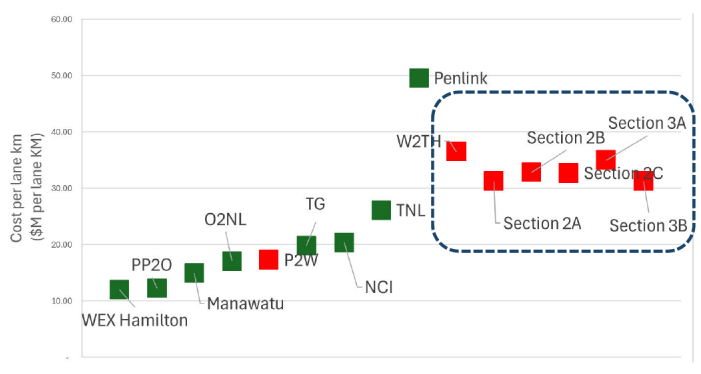
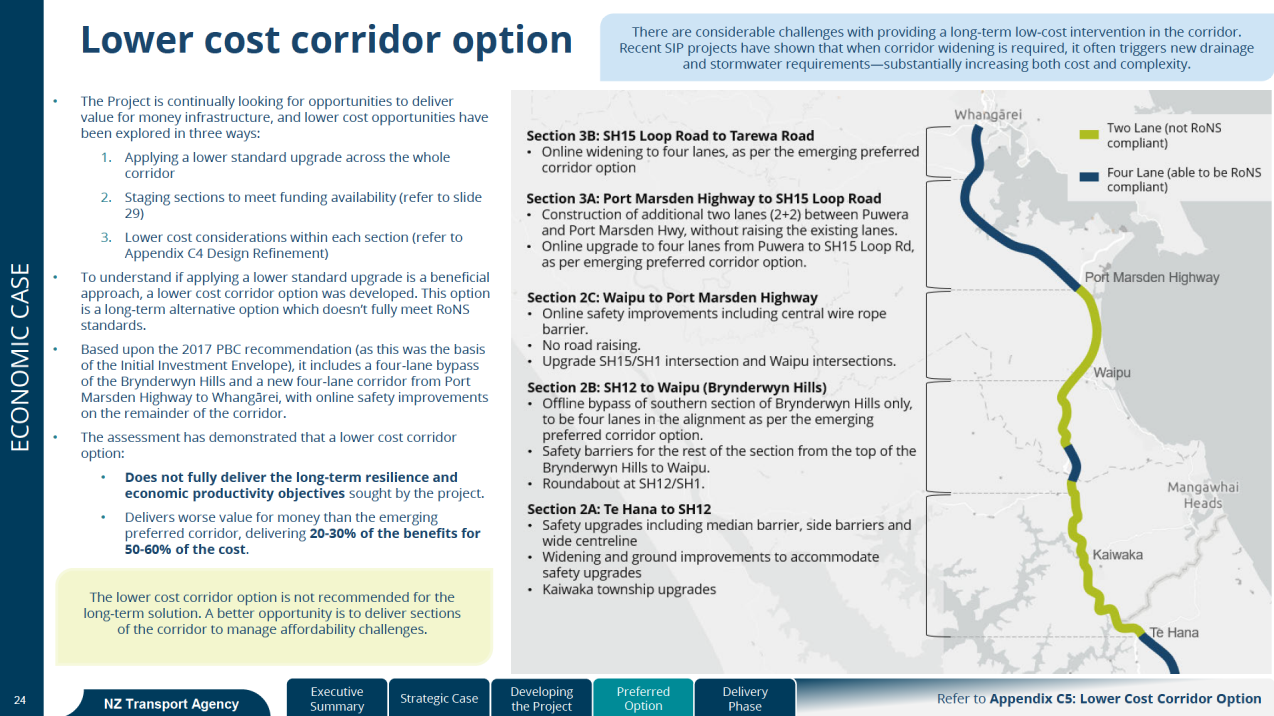
So here’s a question: how much cheaper would it have to be, for a four-lane road to be viable here. I also suspect a large chunk of the cost comes from requiring that this road be built completely off-line – i.e. a whole new road, essentially tripling the driving capacity to Northland.
Why not just upgrade the existing road?
Then, yesterday Business Desk delved into some details of the proposed Public-Private Partnership (PPP) that would pay for the Warkworth to Te Hana section. It includes some of the key issues identified by Connor after OIA-ing the information provided to decision-makers.
The Treasury initially opposed a Crown contribution to the possibly $3 billion Warkworth to Te Hana motorway public-private partnership, which the transport agency was pushing for.
Briefings to Infrastructure Minister Chris Bishop and Finance Minister Nicola Willis obtained under the Official Information Act (OIA) show that Treasury officials argued against a Crown capital contribution because it would “unduly” compromise the risk transfer and incentives that would make a public-private partnership (PPP) a success.
But the Treasury relented once a lack of depth in New Zealand’s debt market was confirmed and a Crown contribution was deemed necessary for the NZ Transport Agency (NZTA) to receive three fully funded bids from private consortia.
…..
Crown to loan to NZTA
Bishop confirmed in March that the Government had committed to a Crown contribution to “bridge the gap in debt market capacity in the procurement of this project”.
A contribution was partly required because “peak debt” requirements for the PPP were “significantly larger in volume, and, with a tenure of 10 years, longer in tenure than any infrastructure financing in the New Zealand market to date”, according to officials in a previously reported Cabinet paper.
A 10-year loan would be provided to NZTA to fund this Crown contribution, the size of which has not been specified. The National Land Transport Fund (NLTF), funded by fuel excise duties and road user charges, among other levies, would be used to repay the loan to the Crown, with interest, over 10 years.
The loan drawdown was expected to occur in 2028/29.
“It’s not that the project is so expensive it needs a capital contribution – it’s that NZ’s debt market does not have capacity for this project three times over (three being the number of bidding consortia) because you can’t have the same debt providers across multiple bidders,” Bishop said at the time.
NZTA pushes for contribution
But a briefing to Bishop and Willis from February 2025 shows that NZTA initially sought Crown contributions for reasons other than a lack of capacity in the debt market.
Although NZTA confirmed that a Crown contribution was not needed to deliver the PPP, in a board-endorsed paper, the agency recommended that a capital contribution – the sum redacted – be paid during the second half of the expected eight-year construction of the road.
“NZTA’s recommendation is based around the benefits of achieving reduced whole-of-life financing costs while retaining significant PPP risk transfer, maintaining a size of project that is appealing to the market, and decreasing the risk transfer to design and construction contractors,” the Treasury briefing read.
A separate Ministry of Transport paper, proactively released, phrased the NZTA board’s interest in a capital contribution as being about “lowering the dependence on more expensive private sector debt”.
What a hot mess. Does this now make it a PPPP – a partial public-private partnership?
Those last two last sentences in particular are quite telling, with agencies acknowledging that this will be a more expensive way to pay for the project.
Why are we saddling ourselves and our kids with having to pay more for something, just because of an ideological commitment to building a particular highway a particular way? Is that responsible management?
Not to mention, this now feels a bit like Dad splashing out on a six figure sports car by taking out a payday loan, while the country as a whole is struggling to afford food and pay rent – and still mopping up from the latest climate disaster. Make it make sense.
Greater Auckland’s work is made possible by generous donations from our readers and fans. If you’d like to support our work you can join our circle of supporters here.
Share this