
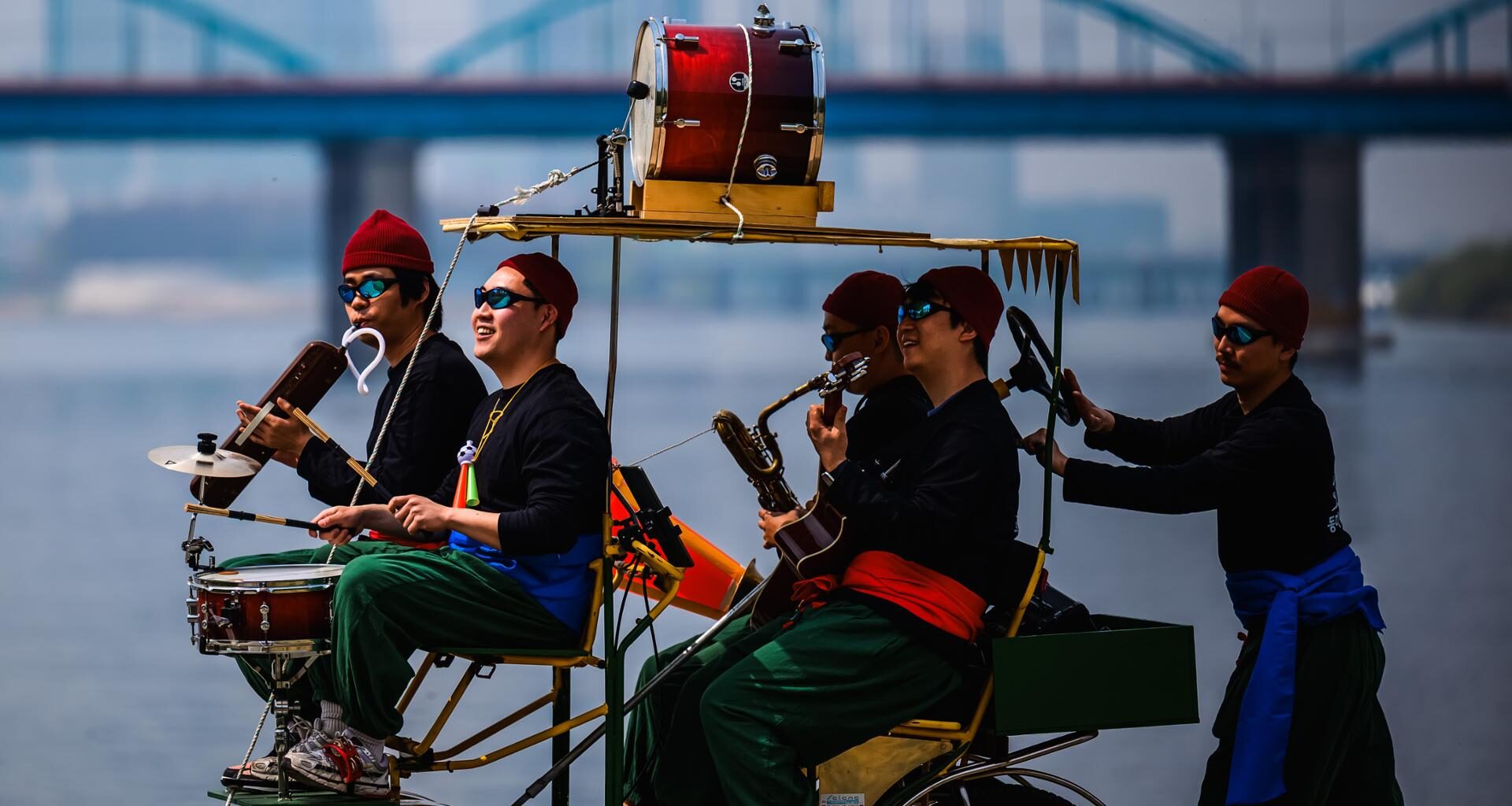
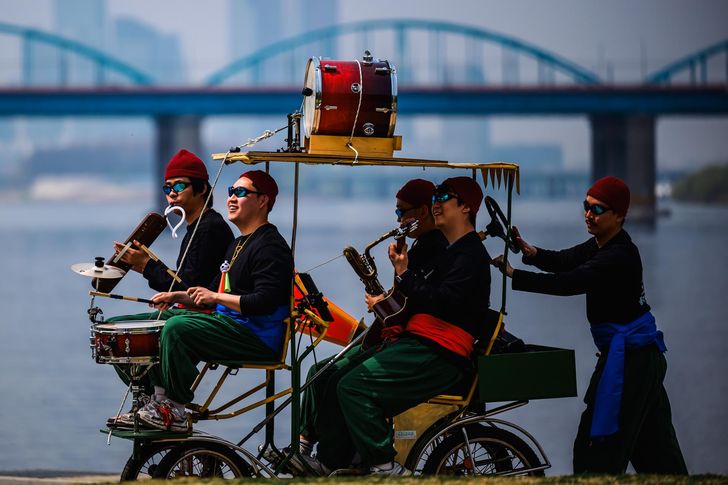
Dongmi Bicycle Club performs at Han River Park in Seoul during an interview with The Korea Times, April 3. Korea Times photo by Choi Won-suk
On a bright spring afternoon at Yeouido Han River Park in Seoul, a strange vehicle glided past: a four-wheeled bicycle stacked with people playing drums, saxophone, guitar and melodica, pushed from behind. All the band members were dressed in red caps and colorful sashes. As the band played a breezy Korean pop ballad from its moving stage, people raised their phones and shouted, “This makes me so happy!” and “They’re so cute!”
The group is Dongmi Bicycle Club, an indie band turning some of Korea’s most familiar songs into a rolling street parade and reinventing what busking looks like in Seoul. Video clips of the band weaving through Seoul’s landmarks and busy markets have gone viral on social media in recent weeks, with fans calling them “the hottest people right now” and begging them to visit their hometowns across the country, from Daegu to Jeju.
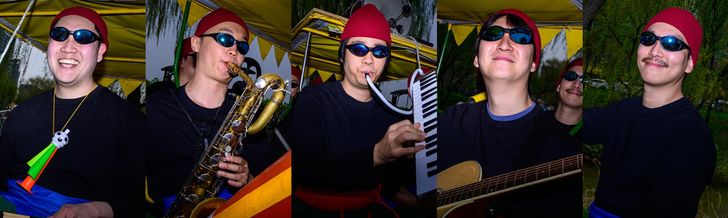
This combined photo shows members of Dongmi Bicycle Club. From left, drummer Lee Sung-min; leader and saxophonist Shin Choi-go-young-jin; melodica player and music director Won Chung-yeon; guitarist Shin Myoung-jun; and videographer Kim Yeon-soo. Korea Times photo by Choi Won-suk
From Jazz trio to rolling parade
Dongmi Bicycle Club started with saxophonist Shin Choi-go-young-jin, drummer Lee Sung-min and melodica player Won Chung-yeon. They met as students at Seoul Music High School in the early 2010s. Joined by guitarist Shin Myoung-jun, they first formed Dongmi Club, an instrumental jazz band.
“Dongmi Club was jazz-based, and we tried to express what we felt through jazz,” Shin said. “But when we performed, communication with the audience felt one-sided. Even if we tried to explain the songs, people couldn’t really understand them.”
The four friends started to wonder if there was a way to bring the music physically closer to people. “We were joking, ‘What if we played on top of a car?” Shin recalled. “Then someone saw a video on Instagram of people performing on a bicycle overseas. We thought, ‘Should we try this?’ and just kept pushing the idea until we finally found the bike (we liked).”-
The band’s name also evolved.
“At first Dongmi didn’t have a deep meaning,” Shin said. “We jokingly said ‘crazy people from the neighborhood,’ or ‘beauty of the East.’ Now we think of it as (the Chinese ideograms) ‘dong’ for ‘moving’ and ‘mi’ for ‘beautiful.’ We ended up on a bicycle, after all — we’re moving and showing a new form of beauty wherever we go.”
Videographer Kim Yeon-soo also joined the band to make videos and promote the group on social media.
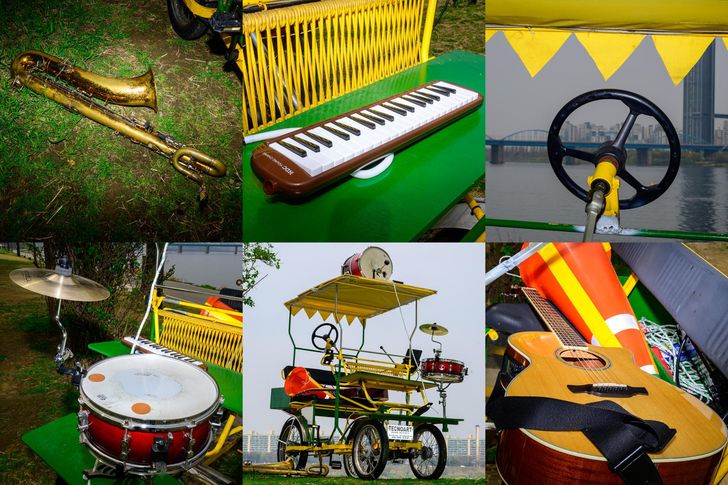
This combined photo shows Dongmi Bicycle Club’s instruments and the Italian-made quadracycle the members use for live street performances. Korea Times photo by Choi Won-suk
Italian-made quadracycle
Getting the kind of bike they wanted was a bit of a struggle. Acquiring a large, flat-bed bike resembling a rickshaw was almost impossible in Korea.
“We called all kinds of places and asked, ‘Can you sell us one?’ They all said they don’t handle that,” guitarist Shin said.
Through word of mouth, they eventually tracked down a rental shop in Gangwon Province and drove out to buy a used Italian-made quadracycle — the fanciest and priciest model on the lot. Back in Seoul, they stripped it down and rebuilt it.
“We bought a truck because of the bike,” Kim said. They still use the truck to transport the bicycle around for concerts.
Their costumes include red caps, black shirts, green pants and blue or red sashes. “We’re preserving the Korean spirit,” Lee said, adding that they drew inspiration from the Korean flag.
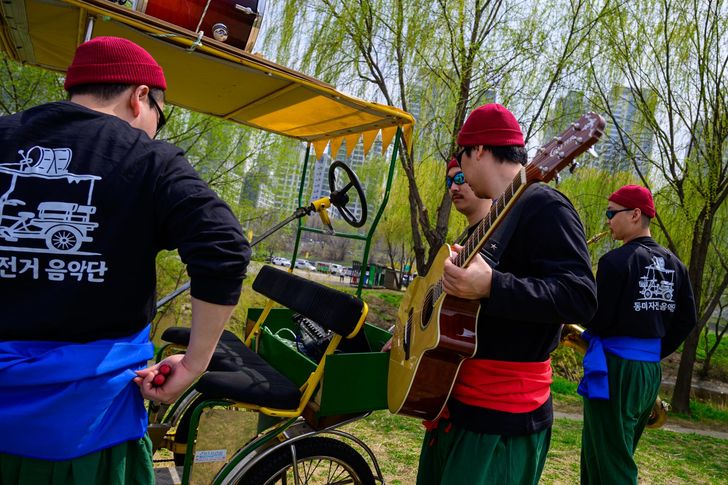
Dongmi Bicycle Club prepares for a performance at Han River Park in Seoul during an interview with The Korea Times, April 3. Korea Times photo by Choi Won-suk
Familiar Korean hits on unfamiliar wheels
Before the band’s official debut, they rehearsed indoors at the practical music academy they run together, but practicing in outdoor spaces quickly proved impossible. “We tried rehearsing while riding at first, but people just crowded around. We attracted attention whether we want it or not,” Lee said.
The band’s official outdoor performance took place at Dongmyo flea market in central Seoul, in November 2024. On weekends, the area is packed with vendors peddling vintage items and clothing, with crowds ranging from teenagers hunting for trendy threads to retirees searching for old records.
“From the moment I agreed to shoot, I knew we had to head to Dongmyo,” Kim said. “To me, it’s the most authentic Korean place, with everyone from teens to people in their 80s all in one place. If we showed ourselves there, I thought we would really know how different generations react.”
What was supposed to be a short performance turned into a roughly 30-minute rolling concert as people followed the bike, cheered and asked questions.
“We couldn’t stop because people liked it so much,” Shin said. When their tire suddenly burst, a group of older men rushed over to help. At a small bike shop nearby, the owner warned them that the Italian-made wheel would take too long to repair, so the band just pumped in more air and decided to keep going.
For Kim, the emotional reaction was so overwhelming that the technical frustrations didn’t matter. “Everyone there was smiling like boys and girls again,” he said. “It reminded me of kids running after fumigation trucks when we were young. Seeing those faces through the camera made me feel proud.”
To make the performances more accessible, Dongmi Bicycle Club built its sets around some of Korea’s most recognizable songs. At Dongmyo, they played “Unconditional (Mujogeon),” a trot hit beloved by older Koreans. At Dongdaemun Design Plaza, they performed You Hee-yeol’s “At the Park”— a mellow, nostalgic pop song associated with lazy afternoons.
In Insa-dong, a neighborhood known for traditional crafts and international tourists, they tackled BTS’ global hit “Butter,” causing an impromptu dance party. At the Yeouido Cherry Blossom Festival, they rolled slowly under a shower of pink blossoms while playing “Cherry Blossom Ending,” a popular song from 2012.
Local celebrity
Online clips of the band have racked up hundreds of thousands of views across Instagram, TikTok and YouTube.
Fans have thrown out playful questions like, “Does the song get faster going downhill?” and “Does it slow down going uphill?” and the band has answered with equally playful videos. In one, they glide down a slope, playing at a comically accelerating tempo. In another, they laboriously cycle up a hill to the caption, “Are you satisfied now? (Please),” as the music starts to slow and finally everyone except Won jumps off the quadracycle.
Kim Sang-jun, a 60-year-old listening during the interview, responded candidly to the band’s musical performance.
“You’re really amazing,” he told them. “Where did you come from? I’ve never seen anything like this before, and seeing you made me so happy. I wish there were more things like this — to be happy without thinking about anything for a while,” he said with a smile. “You’re really great. You’re going to be big.”
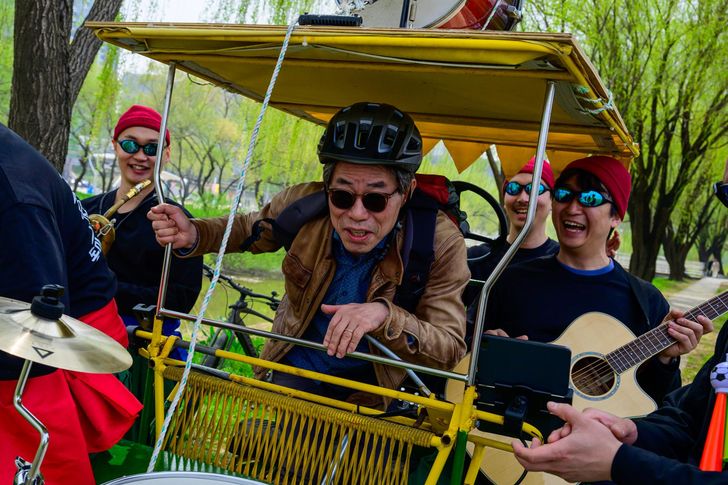
Kim Sang-jun, a 60-year-old passerby, poses with Dongmi Bicycle Club on the band’s quadracycle during an interview with The Korea Times at Han River Park in Seoul, April 3. Korea Times photo by Choi Won-suk
Dreaming of tours through North Korea, China
As they gain more followers, the band is thinking more seriously about what to do with the attention.
Their initial goals were modest: They wanted to earn enough through their music to eat well with friends and do more for their parents. Now, they talk about bringing small moments of joy to isolated groups like older people living alone in mountains or children who rarely see live performances. “We want to leave every place we pass with some happiness and pleasure,” Lee said.
“We want to be a team that spreads beauty as we move. The places we pass through become more beautiful, too — even if we’re still the ‘crazy ones’ from the neighborhood,” guitarist Shin added.
Their future wish list is long and slightly unrealistic, in the best indie-band sense. They want to circle Jeju Island using its famed coastal roads, go on a nationwide tour, roll through an amusement park and after reunification, travel overland through China to North Korea. Kim dreams of performing in an elementary school playground, slowly circling the track until every child runs out from their classrooms to join the parade.
He is also quietly sketching an ambitious vision. “If we ever get the chance, I want to organize a parade with maybe 1,000 people,” he said. “We’d lead at the front and other teams would join behind us, trying to deliver even more happiness as a bigger group. I don’t know if it will be possible, but if we keep going like this, maybe one day.”