
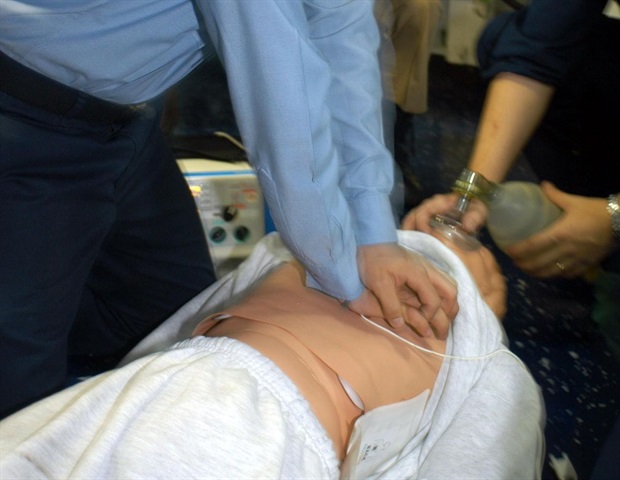
A cutting-edge University of Cincinnati College of Medicine study has shown how emergency medicine researchers can partner with community emergency medical services nationwide to investigate the causes of sudden cardiac arrest.
The study, “Cincinnati Biorepository to Enhance the Acute Resuscitation of Cardiac Arrest Patients (Cincy BEARCATS): A Feasibility and Pilot Study” was recently published in Prehospital Emergency Care, the official journal of the National Association of EMS Physicians.
Sudden cardiac arrest occurs when a person collapses outside of a hospital setting, said lead author Justin Benoit, MD, an associate professor of clinical emergency medicine. Only about 10% survive.
It’s a fast-paced problem. We only have about 30 minutes to try to revive the patient. There’s not even time to get to the hospital. The best thing to do is work on the person at the scene.”
Justin Benoit, MD, associate professor of clinical emergency medicine
Traditional clinical research is not feasible in those moments. So UC researchers began partnering with the Cincinnati Fire Department (CFD) in 2022 for this first-of-its-kind study. Benoit and his collaborators developed kits that allowed CFD paramedics to draw blood from sudden cardiac arrest patients during treatment. After care was completed, the paramedics delivered the samples to University of Cincinnati Medical Center, where they were stored in a biorepository for later analysis.
Researchers collected 18 samples in the pilot study, demonstrating that the approach is feasible on a larger scale.
Benoit said the samples also showed significant variation among patients, with no uniform disease processes, underscoring the need for a larger study.
“It further demonstrated that one size doesn’t fit all,” said Benoit. “We know cardiac arrest has a lot of potential causes. This is not only a disease of the old and frail. We really want to figure out what is going on with these people.”
What’s next
Benoit and his collaborators are now seeking grant funding to expand the study at sites across the United States, including Seattle, Detroit, Minneapolis and Irving, Texas. They intend to collect blood samples from 700 patients.
The long-term goal is to better understand what triggers sudden cardiac arrest and develop a point-of-care diagnostic tool.
“My goal is, 20 years from now, if somebody’s in cardiac arrest when EMS agencies arrive, they’re going to be able to get a little blood sample, run it through a point-of-care machine and it’s going to tell us: ‘The patient is having this kind of cardiac arrest. You need to treat it this way,'” said Benoit. “We’re going to be much more specific about how we treat patients in the future.”
Study collaborators include Jason T. McMullan, MD; Erica M. Fatica, PhD; Heidi J. Sucharew, PhD; Christopher M. Barczak and Robert L. Hug at UC; and James E. Rose at Cincinnati Children’s Hospital.
Treating sudden cardiac arrest
For now, Benoit said an ideal sudden cardiac arrest response involves calling 911, using an automated external defibrillator and performing CPR.
A companion or bystander who knows CPR can make a difference. Lay rescuer CPR can buy time for a person until medics arrive. “You are literally that person’s beating heart,” said Benoit. “When EMS crews arrive, that’s when advanced cardiovascular life support begins.”
One approach uses CPR and defibrillation to treat shockable rhythms such as ventricular fibrillation and pulseless ventricular tachycardia, which prevent effective blood flow.
“That’s actually the better one, because it has a 29% survival rate across the U.S.,” said Benoit. “But it only happens 18% of the time in the U.S. and 17% of the time in Cincinnati.”
The other category includes asystole, or cardiac flatline, and pulseless electrical activity, in which the heart shows electrical activity but does not pump blood, resulting in no pulse. Since both are considered non-shockable rhythms, they are treated with CPR and intravenous epinephrine to stimulate the heart.
Return of spontaneous circulation means the heart is beating on its own again. It signals successful resuscitation, though the patient may remain unstable.
Out-of-hospital or sudden cardiac arrest:
Occurs about 30 times a day in Ohio
Occurs about 300,000 times a year in the U.S.
Has a survival rate of about 10%
Leads to $11.3 billion in economic productivity lost
Source:
Journal reference:
Benoit, J. L., et al. (2026). Cincinnati Biorepository to Enhance the Acute Resuscitation of Cardiac Arrest Patients (Cincy BEARCATS): A Feasibility and Pilot Study. Prehospital Emergency Care. DOI: 10.1080/10903127.2026.2631182. https://www.tandfonline.com/doi/full/10.1080/10903127.2026.2631182