
Deliberately altering the atmosphere to cool the planet is one of the most controversial climate ideas out there.
But a new study suggests that, at least in climate models, one form of geoengineering could help protect the Amazon rainforest from some of the carbon losses expected under severe warming.

The researchers looked at stratospheric aerosol injection, or SAI.
The basic idea is to cool Earth by increasing the reflection of incoming sunlight, essentially trying to mimic the planetary cooling effect that sometimes follows major volcanic eruptions.
Scientists have long worried that doing this might also cut the amount of sunlight reaching plants or shift rainfall in damaging ways. But in this study, the model results pointed in a more complicated direction.
A surprising result
The team used five Earth system models to compare three broad futures: a high-emissions world, a more moderate emissions path, and a high-CO2 world in which stratospheric aerosol injection is used to cool the climate back down toward the temperature level of the moderate scenario.
What they found was surprising even to the researchers. In these simulations, land ecosystems globally stored more carbon under SAI than under either the high-emissions or the mid-range emissions scenario.
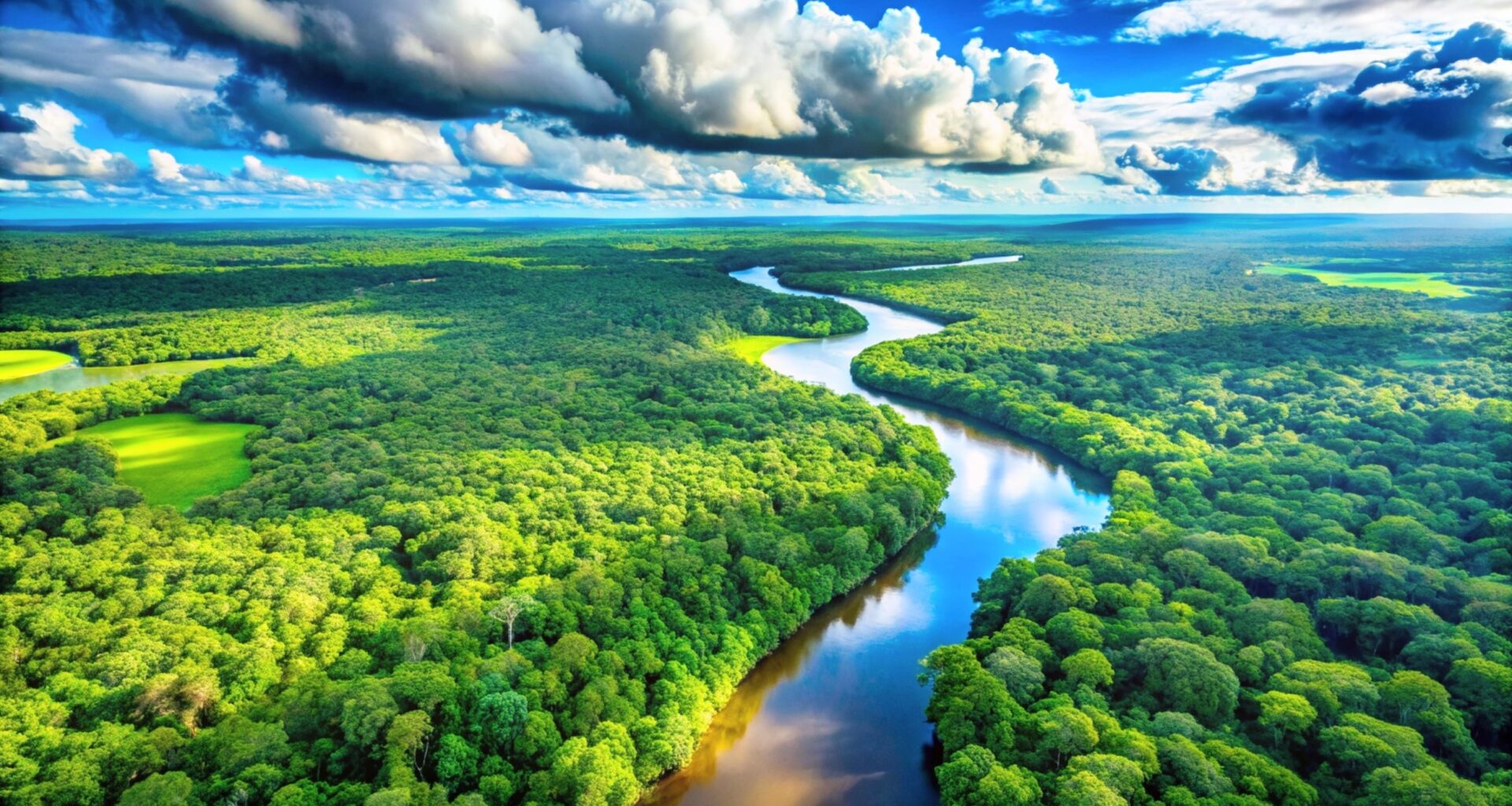
The effect stood out especially strongly in the Amazon. In the models, land carbon storage in Amazonia was 10.8% higher under the high-CO2-plus-SAI scenario than in the high-emissions scenario without geoengineering.
It was also 8.6% higher than in the moderate-emissions scenario, even though that moderate pathway had a similar level of global warming.
“Surprisingly, in these three scenarios, we find that the Amazon rainforest is most productive in the scenario with SAI geoengineering,” said study co-author Peter Cox from the University of Exeter.
Why the Amazon responded this way
In the high-emissions world, heat suppresses forest growth and soil carbon storage. SAI, in the models, takes the edge off that warming.
And because the SAI case still has very high atmospheric CO2, plants also continue to experience the fertilization effect that extra carbon dioxide can have on growth.
In other words, the Amazon in this scenario seems to get some of the growth benefits of high CO2 without taking the full hit from the corresponding warming.
Globally, the model results showed the same general pattern. Compared with the moderate-emissions scenario, the SAI case produced 15.6% higher global net primary productivity and 5.9% higher land carbon storage, largely because of that continued CO2 fertilization.
That does not mean SAI is a magic fix, and the paper does not present it that way. It means that in these particular simulations, cooling the world artificially while CO2 remains high changed the balance for land vegetation in ways that often favored more carbon storage.
Geoengineering beyond the Amazon
The important thing is that the findings are not uniformly positive.
The same paper reports that some regions did worse under SAI, including eastern Africa, parts of the northern high latitudes, and Indonesia, where net primary productivity and land carbon storage declined.
The authors also stress that the apparent benefit seen in the Amazon was not something they found across all tropical forests.
That matters, because it reminds us this is not a clean story where geoengineering helps everything. Even in model space, there are winners and losers, and once you move from models to the real world, the uncertainties only multiply.
The reason that solar geoengineering remains so controversial and leads to political and ethical questions is that any large-scale intervention in Earth’s climate would affect regions differently and could create risks that are very hard to govern fairly.
Just an emergency help
The authors are careful about that too. They do not present SAI as a replacement for cutting emissions or protecting forests on the ground.
Study lead author Isobel Parry said the best long-term protection for the Amazon is still a combination of reduced rates of both deforestation and anthropogenic climate change.
However, Parry agreed that SAI might provide some emergency protection if we fail to get climate change under control.
This is not really a case for relaxing about fossil fuels or assuming technology can rescue ecosystems later.
It is more like a warning that if the world keeps failing to limit warming, then dangerous ideas that once felt unthinkable may start to look less fringe and more like emergency options people will want to understand better.
What the study really challenges
What this paper does most clearly is challenge one common assumption: that geoengineering would automatically hurt plant growth by dimming sunlight and disrupting rainfall.
In these models, that was not the dominant effect. At least for the Amazon, the reduced warming mattered more.
That does not settle the larger geoengineering debate, but it does add something important to it. If SAI is going to remain part of climate discussions, then its possible effects on forests, carbon storage, and vulnerable ecosystems need to be examined openly rather than assumed.
Finally, the research suggests that in a warming world, even deeply controversial climate interventions may have to be studied not because they are ideal, but because the alternatives may be getting worse.
The study is published in the journal Earth System Dynamics.
—–
Like what you read? Subscribe to our newsletter for engaging articles, exclusive content, and the latest updates.
Check us out on EarthSnap, a free app brought to you by Eric Ralls and Earth.com.
—–