
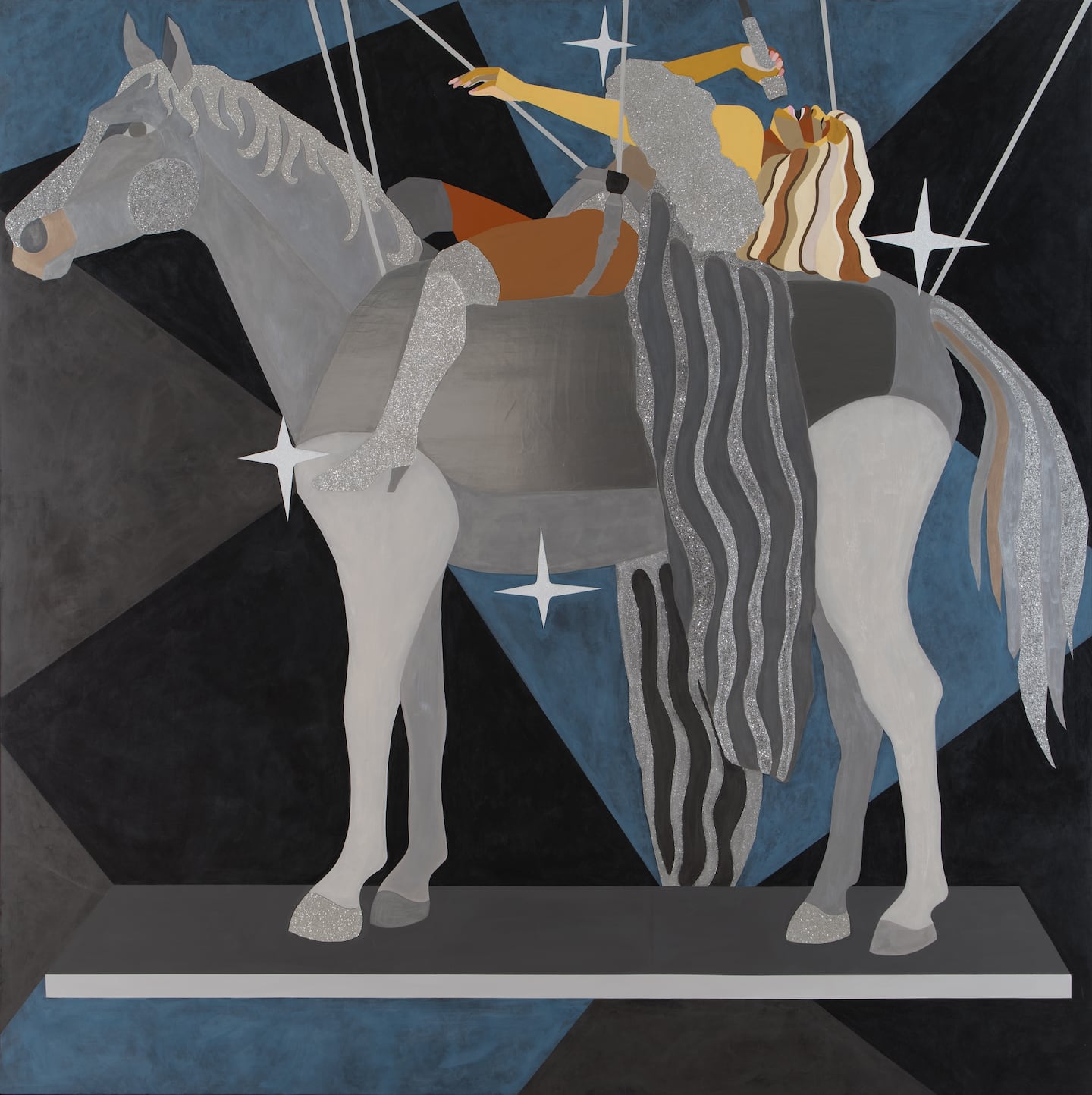
 Derrick Adams, “When the Stars Align,” 2026. Derrick Adams and Gagosian
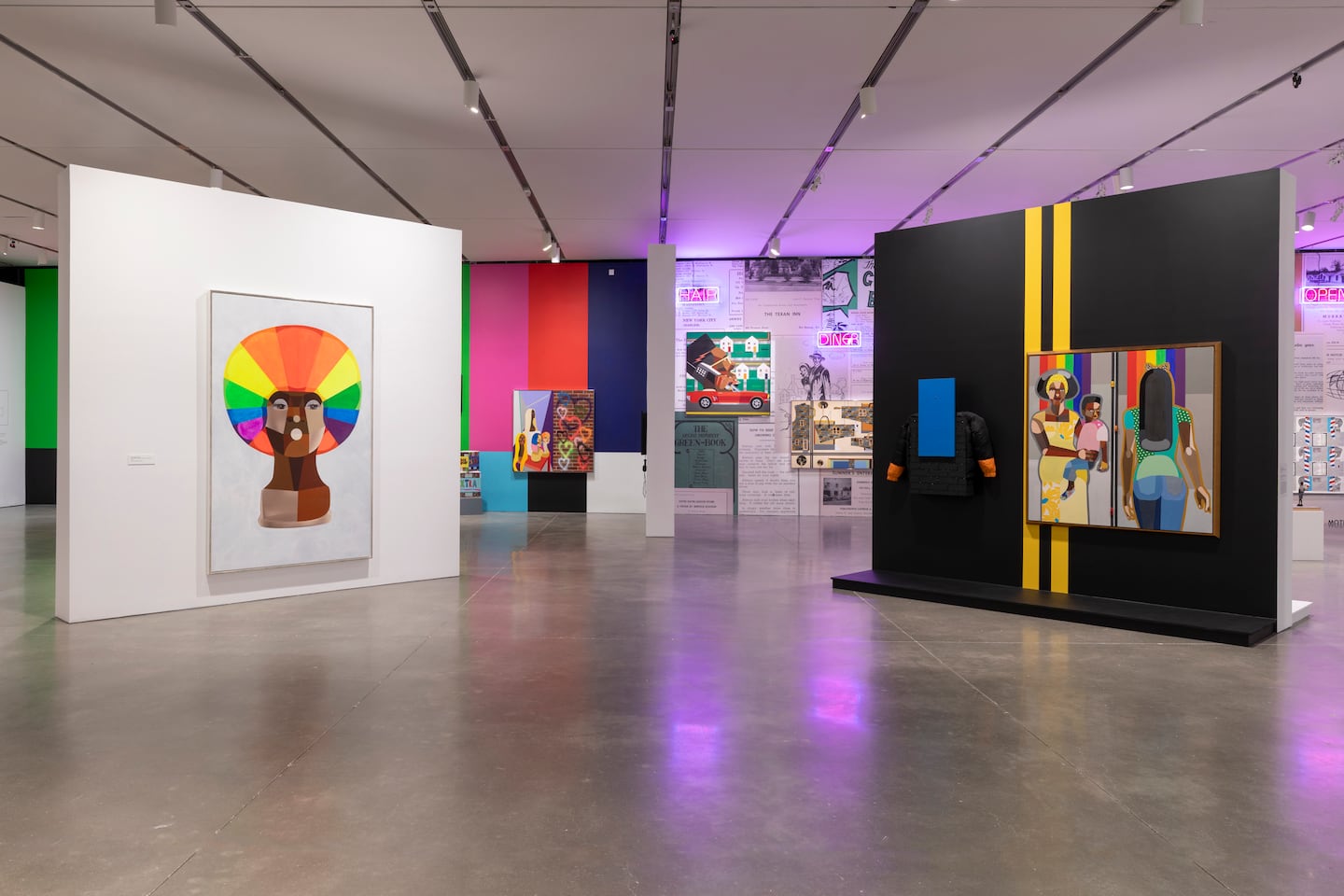
Adams, who grew up in a working-class Black neighborhood in Baltimore, had a front-row seat to joy as a cultural practice. His stepfather, Guy Curtis Davidson, was the drummer for Parliament-Funkadelic, George Clinton’s deliriously unhinged, deeply influential funk orchestra. His first cousins were Russell Simmons, the founder of Def Jam Records, and his brothers Joseph, ‘Run’ of Run-DMC, and Danny, a successful painter. Any one of them would have suggested to a young Adams a world of bright possibility. Together, they might have made a life and career in cultural achievement seem just kind of normal.
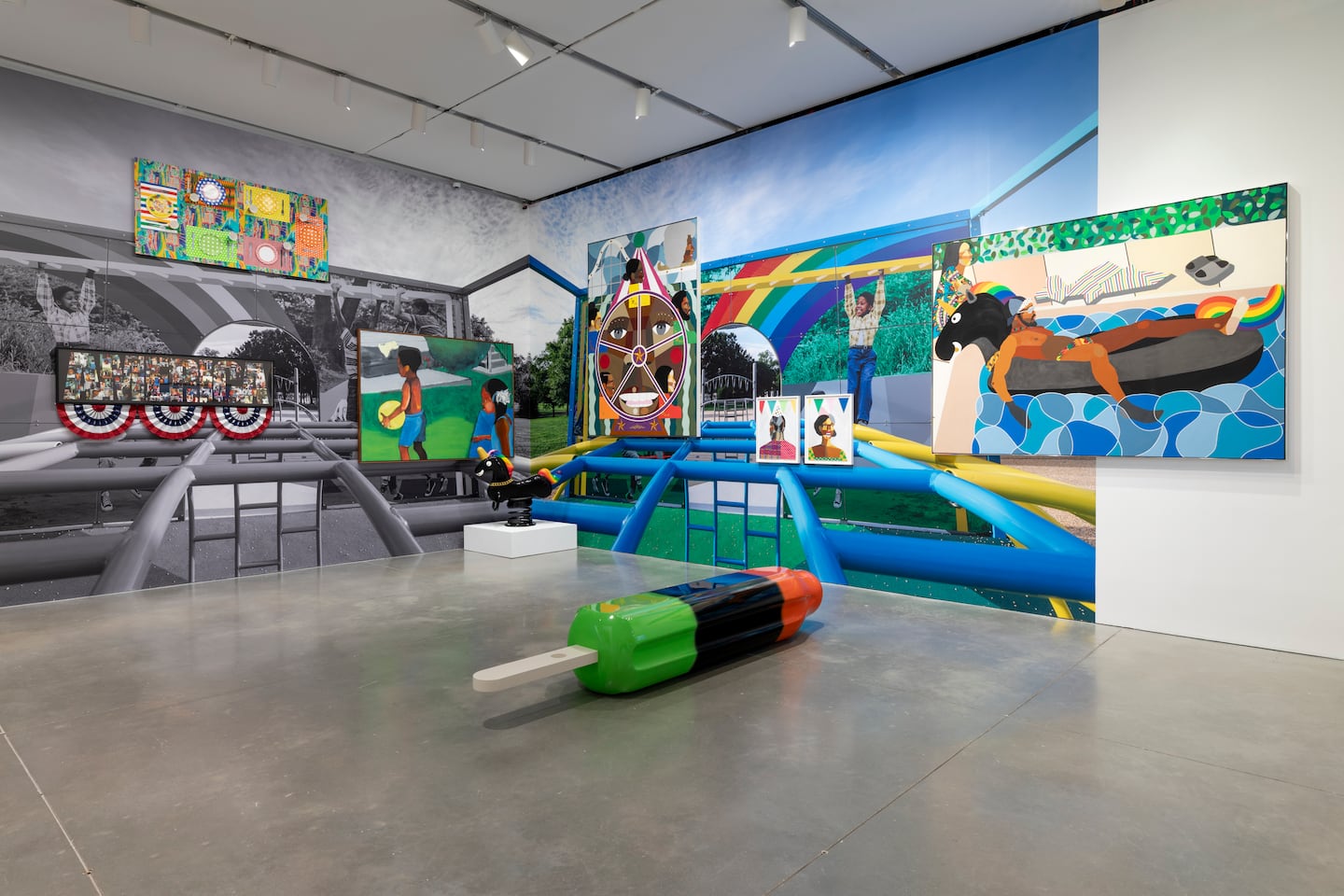
The spectrum of those influences, affirming Black life as worth not only acknowledging but celebrating, feels like groundwork here. You can think of his series, “Floating,” bright expressions of observed leisure, as something elemental to the world he creates. In the series, Black subjects drift in bright blue swimming pools on an array of inflatables, and in evident bliss.
 Installation view, “Derrick Adams: View Master,” at the Institute of Contemporary Art/Boston, 2026.Mel Taing
Taken at face value, such works can fool you into thinking they mean only to capture simple seductive pleasure. “I’ll Be Right Here,” a 2026 entry to the series that hangs here, features a man snoozing on a rainbow-maned blow-up unicorn, a foot dangling in the water. Think, and look, a little more deeply, if you’ll pardon the pun. Much of the history of the depiction of Black subjects has rarely been so blissfully mundane. Adams counterweighs a heavier history of violence and trauma — in movies and on TV, in the broad myths of urban American decay — as an act of defiance: unremarkable leisure as revolution.
To get there, sunny images can’t be simple ones, and Adams acknowledges it literally on the surface. Using a gamut of materials — paint, but also collaged scraps of fabric, wood, caution tape, and in plenty of instances, doll furniture and toy cars — Adams constructs a world cobbled of fragments, never quite convincingly whole. The people in his pictures are knit together in angular patches of color, fractures forced together in unsettling compositions.
The art nerds among us (that’s me) will note a deliberate nod to Cubism, which offered a fractal view of an object from multiple perspectives at once. The point, to say there is no single way of seeing anything that’s authoritative or true, is the relevant kernel here. In looking at the history of portrayals of Black life in America, Adams isn’t fracturing perspective so much as perception, denying a single, stable image of a history written largely not by Black hands.
 “Derrick Adams: View Master” at the ICA. Foreground: “Playthings,” 2002/2018.Murray Whyte/Globe Staff
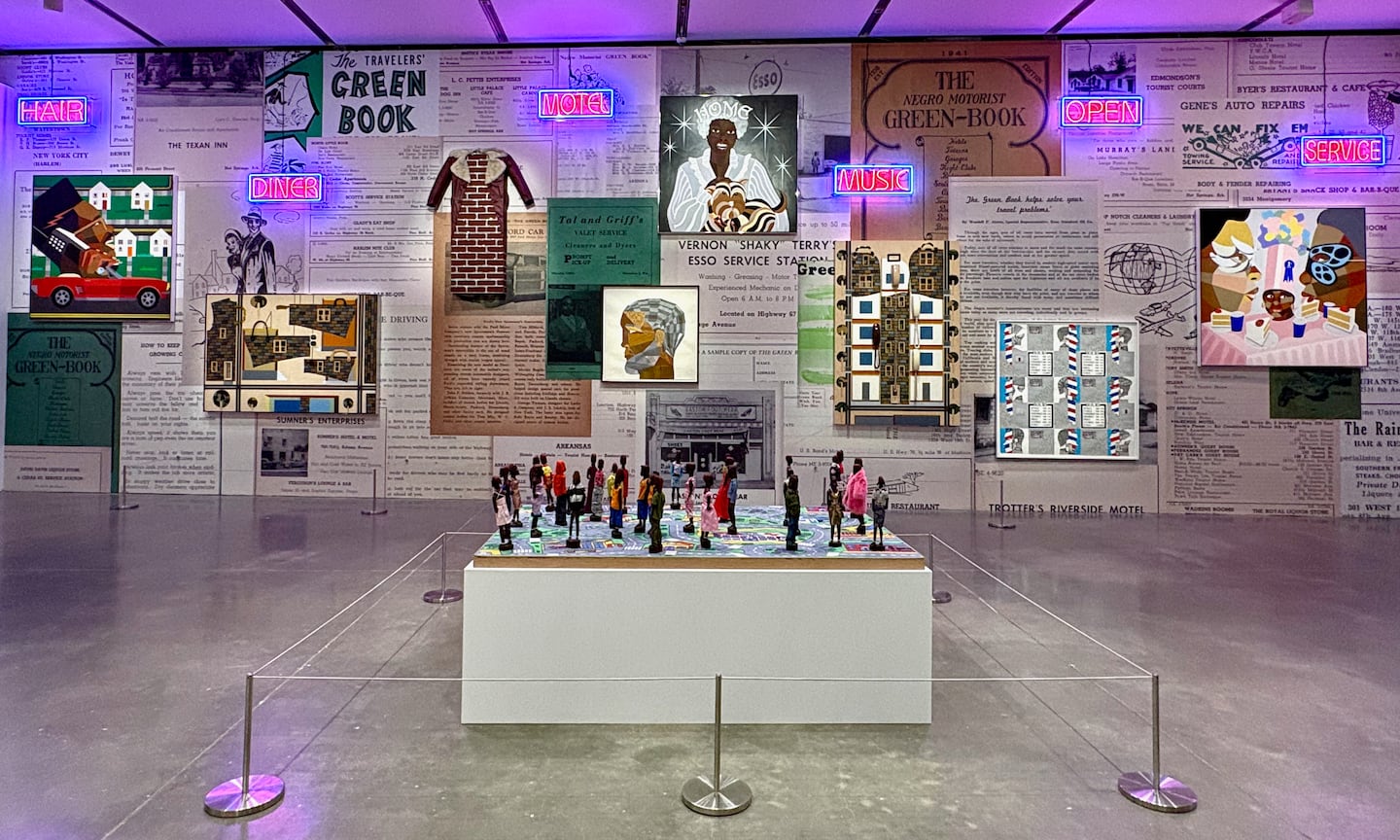
That sounds complicated, I know. Adams, doesn’t demand a deep dive. He wants you to be happy, to drink in the froth of visual joy he serves up. But he also wants you to want to come closer. Single pieces seduce, confuse, amuse, all at once. In “Easy Street,” 2025, an outsize profile of a Black man in Adams’s trademark fragmented style perches on top of a red convertible as he barks into a cellphone while driving past literal cookie-cutter two-dimensional houses: “If you’re listening God, please don’t make it hard.” A 2024 painting of a silver-haired Black woman holding a shaggy purse-size dog, is emblazoned, puzzlingly, with the sparkly text of the word: HOME.
Like almost all of his work, these works are visually inventive and genuinely original. The undercurrent of puzzlement is a cue — to wonder less what he means, and embrace what the work makes you feel. Adams doesn’t give clues so much as contexts. He conceived giant collage wallpapers for the various sections of the show. In this one, the wall is papered with pages of The Negro Motorist Green Book, a pre-civil rights travel guide for Black motorists that listed businesses — restaurants, gas stations, motels — that were safe to stop at in the segregated South. A reprise of a 2018 show he called “Sanctuary,” it resonates here in deep and oblique ways. “Easy Street” is pinned to big blow-ups of the book’s typewritten pages; its cartoony, almost clichéd liberation takes on new meaning, or at least it did for me. A joy ride now in a different era might have been a literal matter of life and death.
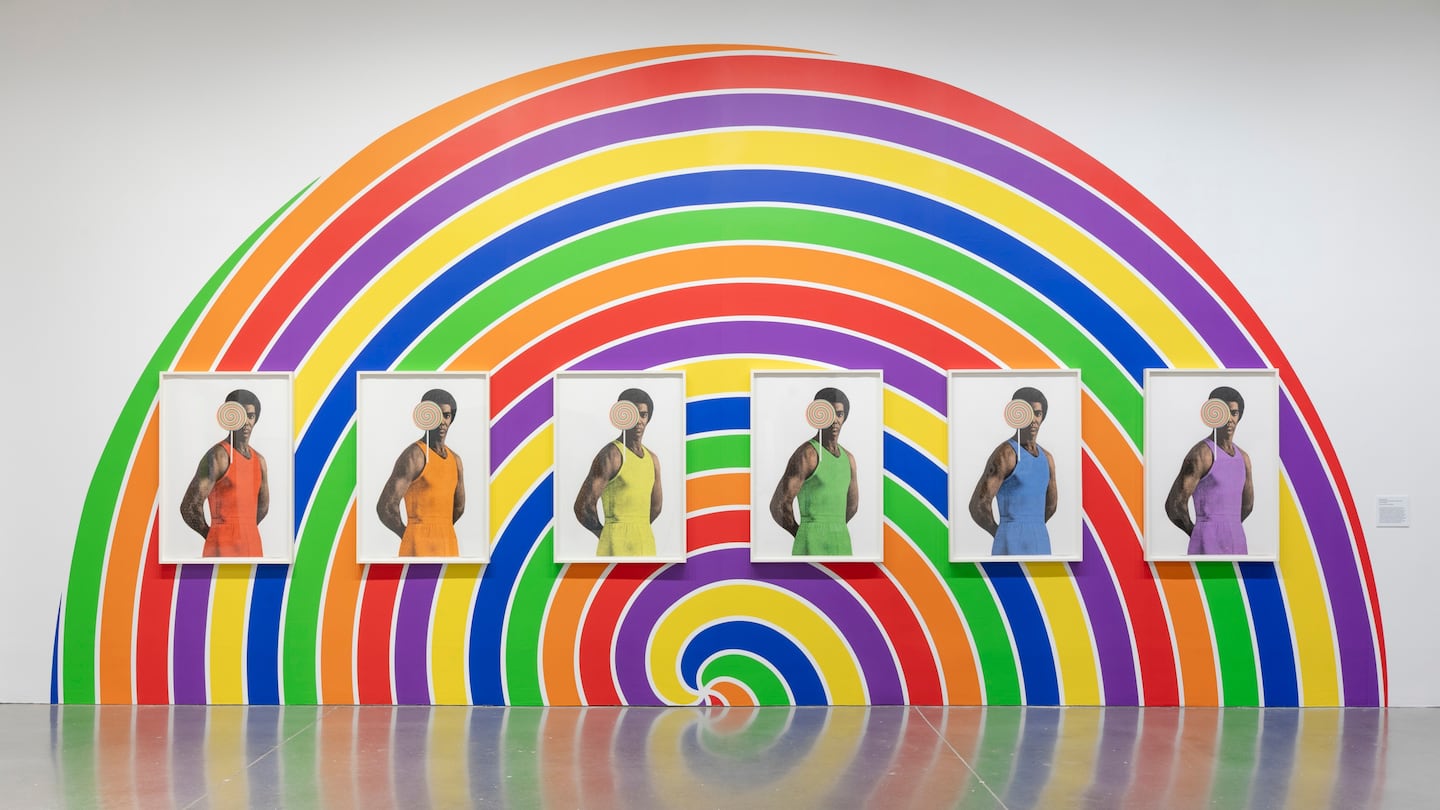 Derrick Adams, “Eye Candy,” 2023. Installation view, “Derrick Adams: View Master,” Institute of Contemporary Art/Boston, 2026. Courtesy the artist and Gagosian. © Derrick Adams.Mel Taing
A sculptural work occupies a tabletop in the middle of the room: “Playthings,” 2002/2018, one of the oldest pieces here, is a congregation of tourist-shop African figurines dressed in Barbie doll clothes. It feels formative. Its absurd humor moves quickly into the realm of critique — about commodity, and a displaced culture’s quest for roots. They’re positioned on an infant’s playmat depicting a street winding through a neighborhood with cutesy versions of a school, hospital, fire station, all set in bright green grass. It says something more, I think, about diaspora, forced migration, and the historic struggle Black Americans have always had to situate themselves in a context they did not choose.
It’s an important touchstone from an earlier time, from when Adams was yet to formalize his approach, and the rawness, the directness, is something to savor. But across the decades, it has close kin here nonetheless. In “Eye Candy,” 2023, the image of an underwear model from a 1970s issue of Ebony magazine is reproduced in a rainbow of color — a reproduced commercial product, from which you could pick your favorite. The echo of Pop Art and its sly embrace of consumer culture is loud and clear, a frequent comparison for Adams’s candy-colored oeuvre. But the piece is powerful in a way unique to it: It’s a reminder of the objectification every one of Adams’s pieces resists — a destabilizing of a simple view, and an insistence on the complexity and fragmentation of the Black American experience. Adams’s work may be about dignity and joy, but in its fractures, the picture is far from complete — like America itself.
DERRICK ADAMS: VIEW MASTER
Through Sept. 7, Institute of Contemporary Art Boston, 25 Harbor Shore Drive. 617-478-3100, icaboston.org
Murray Whyte can be reached at murray.whyte@globe.com. Follow him @TheMurrayWhyte.