
It showed New Zealand’s overall productivity has fallen by about 0.5% every year since 2020.
That means we are investing more in the economy and working harder to produce less.
Imagine spending tens of thousands of dollars to renovate your kitchen and investing extra hours of your time in a cooking class, only to find that it took longer to cook dinner and it tasted worse.
You wouldn’t be happy, would you?
I don’t know how to put it more bluntly than that.
But I do know that, as a topic, New Zealand’s productivity problem doesn’t resonate with a mass audience.
I had to write about it this week without putting the word itself in the headline, because the detailed metrics we get at the Herald make it clear that would be a big turn-off for readers.
Productivity stories just don’t rate. The concept is too abstract. It deals with New Zealand’s economic performance in aggregate.
People respond more readily to stories that relate immediately to them.
That’s why cost-of-living issues and mortgage rates are so popular.
Never mind that our poor productivity is the primary reason the cost of living is so high.
Funnily enough, Prime Minister Christopher Luxon is at his best when he is talking about New Zealand’s productivity challenge.
He understands the problems; he understands the multifaceted nature of the solutions.
He’s trying to address it. If he were unfettered from the handbrake of a coalition, I think he’d be doing a better job.
Unfortunately for him, it’s not the issue that wins elections, even though it should be.
It doesn’t have the urgency or drama to cut through in a news cycle based on personality and conflict.
Meanwhile, there is a large and increasingly frustrated section of the public that quietly understands and cares about this stuff.
Well, if these crucial productivity issues are not hot enough to cut it on the campaign trail, why don’t the two major parties just get together and solve them in advance?
Perhaps New Zealand does need a grand coalition of National and Labour to break out of the political stalemate and inertia that MMP has delivered.
Auckland Mayor Wayne Brown has been making the case in the past few weeks.
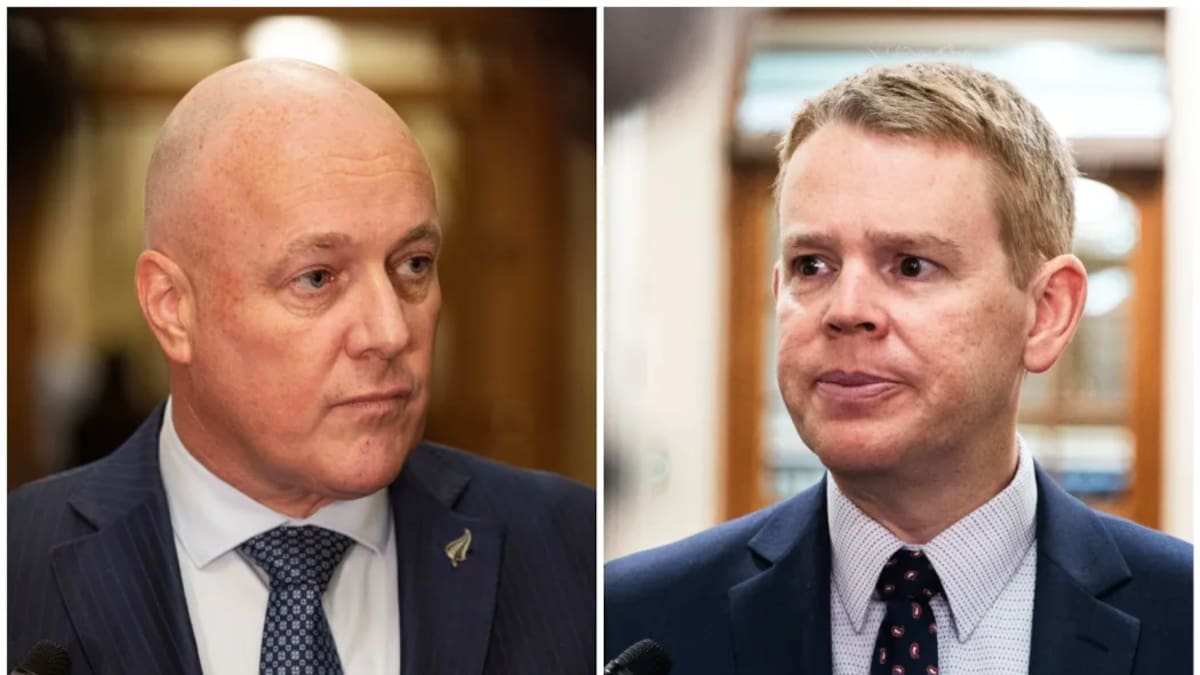
Prime Minister Christopher Luxon (left) may do well to heed a suggestion from Auckland Mayor Wayne Brown, writes Liam Dann. Photo / Michael Craig
I like the idea.
But I suspect the tribal base of both parties means it won’t happen any time soon.
In Germany, where it did happen, it was done to avoid an extremist far-right party being part of the Government.
That’s famously problematic in Germany, so I’m glad the centre-left and centre-right managed to get there.
Let’s hope we don’t ever get that desperate.
But consider the remarkable degree of policy compromise required to form an MMP coalition.
Both major parties manage that, so it does seem ridiculous that they can’t forge more bipartisan policy agreements around the pressing issues about which they broadly agree.
We still have bipartisan agreement about monetary policy and trade.
There was tension around the India free trade deal. But Labour and National talked and made the best decision for New Zealand outside of coalition politics.
So what next? I would argue we need agreement around savings and superannuation.
We need agreement about infrastructure investment and we need agreement about immigration policy.
I couldn’t do any of these topics justice if I dedicated a whole column to each.
But let me summarise quickly.
As I discussed last week, Treasury, the IRD and just about every economist you can find is shouting from the rooftops about the unaffordability of New Zealand’s current retirement scheme, given the ageing population.
The answer is that we need to boost our national savings rate and change the eligibility for the pension.
The two go hand in hand.
I think we more or less have a consensus on lifting KiwiSaver contributions.
But should the Super age rise (as National proposes) or should it be means-tested (as Labour prefers)? Or might a light-handed mix of both make most sense?
I don’t know, but these things are just details.
Get a room and work it out.
When it comes to infrastructure, both major parties accept we have an infrastructure deficit – about $30 billion worth at last count.
Unfortunately, the debate about which projects we fund has been hijacked by those who want to fight culture wars – woke versus anti-woke and all that nonsense.
Big projects are planned at great cost and then dumped on the change of Government.
Really big projects, such as another Auckland harbour crossing, don’t even get that far.
Planners inevitably offer up a range of options, from the cheapest to the most expensive. And, if you like, from most woke and carbon emission-friendly to least.
Then we end up in a stalemate while Act and the Green Party argue over the most extreme options.
The two major parties, representing the mainstream of public views, ought to be able to work out a compromise – a national infrastructure plan that won’t change every three or six years.
They should rank and prioritise the full pipeline of projects that are needed by listening to experts and negotiating before elections.
If we could actually offer long-term certainty to outside investors, we might find it easier and cheaper to get things built.
Finally, we need a bipartisan immigration policy that won’t see net population gains swing between 135,000 and 10,000 as they have done in the past couple of years.
You can’t plan around that.
We need a steady positive flow of quality migrants.
Labour and National agree on that. So what are they arguing about… details?
A net gain of 50,000 a year? I don’t know the number. But it’s not rocket science, it’s something between the two extremes we’ve just experienced.
Let’s take the important structural stuff out of the triennial political circus. There will still be plenty to argue about.
Ideological differences about how we address health, education, poverty and inequality will still be debated intensely.
But wouldn’t it be nice to actually have some money in the economic tank to deal with them?
Liam Dann is business editor-at-large for the New Zealand Herald. He is a senior writer and columnist, and also presents and produces videos and podcasts. He joined the Herald in 2003.
Catch up on the debates that dominated the week by signing up to our Opinion newsletter – a weekly round-up of our best commentary.