
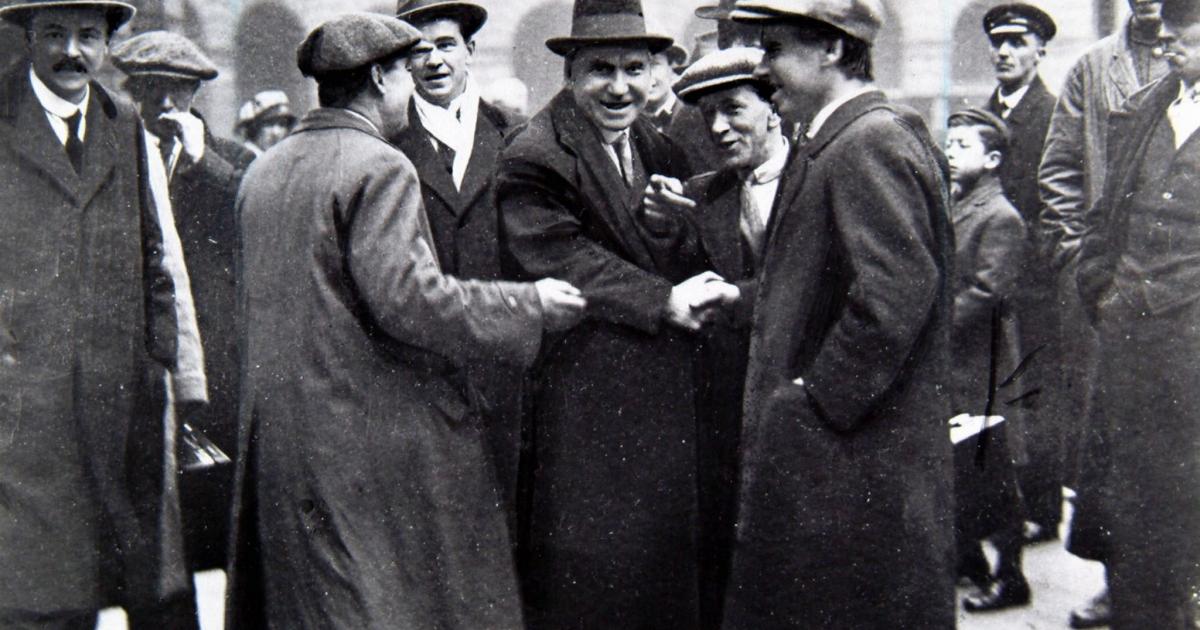
At the event, the campaign will launch the next crowdfunder to raise the rest of the funds required to commission a life-sized, bronze statue of Maclean to be erected at Glasgow’s Saltmarket.
The event, taking place in the Old Burnt Barns, 179 London Road, Glasgow G40 1PA, and starting at 7pm, will be chaired by the author Ron Culley. He will open the meeting, before a number of speakers will address the question “Why a statue of John Maclean?” After the speeches there will be a Q&A session where folk can find out more about Maclean and how the campaign is going. It’s an open meeting – all welcome.
Poster for John McLean event (Image: Supplied)
For the last three weeks I’ve been writing about an exhibition currently running in Shetland Museum in Lerwick, centred on the lives and work of Hugh MacDiarmid, his wife Valda and their son Michael, on the island of Whalsay from 1933-42.
It is perhaps even less well-known that John Maclean visited Shetland in 1907, and I am indebted to Brian Smith of the Shetland Amenity Trust, for reminding me of this. To quote the biography by Maclean’s daughter, Nan Milton: “Maclean spent six weeks of his summer holiday in 1907, for the third year in succession, on a propaganda tour, covering every area in which a branch [of the Social Democratic Federation (SDF)] existed, and doing pioneering work in many others, like Lerwick in the Shetlands.
READ MORE: Inside the must-see exhibition currently running in Shetland
“There he gave evening lectures for a week under the auspices of the Lerwick Working Men’s Association. His subjects, as advertised in the local newspaper, were: ‘The Inevitability of Socialism’, The Basic Principles of Socialism’, Socialists and Education’, Socialism and the Trusts’, ‘The Class Struggle’, and ‘Socialism and Morality’.”
The following paragraph was quoted by Milton as a tribute paid by one of his audience at that time, as told to Peter Jamieson in Lerwick in 1948: “Maclean was an outstanding personality. I have pleasant memories of he and I strolling out the North Road, he with [a copy of Marx’s] Capital firmly held under his arm, listening eagerly while I tried to demonstrate some of the enormities of landlordism and the iniquities of ‘fishing tenures’ in Shetland.
“He was most attentive and the tenderness of his heart was outstandingly apparent when there was mention of oppression and hardship.”
Milton comments: “The concrete results of his summer tours were new branches and new members for the established ones. Thus before leaving Shetland that year a new branch had been formed in Lerwick.”
Despite the numerous lectures and talks and the sheer energy he must have spent travelling and addressing the meetings, Maclean’s writing is quite limited, although the collection In The Rapids Of Revolution: Essays, Articles And Letters 1902-23, edited by Nan Milton (London: Alison & Busby, 1978) is an essential book for anyone interested seriously in Scotland’s social history and possible futures.
Milton explains that the reason why there’s a relative scarcity of his writing was due to the fact that Maclean was first and foremost concerned with education. “The Scottish working class was poorly educated. After leaving school, very few read anything but newspapers, although all respectable households contained at least two books – the Bible and the poems of Robbie Burns. Maclean’s educational work had to be done orally, and he never at any time wrote more than a short pamphlet.”
In 2026, with almost all Scotland’s public media opposing independence and suppressing any genuine discussion of its virtues and liabilities, the priority of education enacted by Maclean seems to me exemplary, and more urgently in need of recognition than ever.
On April 26, 1913, in the SDF journal Justice (I owe this information to Brian Smith), the columnist “Gael” (Maclean), discussing the need for SDF publications, noted that “Shetland alone could keep a daily going” – high praise, recognition of the significant radical component in Shetland and a register of the fact that he was still thinking about his comrades in the northern archipelago more than half a decade later.
And this returns us to the exhibition – Outwith: Valda, MacDiarmid and Whalsay – at the Shetland Museum. And it prompts me to consider MacDiarmid’s involvement with the local people and how the economy of Shetland enters his poetry.
In 1939, MacDiarmid gave practical help to a group of Whalsay cottars, opposing the County Assessor’s raising of rates. At their request, MacDiarmid argued forcefully for them, in meetings and in letters, pointing out that they shouldn’t be charged any rates, as they had no public amenities at all.
The assessor, Thomas Johnston, wrote to the laird, William Bruce, MacDiarmid’s erstwhile bridge partner in Symbister House, who agreed that the poet was “an infernal nuisance. He is being well watched here I can tell you, and will be reported if there is any sedition.”
MacDiarmid secured a Sir Alexander MacEwan to act as the cottars’ legal representative but it was impossible, in the event, for him to get to Shetland in time to do so.
When the appeals were dismissed, the assessor wrote a letter to the Lerwick paper to justify himself. MacDiarmid replied, noting of Johnston and the “reactionary council” who supported him: “I repudiate all the ‘conventional lies’ which are used to dignify Mr Johnston’s business – and mask his personal responsibility for what he does. I am simply and solely concerned with the ultimate fact that on no matter what specious pretexts in the home country of the wealthiest empire in the world, and at a time when national service is being appealed for on all hands or made compulsory, the administrative system finds it necessary to ‘put the screw’ on the poorest of the poor and wring a few more shillings out of people below the subsistence level. That is what it all boils down to, and I have no hesitation in stigmatising it as a shameful and intolerable state of affairs and condemning lock, stock and barrel the system under which it takes place and the officials who work that system.”
In his autobiography Lucky Poet, MacDiarmid pictures himself in his croft, “a nice commodious four-roomed cottage standing on a hillside and looking out over a tangled pattern of complicated tideways, voes, and islands with snaggled coasts to the North Shetland mainland and the Atlantic”.
The human scale is suggested again when says, 400 pages later, “These are the thoughts with which I sit by my Shetland window completing the writing of this book …”
So when we consider the matters of MacDiarmid’s daily life, domestic work, local conditions, contexts of social inequality and political injustice, and see them measured in his imagination and literary work, there is no discrepancy between the daily work, the material facts, storms, opposition and darkness, and the love of islands, the returning tides, the value of the lives of the people around him and what his best art might deliver, long-term.
What mattered for MacDiarmid is not what the artist has to teach in any condescending way but rather what the artist has to learn from the lives of the people he lives among, forms of attention, acquiring knowledge, forming articulation and taking action.
READ MORE: A real hub of creativity is found in Shetland Museum’s Outwith exhibition
In the last chapter of Lucky Poet, he describes a ship’s captain on the bridge in a storm, the waves crashing over him: “Being covered and lost under water meant nothing to him. But the blow of the water – that was something! The deck had been boarded by a moving mountain – ‘He’ll be drowned!’ – ‘No more than a fish!’ – The mountain had slid off.”
The same thing is there in the poetry, magnified and even more sharply focused, as in The Wreck of the Swan:
No dreamers these but hard-bitten men
Used to all the tortures of
Old Feathery legs –
The black villain who rides every crested wave
North of 65 degrees – he and his accursed legions,
The fog, the blizzard, the black-squall and the hurricane.
Up to their waists in water on the foredeck,
And sweeping all hands in a heap on the lee-scuppers,
Their arms and hands clawing up through the boiling surf
Still grasping wriggling fish and gutting knives.
The poem has its documentary imperative: “Time the public knew what these men have to face.” There were at that time, MacDiarmid tells us, nearly 100,000 of them at sea, and if you consider the fishing industry to include shipbuilders, rope, net and box manufacturers, fish friers, buyers, retailers, salesmen, railways and road transport, coal, salt and ice industries, you might say that around three million folk depended on the trawlermen for a living. Again, the specific working economics connect to literary perception and social vision. Making these connections allowed MacDiarmid access to the world beyond Shetland in precisely this way.
Towards the end of the volume Stony Limits (1935) comes the poem Lament for the Great Music, which takes us from Shetland south and west to mainland Scotland, out from the pre-eminently Norse influences and into the Gaelic and Celtic worlds of Scotland, connecting them deliberately, beginning to encompass and envision a plural nationality, and to go beyond that by connecting all this, in the opening lines of the poem, with the archipelago of ancient Greece.
AS Greece once was, so Scotland’s archipelagos and Highlands are now, a singular “fold of value in the world”. This is the meaning of the questions that open the poem Scotland Small?, which we quoted a fortnight ago: “Our multiform, infinite Scotland, small?”
The multiplicity of meanings and identities uncovered in this poem, of flowers and insect life, are tied to the specific post-Clearances history of the landscape in view, with its peat-hags “not worked / Within living memory” (because the crofters have gone) and where “the little Blackface sheep” that have replaced them, are found grazing. The result is a poem that famously evokes the intrinsic potential of Scotland yet also connects that unsentimentally to its specific history.
MacDiarmid was the first poet of the last century to work like this, so comprehensively and deeply, the process extending from Shetland to the western archipelagos of Scotland. In September 1937, he made an extensive tour of the Western Isles.
His letters allow us to track his journey through the Hebrides, visiting Skye, Raasay, South Uist, Canna, Eigg, Barra, and Tobermory on Mull, and so on.
In 1939, he published The Islands Of Scotland, the first book of its kind to shift the focus decisively away from the Hebrides. Up till then, they were the islands romanticised to the point of cliche and associated most in the popular imagination with the nostalgic and ill-fated destiny of Bonnie Prince Charlie and related legends.
In the book, MacDiarmid devotes 50 pages to Shetland, 20 to Orkney and 25 to all the Hebrides – vastly disproportionate, you might argue, but also perhaps a necessary counterbalance, emphasising contemporary living conditions as well as lasting qualities of social life and spiritual identity to be found nowhere else in the world.
This is anti-romantic, in one sense, but realism is not the book’s only strength.
READ MORE: How can we neglect one of Scotland’s most prominent sons?
The major result of MacDiarmid’s multi-faceted understanding of Scotland’s plural identity was his editing The Golden Treasury of Scottish Poetry, published in 1940. In this, poems in English and Scots appear alongside translations from Latin and Gaelic, the latter made with the help of Sorley MacLean.
They included major poems by Duncan Ban MacIntyre and Alasdair mac Mhaighstir Alasdair. MacDiarmid was introduced to MacLean on a visit to Edinburgh in 1934, and the Gaelic poet visited him on Whalsay in 1935, before going to war in North Africa. MacDiarmid tells us that his own poem, In Talk with Duncan Ban MacIntyre, was written after making the translation of Praise of Ben Dorain, which dates it to 1939.
He praises Duncan Ban by saying that only in his poetry can we feel we stand in the woods by a river as three hinds and a stag approach, rise on their hind legs and browse on the twigs above us, close enough to touch as their breath comes into our faces. Then he continues: We have the feeling of having reached that state All watchers of animals desire Of having dispensed with our physical presence.
Or is that it? Is not really the bottom of our desire Not to be ignored but to be accepted?
MacDiarmid’s entire understanding of identity had been fashioned anew from his experience of the archipelagos of Shetland, then Orkney and the Western Isles, and then as this applied to Scotland as a whole, and beyond that to all the world, through all time.
In the same years as he was working on The Golden Treasury, he was putting together the passages that would ultimately form what he hoped would be the biggest poem in history, comprehensive yet open.
He sent the typescript of an early version of what was to become In Memoriam James Joyce to TS Eliot in 1938, from Shetland, when he was 46 years old, though it was not to be published till 1955, when MacDiarmid was 63, and he had been working on it right up to its publication.
Parts of The Kind of Poetry I Want appeared in Lucky Poet in 1943, the book of that title in 1963, and further passages have appeared since, but all of this magnum opus, what he called “a vision of world language” (not a single language for all people but a multiplicity of forms of expression changing through time across all nations and localities), had begun to come together in Shetland.