
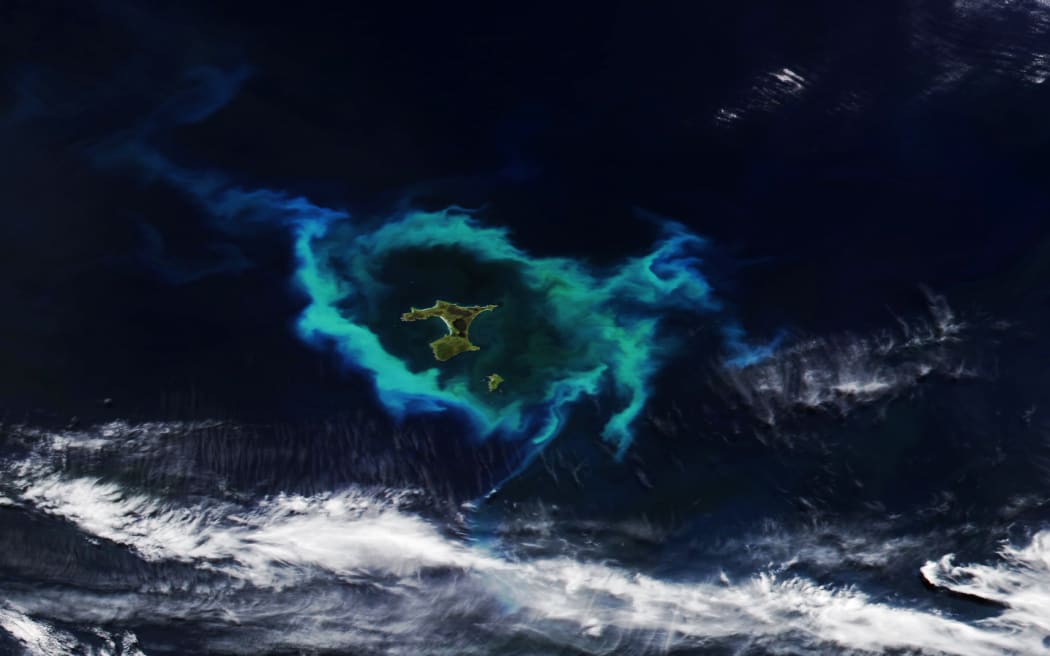
A photo of a glowing ring of phytoplankton surrounding Chatham Island taken from space.
Photo: NASA
The government has handed out millions, and is now asking questions over how the Chathams can help itself get out of the dire financial shortfall it’s in.
A year ago, regional development minister Shane Jones took a Hercules full of media, business experts and a brass band to the remote Chatham Islands.
He wanted to see for himself how its problems could be addressed, including a replacement for the islands’ unreliable, 40-year-old lifeline of a ship, the Southern Tiare.
Since then, a lot has happened.
Last Friday the minister announced loans for regional airlines including $17.2 million for Air Chathams from the Regional Infrastructure Fund, saying the money would manage debt, help maintain fleets and continue operating important routes. (As well as flying to the Chatham and Pitt Islands, the airline connects to Auckland, Whakatāne, Whanganui, Kāpiti, Wellington and Christchurch.)
Last September a $24m government contract was signed for a new boat; money’s been found to upgrade the airport and the wharf; and a new wind turbine farm is being built to reduce the island’s reliance on diesel.
There’s a new mayor, and a new chief executive – but the reason behind the departure of the CEO, former Labour MP Paul Eagle, was an audit office report revealing his unauthorised spending, largely on his council home, and the lack of governance from an already-cash-strapped council.
Newsroom Pro’s editor Jonathan Milne has been following the saga and talks to The Detail about what happened, as well as painting a wider picture of what’s going on now on this expensive-to-live-on island 800 kilometres east of mainland New Zealand.
“For a couple of years now the Auditor-General’s office has been sounding a note of concern about the financial statements of the council, and questioning whether it could actually remain as a going concern, which is pretty serious,” he said.
“The council had acknowledged that and said basically, ‘well we are really struggling’. They were constantly living at the very limit of their $500,000 overdraft. The former mayor Monique Croon told me that there were rusty, derelict cars piling up all over the island that they couldn’t afford to move, they couldn’t afford to fix the potholes in the road despite some funding from the NZ Transport Authority.
“So they were really struggling just to do the basics.
“Their rates can’t even come close, they don’t even pay a fraction of what it costs to maintain the infrastructure on the island.
“What they get is a grant from Internal Affairs – from the government – every year, several million dollars that basically keeps the wheels turning, but they say even that wasn’t enough and they were struggling to deliver.”
That was before the council’s new chief executive landed, blowing out the budget for renovating his council house with high-end German appliances and extra power points.
“This ended up being quite gold plated,” says Milne.
“It became quite shambolic.
“He ended up taking over as chief executive, running the project himself, and it wasn’t just this. There were all kinds of contracts being let to do strategic work, one of which they approved his wife sub-contracting … so it was all starting to turn into a really bad look.”
Milne stresses there was no allegation of fraud, but one of the locals wrote to the Auditor-General about it.
“Bearing in mind the Auditor-General was already concerned about the finances of the council and whether it could remain a going concern, and now they’ve got this added concern of a chief executive who seems to be spending with some kind of reckless disregard.”
After the draft Auditor-General report came out, Eagle quit, and Milne has seen the final report, which he said is damning.
The Serious Fraud Office is considering an investigation.
Asked what the Chatham Islands offers to New Zealand, Milne says the answer is huge – literally.
The islands expand our Exclusive Economic Zone, where we control the fisheries, enormously.
“As the islanders see it … that’s their gift to New Zealand,” he said.
Also on The Detail, Newsroom’s environment editor David Williams talks about another issue facing the islands, which is a Department of Conservation (DoC) restructuring.
The last restructure, in 2024, cut numbers on the Chathams from 10.5 full time-equivalent positions to 4.6, bolstered by temporary secondments in summer.
He said locals warned in submissions only just made public that the changes would be problematic, and are not happy with the lack of DoC boots on the ground. They point to issues with the lack of continued work on predator-proof fencing and the danger to unique plant species, among other concerns.
“People were really worried. They didn’t think there was enough expertise or enough staff on the ground to do the work.
“The follow-up is people are saying that is very much the case, unfortunately.”
Check out how to listen to and follow The Detail here.
You can also stay up-to-date by liking us on Facebook or following us on Twitter.