
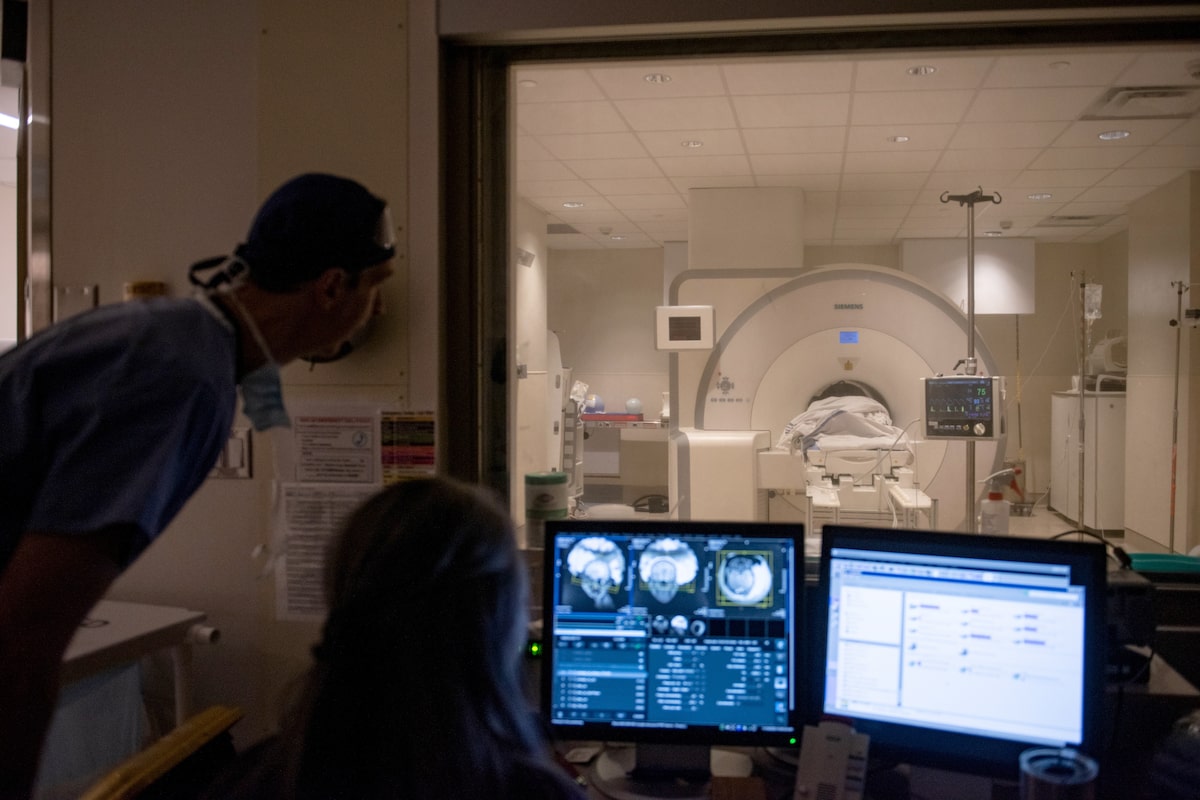
Anaesthesiologist Dr. Chris Idestrup, left, and MRI technologist Ruby Endre monitor a patient as she undergoes maintenance chemotherapy using MRI-guided focused ultrasound treatment.Galit Rodan/The Globe and Mail
Sunnybrook Health Sciences Centre will receive a $41-million gift that it says will transform the way clinical trials are designed and delivered, leading to improved patient care.
The contribution from the Westons, one of the country’s most affluent business families, will mean promising therapies reach patients faster, the Toronto-based centre said.
It will also help advance scientific discoveries across the country, said Andy Smith, president and chief executive officer of Sunnybrook.
“The more that we can bring more clinical trials, better clinical trials, to Sunnybrook, as to anywhere in Canada, this is going to do great things for patients and families, and by extension, the communities that we serve,” he said in an interview on Monday.
Sunnybrook receives $10-million donation for OCD treatment and research
The country has the scientific strength and capability to be a global leader for clinical trials, he said; however, that progress can be slowed by factors that include inadequate infrastructure and limited capacity.
“The gift is for Sunnybrook, but we really see it as being a catalyst for better achievement as team Canada, our collaboration across Canada.”
Kelly Cole, president and CEO of the Sunnybrook Foundation, said the contribution is a vote of confidence for the health sciences space, as well as the Canadian health care system.
While donors tend to select a specific area of care, this gift will not be directed at one research project alone, she said, adding she hopes it will be a catalyst for other philanthropy and grants.
“This is about lifting up and transforming clinical trials: how they’re delivered straight across the organization, making it as simple and easy for the investigator to come forward with a new clinical trial and move faster from that moment of discovery to the ultimate patient impact,” Ms. Cole said in an interview.
The Sunnybrook Foundation said on its website that the contribution will go toward expanding specialized teams, introducing a new integrated management system for trials and creating opportunities for first-time scientific investigators.
Sunnybrook has performed several Canada-first trials on areas such as ultrasound technology, cancer, critical care, trauma and high-risk pregnancy. Trials have also used sound waves to cross the blood-brain barrier, which acts as a gatekeeper to the brain.
Last November, a study conducted by researchers in Canada and the U.S., and published in the Lancet Oncology journal, showed for the first time that use of microbubble-enhanced ultrasound could help patients live longer.
The procedure involves injecting tiny air bubbles, which act as a contrast agent, into a patient’s bloodstream, where they circulate to the brain. When ultrasound waves are applied, the microbubbles absorb the energy and cause cells in the blood-brain barrier to pull apart. This creates a temporary window, through which therapeutics can enter the brain.
Nir Lipsman, a neurosurgeon at Sunnybrook who champions the use of the technology, said in an earlier interview that trials are engines of discovery and innovation, but they require funding and infrastructure to move ahead as safely and judiciously as possible.
“This is the mechanism that we have as a medical community to take treatments from ideas to the bedside, from a concept to making a difference in patient’s lives,” Dr. Lipsman said.