
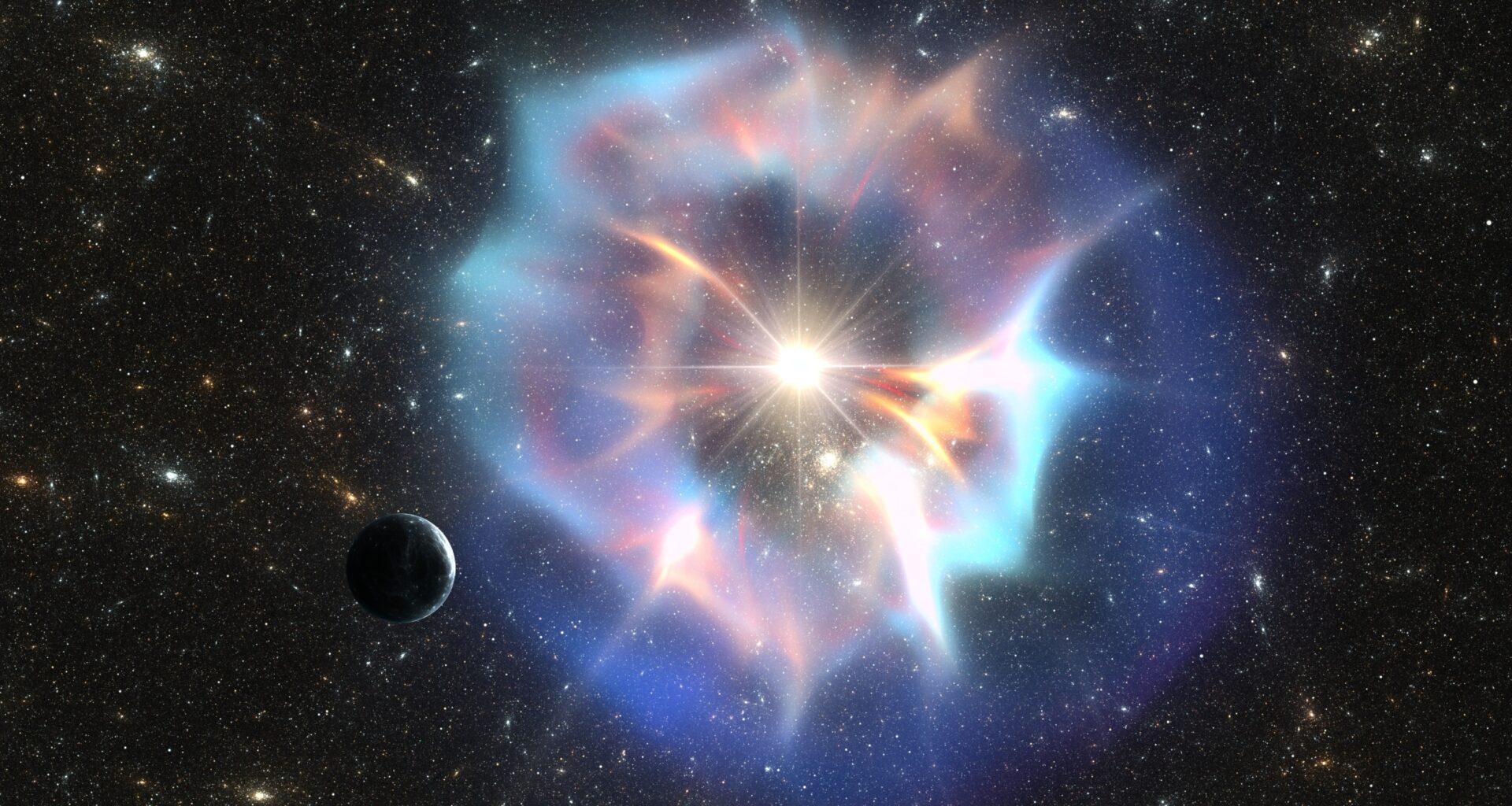
A dying massive star can regain spin deep inside itself instead of simply slowing down, according to new research.
The reversal challenges the usual story of stellar death and could change how astronomers predict the forces behind some supernovas.
Evidence inside a star’s collapse

In the new study, the crucial evidence came from an oxygen-burning shell, a layer where oxygen fuel releases heat.
By tracking that layer at Kyoto University, astronomer Ryota Shimada showed magnetic fields could reverse spin flow.
Before the reversal, magnetism carried spin outward. After it, the same forces moved spin inward and the shell sped up.
The result does not prove every massive star behaves this way, but it exposes a missing rule in many stellar life-cycle models.
Layers can lose or gain spin
Stars do not carry spin evenly. Angular momentum, the stored spin an object carries, can move between layers.
Inside a convection zone – a churning layer of hot and cooler gas – flowing material carries heat and drags magnetic fields.
Those tugs act through Maxwell stress, magnetic tension that transfers spin, so fields can brake one layer while feeding another.
Because the same layer can lose or gain spin, magnetism cannot be treated only as a spin-down force.
A clear pattern emerged
A key control point was the Rossby number, a measure comparing a layer’s rotation with its churning motion.
When that number stayed above one, magnetic stress pulled spin outward and helped the shell slow down.
After the number dropped below one, the magnetic pattern flipped and sent spin inward instead through the shell.
Earlier dynamo theory, which explains magnetic fields born from moving gas, made that reversal plausible beyond this single model.
Confirming the spin pattern
To make the discovery useful, Shimada’s team turned the three-dimensional behavior into a one-dimensional model, a simplified radial star calculation.
That model used rotation, density, and nuclear heat release to estimate where magnetic stress would send spin inside the shell.
The model predicted the inward turn around 340 seconds, close to the simulation’s 350-second reversal.
Matching both direction and strength matters because stellar-evolution codes, programs that follow stars through time, cannot run full three-dimensional interiors.
Why spin matters
Spin can influence what kind of remnant a massive star leaves when its central core finally collapses.
Fast rotation can help power unusually strong explosions, while slower cores better fit neutron stars, dense collapsed remnants.
Magnetic prescriptions used in earlier core-spin models, calculations of stellar core rotation, mostly treated magnetism as an outward spin drain.
A field that sometimes feeds spin back inward makes the final core rate harder to predict.
Lessons from the Sun
The Sun has long tied magnetism to the slow loss of stellar spin because it is close enough to measure.
Magnetized stellar winds, charged outflows from stars, carry material away and drain surface spin over time.
By reading stellar vibrations, asteroseismology later showed many stars lose interior spin faster than simple models expected.
“We suspected that the flow inside the massive star’s convective zone may evolve analogously with the solar convective zone,” said Shimada.
What earlier simulations showed
Earlier computer simulations from 2023 already showed magnetic fields could grow fast inside late-stage massive stars before their collapse.
In one run, oxygen-shell fields reached about 100 billion gauss – a magnetic-strength unit – within 180 seconds. Neon-shell fields reached half that.
Those fields suppressed mixing, reduced nuclear fuel at the shell base, and quickly pushed the layers toward rigid rotation.
The new research adds the missing inward case, so earlier outward-only rules now look incomplete for some massive stars.
Limitations of the study
One simulation cannot map every star, especially because real stars differ in mass, fuel layering, and rotation.
The calculation covered a short late-life window, not the full birth-to-death history of a star. Neon and carbon shells in the run had not settled enough to test the same rule cleanly.
“Slow rotation might even be forbidden in some classes of massive stars,” said Lucy McNeill, a co-author of the study at Kyoto University.
Future research directions
Future tests must place the new rule inside full stellar-life calculations that follow many masses, stages, and starting spin rates.
Such calculations would show whether inward magnetic transport survives beyond one oxygen-shell episode in different massive stars.
They also need better treatment of chemical mixing, the way burning products and fresh fuel blend.
Without that piece, modelers may predict a spin rate while missing the fuel changes that set the stress.
Dying stars now look less predictable because magnetism can move spin inward or outward inside layered, burning interiors before collapse.
Better models could improve supernova forecasts, but only if future simulations test the rule across more stars.
The study is published in The Astrophysical Journal.
—–
Like what you read? Subscribe to our newsletter for engaging articles, exclusive content, and the latest updates.
Check us out on EarthSnap, a free app brought to you by Eric Ralls and Earth.com.
—–