
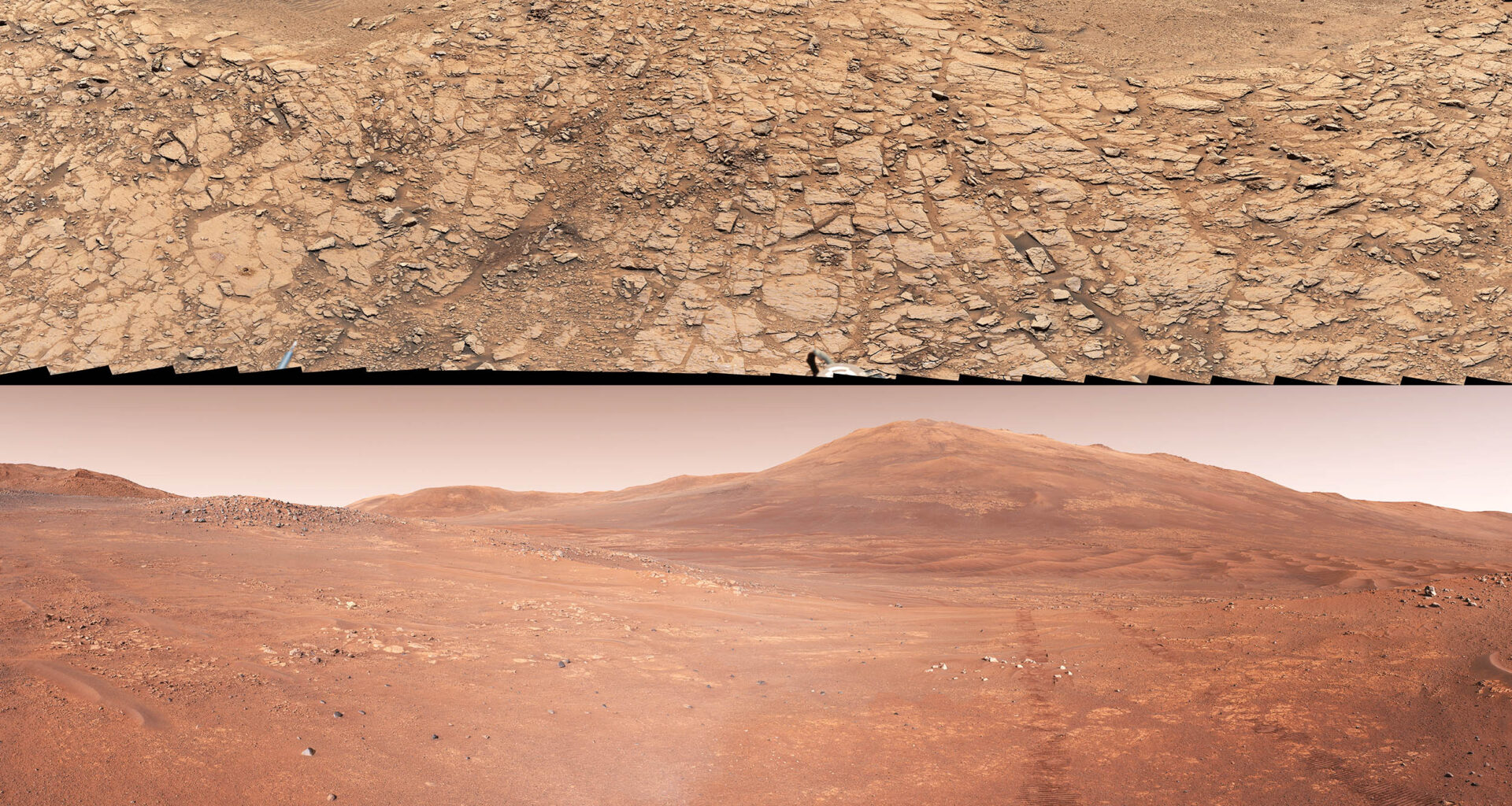
Mars will not readily reveal its secrets. Instead, it conceals them within dust, rocks, and permafrost.
However, two NASA rovers are currently assisting in deciphering this tale, layer by layer, from vastly different locations on the planet.

Each rover on Mars has already captured panoramic 360-degree vistas of its respective environment. These panoramas are more than just beautiful photographs; rather, they are snapshots of time.
The two Mars rovers are located almost 2,345 miles away from each other – roughly the same distance from Los Angeles to Washington, D.C. – and both are surveying landscapes formed billions of years ago.
A timeline written in rock
Curiosity is climbing Mount Sharp, a 3-mile-high stack of layered rock inside Gale Crater. Each layer marks a different chapter.
Lower layers formed first, higher ones later. As the rover climbs, it moves forward through time, studying younger terrain.
Perseverance is doing the reverse. It landed in Jezero Crater in 2021 and is heading toward some of the oldest surfaces in the solar system.
Its route takes it deeper into Mars’ early past, where the first conditions for life may have taken shape.
Scientists working with NASA’s Jet Propulsion Laboratory and Caltech say this two-way approach fills in gaps. One rover looks at what Mars became. The other looks at where it started.
Ancient water left its mark
Curiosity’s latest panorama, made from 1,031 images taken between November 9 and December 7, 2025, shows a strange pattern of ridges.
From above, they look like spiderwebs spread across the ground. These features likely formed long ago when groundwater flowed through cracks in the rock.
Minerals settled in those cracks and hardened. Over time, wind wore away the softer rock, leaving the tougher material behind. The result is a raised pattern that maps where water once flowed underground.
That matters because water is key. When Curiosity landed in 2012, its main goal was simple: to find out if Mars ever had the right conditions for life.
Within a year, it drilled into an ancient lakebed and confirmed that it did. The chemistry was there, the nutrients were there, and microbes could have survived.
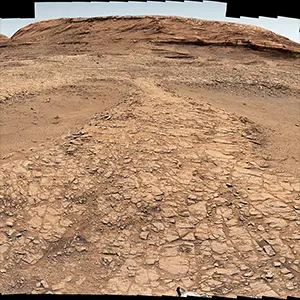 NASA’s Curiosity Mars rover captured this 360-degree view of a region filled with low ridges called boxwork formations between Nov. 9 and Dec. 7, 2025. At 1.5 billion pixels, this is one of the largest panoramas Curiosity has ever taken. Credit: NASA/JPL-Caltech/MSSS. Click image to enlarge.Carbon clues in Martian rock
As Curiosity climbed higher, it found something else: a mineral called siderite, which may hold carbon dioxide from a thicker, older atmosphere.
Scientists had expected to find carbonate minerals like this, but they had rarely appeared before.
The rover has also detected complex organic molecules in Martian rock. Some are long chains of carbon that resemble the building blocks of fatty acids.
In one sample drilled in 2020, researchers identified 21 carbon-containing molecules, seven of which had never been seen on Mars before.
These discoveries do not prove life existed, but they show that the ingredients and conditions were present.
A crater that once held a lake
Perseverance is unfolding a new episode of the Mars tale, with a sweeping panorama composed of 980 individual pictures taken from December 18, 2025, to January 25, 2026.
The images highlight an area called “Lac de Charmes,” which lies near the edge of Jezero Crater.
This crater held a lake billions of years ago that was fed by a river system. Over time, the lakebed filled with sediment layers that could have preserved signs of microbial life.
In 2024, Perseverance studied a rock named “Cheyava Falls,” which featured dark specks caused by chemical reactions.
On Earth, such spots are often linked to microbial activity. However, this does not prove life existed, but it is exactly the kind of evidence scientists are looking for.
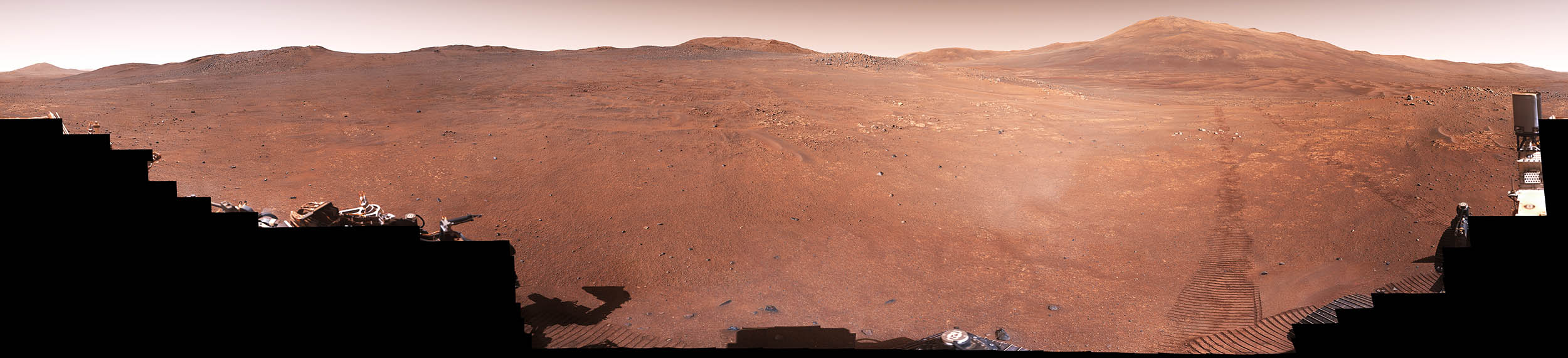 NASA’s Perseverance Mars rover captured this 360-degree panorama of a region nicknamed “Crocodile Bridge” on the rim of Jezero Crater. This region holds some of the oldest rocks anywhere in the solar system. Credit: NASA/JPL-Caltech/ASU/MSSS. Click image to enlarge.Mars rovers prepare samples for Earth
Unlike Curiosity, Perseverance does not grind up all its samples. It drills out small cores, about the size of a piece of blackboard chalk, and stores them in metal tubes. So far, it has collected 23 samples.
The plan is to bring these samples back to Earth someday. Labs here can run tests far beyond what a rover can handle. That could finally answer the question of whether life ever existed on Mars.
Rovers listen to the weather on Mars
Perseverance has also picked up something no one had ever heard before on another planet.
Its microphones recorded electrical sparks inside dust devils, something scientists had only previously theorized.
Its cameras captured another first: visible-light auroras from the surface of Mars.
These faint glows in the sky show how the planet interacts with space weather, even without a strong magnetic field like Earth’s.
Mars missions move forward
Curiosity has moved on from its web-like ridge field and is now studying layers rich in salty minerals called sulfates, which formed during drier periods and add another piece to the climate puzzle.
Perseverance is heading toward even older terrain, including a site known as “Singing Canyon,” where each new location could hold another clue.
Mars today is cold and dry, but these rovers keep finding signs that it was once very different.
Rivers flowed, lakes formed, and the planet’s chemistry shifted over time. Piece by piece, its past is coming into focus.
—–
Like what you read? Subscribe to our newsletter for engaging articles, exclusive content, and the latest updates.
Check us out on EarthSnap, a free app brought to you by Eric Ralls and Earth.com.
—–