
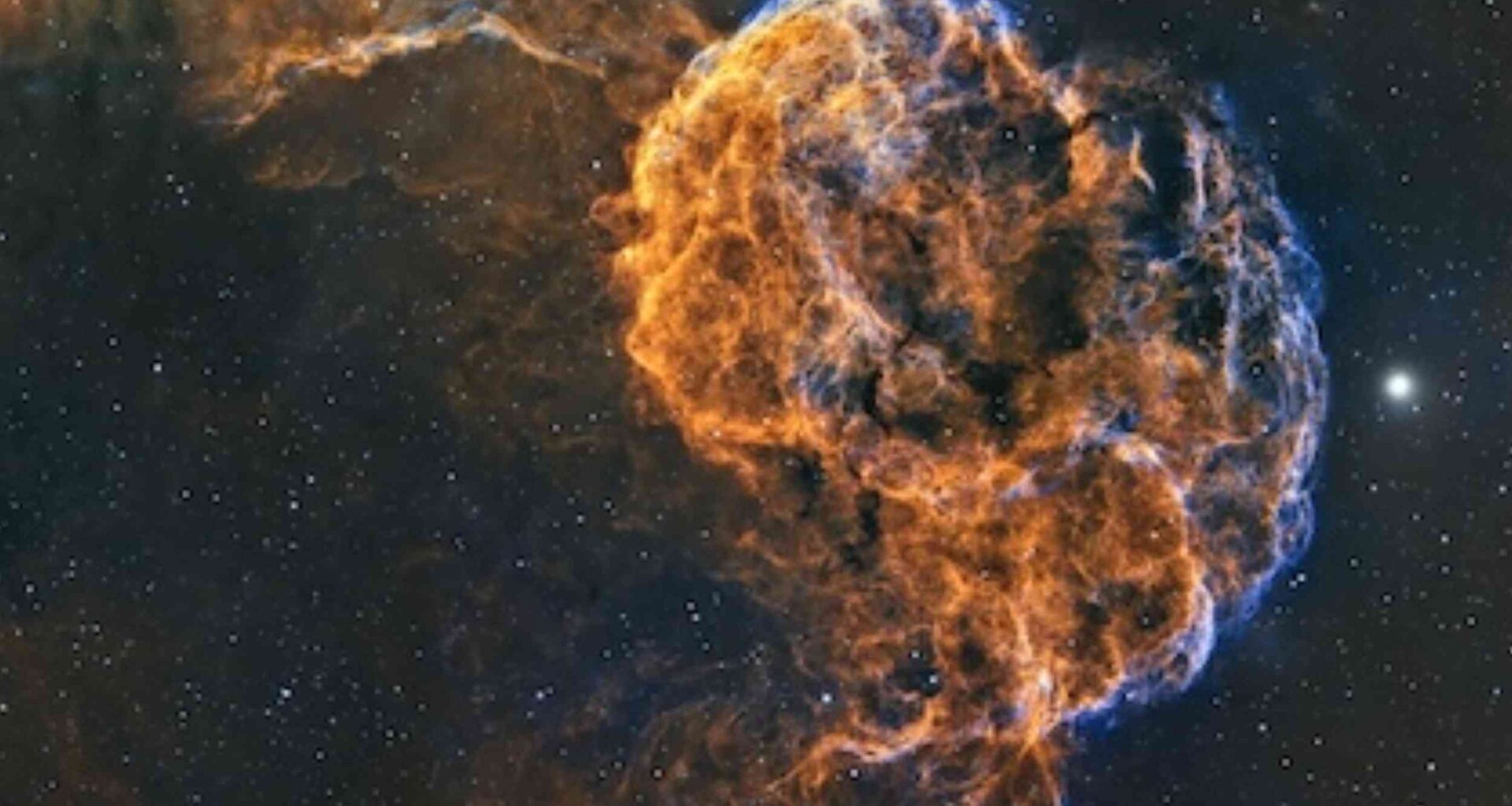
A new study has found that IC 443, the expanding debris of an exploded star, is accelerating protons to at least 300 trillion electron volts.
The finding pushes this long-studied stellar wreckage closer to the long-sought source of some of the Galaxy’s most extreme particles.
Signal from IC 443

Inside IC 443, 5,000 light-years from Earth, two patches of high-energy light mark where the remnant still acts on nearby gas.
By tracing those gamma rays, the LHAASO Collaboration tied the compact patch to fast protons striking surrounding material.
That signal extends beyond 30 trillion electron volts without a clear cutoff. This shows that the accelerator has not yet run out of power.
The discovery strengthens IC 443 as a cosmic-ray source, but the second glow still needs a wider explanation.
Tracing cosmic signals
Cosmic rays, fast charged particles from space, cannot point back to their birthplace because magnetic fields bend their paths.
When protons crash into gas, they create unstable particles that break into gamma rays. These rays travel more directly through space.
Such light gave the team a cleaner signal than the protons themselves, even though the signal still needed careful sorting.
That sorting mattered because the remnant sits near other energetic objects, and overlapping signals can make one source look like two.
Clues from collisions
A supernova remnant, the expanding debris of an exploded star, can keep driving shock waves through nearby gas for thousands of years.
Those shocks squeeze magnetic fields and scatter particles back and forth, so protons gain energy in repeated passes.
IC 443 is especially useful because molecular clouds, cold gas clouds where stars can form, still crowd its edges and give accelerated protons something to hit.
Crowded gas boosts the gamma-ray output, but it also makes the region harder to interpret clearly.
LHAASO isolates sources
High on Haizi Mountain, in Sichuan Province, China, LHAASO watches particle showers created when gamma rays strike the atmosphere.
Its detectors cover a wide sky view and separate incoming light by energy, direction, and shower shape.
For IC 443, the team used years of data and separated a compact, point-like source from a broader region of high-energy emission.
That split kept the strongest proton claim tied to the compact source rather than the whole glowing region.
Old clue revisited
In 2013, a Fermi Large Area Telescope result, from NASA’s gamma-ray space instrument, caught the pion signature in IC 443.
That earlier signal proved protons were colliding with gas, but it did not show the highest energy they could reach.
“The direct detection of pion-decay signatures in supernova remnants closes the loop and provides dramatic observational evidence for a significant component of cosmic rays,” said Jerry Ostriker, an astrophysicist at Columbia University.
LHAASO now extends that evidence upward, from lower-energy clues to photons tens of trillions of electron volts strong.
Why 300 TeV matters
One teraelectronvolt (TeV) equals one trillion electron volts, so 300 TeV marks a far higher proton scale.
Because gamma rays carry only part of a proton collision’s energy, the parent protons must be far stronger.
The 95% lower limit reaches about 300 TeV, meaning the best fit could go higher without breaking the data.
That level remains below the cosmic-ray knee where the particle count steepens near 3.67 quadrillion electron volts, yet it narrows the gap.
Mystery of second glow
A wider glow of high-energy light overlaps another possible remnant and a compact X-ray object in the same region.
Its spectrum reaches similar energies, but the pattern does not point to a single clear origin.
Protons escaping through nearby gas could produce it, while energetic electrons could also boost background light into gamma rays.
That uncertainty keeps the strongest claim tied to the compact source, where the proton-collision evidence is most direct.
Evidence has limits
Strong evidence does not make the compact source a finished case, because a hadronic origin, gamma rays made by proton collisions, remains an assumption.
They checked whether the signal still appeared after accounting for background light from the Galaxy and nearby sources.
Those checks shifted some details but left the compact source consistent within the main reported statistical errors.
The remaining caution centers on the wider glow, where several physical explanations still fit the same data.
Testing the signals
Sharper maps can test whether the wider emission follows dense gas, an older remnant, or a neutron star, a dense collapsed stellar core.
Radio, X-ray, and gamma-ray observations can compare shapes, because different particles light up different materials and energies.
A tighter match with gas would strengthen the proton case, while a broader, smoother glow would favor energetic electrons.
Either outcome would make IC 443 a cleaner guide to how stellar explosions feed the Galaxy’s particle population.
A sharper cosmic map
IC 443 now links an old explosion, dense gas, and gamma rays into a sharper test of cosmic-ray acceleration.
The compact source points to protons reaching at least 300 TeV, while the wider glow preserves the main limit.
The study is published in Physical Review Letters.
—–
Like what you read? Subscribe to our newsletter for engaging articles, exclusive content, and the latest updates.
Check us out on EarthSnap, a free app brought to you by Eric Ralls and Earth.com.
—–