
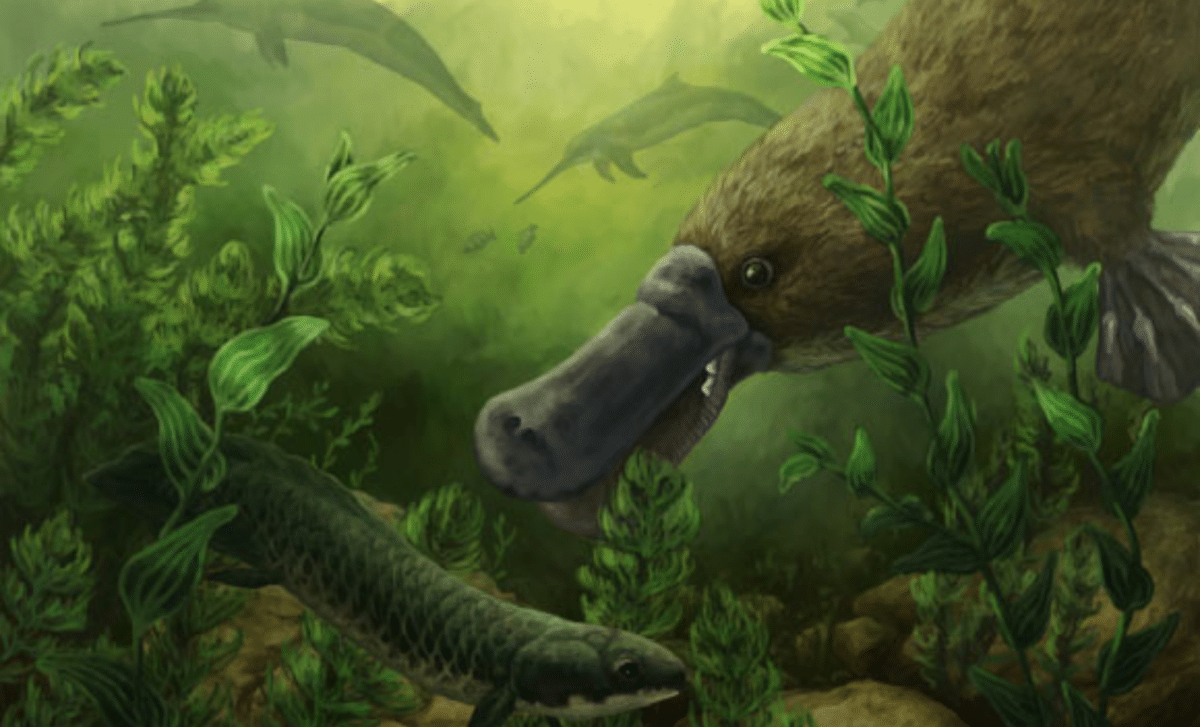
A groundbreaking fossil discovery in South Australia is reshaping the story of one of Earth’s strangest mammals, revealing that ancient platypuses once had fully developed teeth and a much stronger bite. The findings, detailed in the journal Australian Zoologist, provide one of the clearest glimpses yet into the deep evolutionary past of the elusive monotreme Obdurodon insignis.
Rare Fossils Unlock A Missing Chapter In Platypus Evolution
The newly uncovered fossils, found in the remote outback of South Australia, belong to Obdurodon insignis, the oldest known species of platypus. For decades, this species was known only from fragmentary remains, offering little insight into its biology or behavior. That has now changed with the discovery of a lower molar, an upper premolar, and part of the shoulder structure known as the scapulocoracoid.
Published in the journal Australian Zoologist, the study by researchers from Flinders University marks a significant leap forward in understanding monotreme evolution. These fossils confirm that early platypuses retained complex teeth into adulthood, a stark contrast to modern platypuses, which lose their rudimentary teeth early in life and rely on hardened pads instead.
“Platypuses are extremely rare in the fossil record and are often restricted to teeth, so it’s exciting to find new material and learn more about these unique mammals,” said Aaron Camens. The rarity of such finds amplifies their importance, offering a rare window into a lineage that has long puzzled scientists due to its unusual mix of mammalian and reptilian traits.
A Stronger Bite And A Very Different Diet
One of the most striking revelations from the fossils is the presence of large, well-formed teeth, including sharp premolars and robust molars. These features suggest that Obdurodon insignis had a much more powerful bite than its modern descendants, capable of crushing hard-shelled prey.
“The new premolar for Obdurodon insignis shows this species also had large, pointed front teeth, which with its large robust molar teeth could easily have crushed animals with shells or robust exoskeletons, like yabbies [a type of crayfish],” said Trevor Worthy, lead author of the study. This feeding adaptation paints a picture of a more aggressive and versatile predator, thriving in aquatic ecosystems rich with crustaceans and other invertebrates.
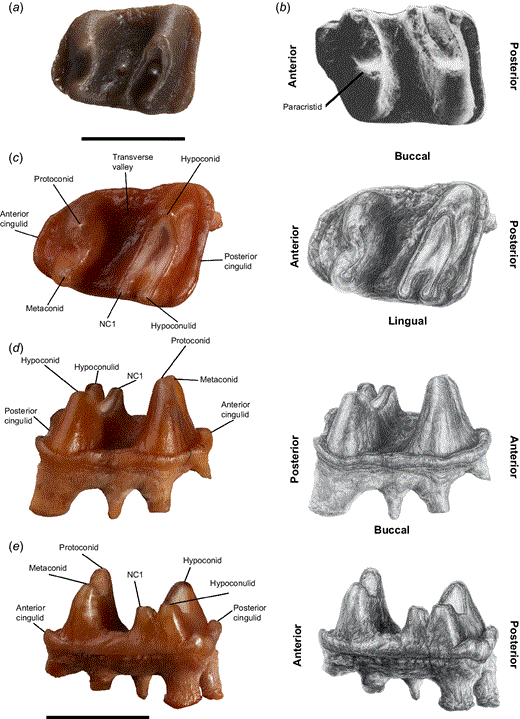 Lower first molars of Obdurodon species. (a) Occlusal view of Obdurodon insignis, image of cast of holotype SAMA P18087, mirrored for ease of comparison (imperfections in cast occur in the transverse valley and between the hypoconulids) and (b) Occlusal view of Obdurodon dicksoni from Archer et al. (1993, fig. 7.1). Other images are of SAMA P55061: (c) in occlusal; (d) buccal; and (e) lingual views. The interpretative drawings on the right of c–e are by G. Conway. NC1 is the anterolingual cusp of the talonid. Scale bar, 5 mm.
Credit: Australian Zoologist
Unlike today’s platypus, which relies on electroreception and soft feeding structures, this ancient species likely combined sensory hunting with mechanical force. The presence of such teeth indicates a transitional phase in monotreme evolution, where feeding strategies were still diverse and not yet specialized into the form seen today.
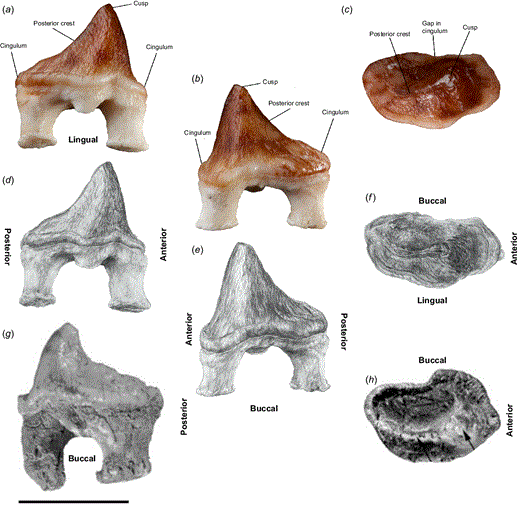 Photographs of the upper right second premolar SAMA P55167 of Obdurodon insignis in (a) lingual, (b) buccal, and (c) apical views. (d–f) Interpretative drawings of (a–c) by G. Conway. (g) The upper right second premolar of O. dicksoni QM F57736 from Flannery et al. (2022, fig. 2B IV) in buccal view, although the orientation is somewhat rotated towards the posterior compared to (b) and (e), and (h) apical view. Scale bar, 5 mm.
Credit: Australian Zoologist
Built To Swim: Anatomy Close To Modern Platypuses
Beyond its teeth, the fossilized scapulocoracoid provides crucial evidence about how Obdurodon insignis moved and lived. This bone, which supports the forelimbs, closely resembles that of modern platypuses, suggesting similar swimming capabilities.
“The other rare find was the discovery of a partial scapulocoracoid, or bone that supports the arm or front limb. This reveals a very similar forelimb structure to the modern platypus, indicating it could swim just as well as its modern descendant,” added Worthy.
This anatomical continuity highlights that while feeding adaptations evolved significantly, locomotion remained remarkably consistent over millions of years.
The combination of strong limbs and powerful jaws suggests a highly capable aquatic hunter, equally adept at navigating waterways and exploiting available food sources. It also reinforces the idea that modern platypuses are not primitive, but rather highly specialized survivors of a once more diverse lineage.
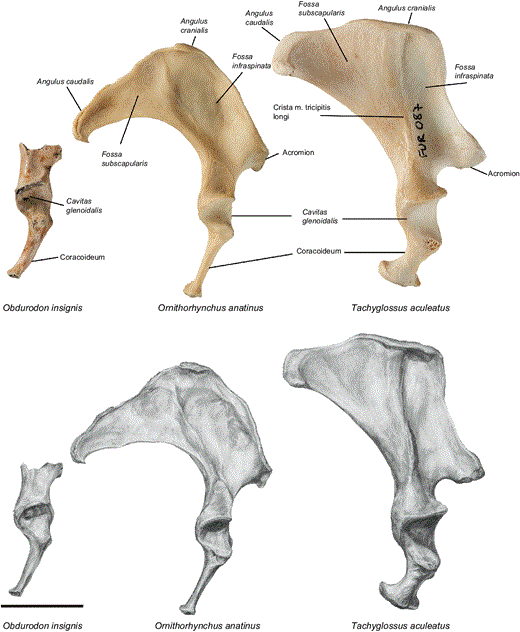 Lateral views of monotreme scapulae as photographs above and interpretative drawings below, comparing the partial right scapulocoracoid of Obdurodon insignis SAMA P58379 to Ornithorhynchus anatinus, SAMA M14097, and Tachyglossus aculeatus, FUR 087, by G. Conway. Scale bar, 20 mm.
Credit: Australian Zoologist
A Lost Tropical World Beneath The Desert
The fossils also tell a broader environmental story. Around 25 million years ago, the now-arid regions of South Australia were lush landscapes filled with rivers, lakes, and dense vegetation. These ecosystems supported a wide array of life, including lungfish, flamingos, freshwater dolphins, and early monotremes.
“These fossils show that 25 million years ago Obdurodon insignis was very similar to the modern platypus. It differs mainly by being slightly larger and having teeth.”
The environment it inhabited was far removed from today’s arid outback, offering a rich habitat where such species could thrive.
“An ancient, toothed platypus lived in these lakes and rivers as shown by the bones of one that settled to the floor of the lake 25 million years ago,” said Worthy. “I have studied this lost ecosystem for many years now, and it is for exquisite fossils like these that I return again and again to the desert. One never knows what erosion or one’s efforts will reveal next.”
These discoveries not only deepen our understanding of platypus evolution but also highlight the dynamic environmental changes that have shaped Australia’s unique biodiversity.