
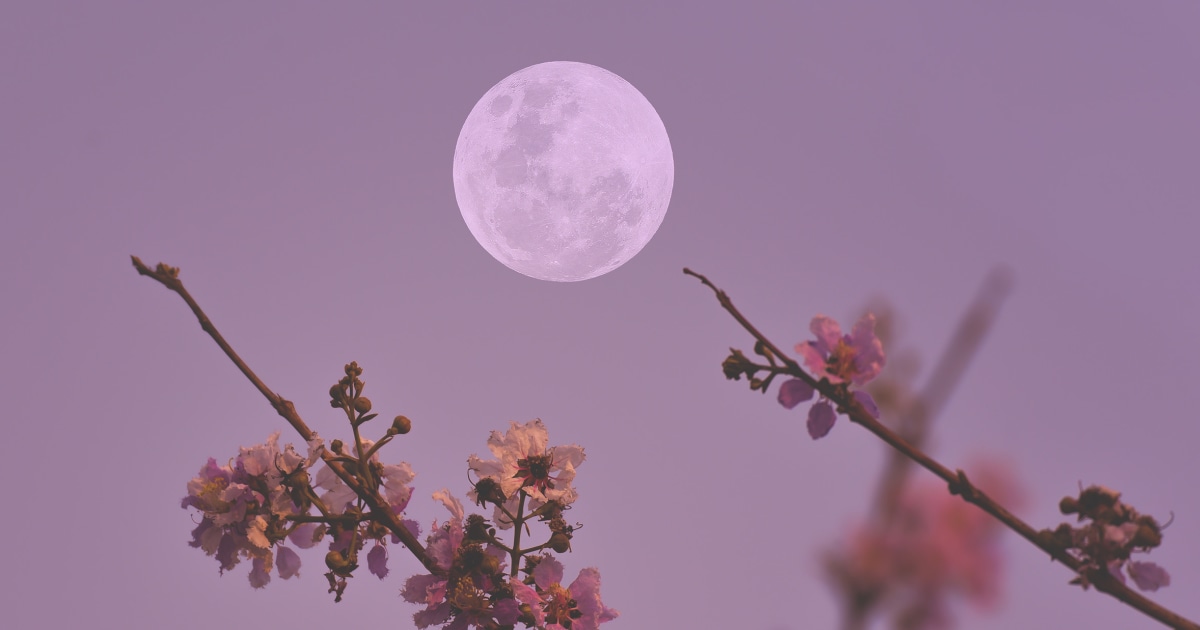
A rare blue moon will light up the sky in May as part of a month that will feature two full moons.
The inspiration for everything from the classic song “Blue Moon” to the nickname of an All-Star pitcher from the 1960s and ’70s only comes along every two or three years, hence the phrase “once in a blue moon.”
The opportunities for skywatchers start right away on May 1 with the first full moon of the month, which is known as the flower moon.
Here’s what to know.
When Is the Best Time to Watch May’s Flower Moon?
The first full moon of the month, known as the flower moon, reaches peak fullness at 1:23 p.m. ET on May 1, astronomer Catherine Pilachowski tells TODAY.com.
While that is in the middle of the day, the moon will still be at 99% illumination on the nights of May 1 and May 2, so any time after the moonrise in your area on those days is a great chance to see the flower moon.
Cloud coverage and weather in your area could also affect viewing.
Why Is It Called the Flower Moon?
The flower moon’s name comes from the fact that the full moon coincides with flowers blooming in the spring across North America, according to The Old Farmer’s Almanac.
The term has been attributed to the Algonquin peoples, according to the almanac.
Indigenous tribes also have other names for the flower moon, including Budding Moon (Cree); Frog Moon (Cree); Egg Laying Moon (Cree); Moon of Shedding Ponies (Oglala) and Planting Moon (Dakota, Lakota), according to the almanac.
When Is the Best Time to Watch May’s Blue Moon?
The blue moon will reach peak fullness at 4:45 a.m. ET on May 31, according to Pilachowski. That means any time late on May 30 and in the early hours of May 31 should provide a great view.
It will be what is known as a “micromoon,” which is the opposite of a super moon. It will occur when the moon is farthest from the Earth, so that it will appear about 6% to 7% smaller than the average full moon and 12% to 14% smaller than a super moon, per Pilachowski.
The moon will be 252,360 miles from Earth during the blue moon on May 31, compared to its average distance of 238,855 miles, according to Pilachowski.
Why Is It Called a Blue Moon?
Pilachowski broke down the working definitions of the term blue moon.
“It’s a second full moon in any month, or a second full moon in a month of any season that has four full moons,” she said. “The first is the definition most commonly used today but stems from some misunderstanding of the definition decades ago.
“Blue moons occur every two to three years,” she continued. “They don’t look blue, but the term apparently comes from a 16th Century idiom for something rare.”
The last blue moon was a blue supermoon in August 2024, which is a rare occurrence that happens about every 10 years.