
Somewhere around 2010, camera design stopped mattering to the photography industry. The DSLR era had produced bodies defined by ergonomics rather than aesthetics, and the first mirrorless wave carried forward the same logic. Cameras were tools, tools looked like tools, and any photographer who cared about how a camera looked was suspected of being a poseur. The mainstream press reinforced the assumption. Reviewers evaluated bodies by their grip comfort, control layouts, button feel, and weather sealing, and any discussion of aesthetics was treated as either irrelevant or faintly embarrassing.
That assumption is gone. The 2024-2026 wave of camera releases has quietly made camera design matter again, and the companies that figured this out are the ones winning the most interesting corners of the market. Fujifilm keeps selling more cameras each quarter. Sigma built a machined-aluminum full frame body that critics cannot decide whether to love or hate but nobody is ignoring. Pentax is making new film cameras. The industry has remembered, all at once, that aesthetic design was never superficial. The way a camera looks and feels is a legitimate factor in whether it gets picked up and used, and photographers were telling the industry this for years before the industry started listening.
The Era When Design Did Not Matter
For most of the 2000s and 2010s, the flagship cameras of the major manufacturers were visually interchangeable. The Canon 5D Mark II, the Nikon D700, the early Sony a7 series. All genuinely great cameras. All black, plastic-feeling, shaped for grip comfort and nothing more. The aesthetic vocabulary across manufacturers was essentially identical: a prosumer black brick with a viewfinder hump, a grip, and a uniform matte finish designed to disappear in the photographer’s hands rather than call attention to itself.
There was a rationale for this, and it was not a bad one. Cameras were tools, the argument went, and tools should be shaped by their function. Photographers who wanted beautiful cameras were told to buy a Leica or a Hasselblad, which existed in a separate universe of pricing and positioning and were understood to be objects as much as instruments. The mainstream manufacturers had no responsibility to build camera-as-object. Their job was to build the most capable camera at a given price point, and any design expenditure that did not contribute to capability was waste.
The unintended consequence of this argument was that cameras stopped being things people wanted to own. They were things people needed to use, which is a different relationship. A photographer who loved their tools in this era loved them in spite of their design, not because of it. The Canon 5D Mark II got its reputation because it democratized full frame video, not because anyone thought it was beautiful. The Nikon D700 earned its following through image quality and reliability, not through aesthetic identity. These were excellent cameras that looked like every other excellent camera of their era, and the industry convinced itself this was a feature rather than a missed opportunity.
The Fujifilm Argument
The camera that proved design mattered in the modern mass-market context was the original Fujifilm X100, released in 2011. It was, at the time, a strange product. A fixed-lens APS-C body with a hybrid optical-electronic viewfinder, styled unmistakably as an homage to the 1950s Leica rangefinder. Reviewers praised the image quality and the hybrid viewfinder. They also, almost uniformly, treated the aesthetic design as a nice bonus rather than a serious feature.
Fifteen years later, the X100VI has been sold out for more than a year. Fujifilm cannot keep the camera in stock. The X100 series has not just survived six generations of refinement. It has become a cultural phenomenon driven almost entirely by its design identity, and the photographers buying it are increasingly people who had never bought a dedicated camera before, converting from smartphones specifically because the camera looks like the thing they want to be photographing with.
The lesson Fujifilm learned from this and the rest of the industry did not, for a long time, was that a camera people want to hold is a camera people shoot more, which is a commercial argument rather than an aesthetic one. More frames taken means more attachment to the camera, which means more upgrades within the ecosystem, which means more lens sales, which means more loyalty, which means a stronger long-term position in the market. Design decisions compounded into business outcomes. The companies that built forgettable-looking cameras got forgettable customer loyalty.
The Design-First Releases of 2024-2026
The past two years have produced a wave of cameras that foreground design decisions as marketing points rather than afterthoughts, and the category has become dense enough to constitute an actual trend.
The Sigma BF, released in April 2025 at $1,999, is the purest expression of design-first thinking in the current market. It is machined from a single block of aluminum over the course of seven hours per unit. It has three buttons, a dial, and a shutter release. No EVF. No hot shoe. No HDMI port. No memory card slot at all, replaced by 230 GB of internal storage. The pressure-sensitive haptic controls are a first in mirrorless photography. The camera has attracted polarizing reviews because it is explicitly not trying to compete on specifications, and reviewers who grade on spec sheets find themselves with nothing to grade. The photographers who love it love it as an object first and a tool second, and Sigma is fine with that, because the people buying the BF are people who would not have bought the spec-equivalent Panasonic Lumix S9 either.
The Fujifilm X half, released in 2025 at $849, puts design at the forefront in a different way. Vertical sensor orientation referencing the half-frame film cameras of the 1960s and 1970s. A physical film advance lever that has to be flicked between shots in Film Camera Mode. A film simulation window on the back that the user swipes to change virtual film stocks. The whole body looks like something from a different century, and that is the point.
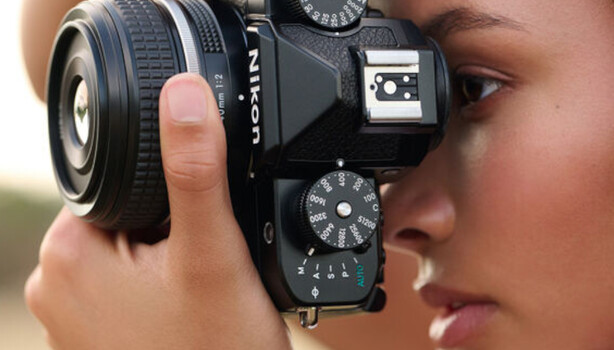
The Nikon Zf brought Nikon into the retro-design conversation in a way the brand had previously resisted. Full frame sensor. Classic mechanical dials for shutter speed, ISO, and exposure compensation. A body that unambiguously references the Nikon FM and FE film cameras of the 1970s. The Zf was not Nikon’s best-selling camera of its generation, but it was the Nikon camera that photographers actually talked about, and the one that converted photographers from other brands specifically because of how it looked.
The Yashica FX-D series, launched on Kickstarter in May 2025, demonstrated the commercial power of design-first thinking at the budget end of the market. The three models (FX-D 100, FX-D 300, FX-D S300) are styled as tributes to the 1979 Yashica FX-3 SLR, complete with a manual “film” advance lever that activates the camera’s film simulations. The cameras use small 1/1.56-inch sensors and cost between $339 and $679 at launch. They are proof that photographers will crowdfund a camera on the strength of its design identity even when the spec sheet is ordinary.
The Pentax 17 pushed the design-first argument all the way back into film. A half-frame 35mm film camera launched in 2024 by a company that had not released a new film camera in decades. The body is styled as a deliberate modern descendant of the half-frame Pentax 17 from 1962. The camera has no autofocus, no light meter display, no electronic niceties at all. It sold strongly enough on its design identity alone that Pentax accelerated its rumored next film camera development.
Why Design Decisions Are Photography Decisions
The instinct to dismiss all of this as aesthetic preference misses what is actually happening. Design and use are not separable categories. The way a camera is designed determines how it gets used, and photographers who ignore design in their purchase decisions are ignoring a real factor in how they will shoot.
A camera with good tactile controls gets used differently than a camera with menu-driven controls. A photographer who can change aperture with a physical ring on the lens, shutter speed with a dedicated dial on top of the body, and ISO with a third dial nearby is a photographer making exposure decisions constantly as they shoot. A photographer who has to navigate menus for any of those changes makes fewer exposure decisions because the friction is higher. The camera with better tactile controls produces more deliberate photography because it invites more deliberation. This is not a spec, but it is a functional consequence of design.
A camera that fits in a coat pocket gets carried more than a camera that does not, which means it gets used more, which means its owner makes more photographs. The X100VI and the Ricoh GR series have demonstrated this for over a decade. The camera in your bag is worth infinitely more than the camera in your closet, and a body designed to encourage carrying is a body that produces more frames across a year.
A camera whose mechanical dials click with the right tactile feedback encourages a different shooting cadence than one whose controls feel plastic and imprecise. This is not a subjective preference. It is the difference between a photographer who checks their settings confidently mid-shoot and a photographer who hesitates to trust what the camera is telling them. Confidence in the tool shows up in the photographs.
These are functional consequences of design choices, and they matter because photography is a practice rather than a specification. The practice happens between the photographer and the camera, in the thousands of small decisions and interactions that accumulate over the life of the body. A camera designed with those interactions in mind produces different photography than a camera designed to win spec-sheet comparisons, and photographers are finally, publicly, allowed to care about that. For a broader perspective on how craft and tool choice intersect across photography genres, The Well-Rounded Photographer covers the range of shooting disciplines that reveal which design choices actually matter in which contexts.
What This Means for the Next Wave of Cameras
The industry has permission now to design cameras as objects worth owning. The commercial case is settled. The X100VI’s waitlist, Fujifilm’s financial results, the Sigma BF’s polarizing-but-selling reception, the Yashica FX-D Kickstarter, the Nikon Zf’s cultural traction. All of these are evidence that design-first thinking produces commercial outcomes, and the companies that take the permission will win more of the next decade’s buyers than the ones who stick with generic-tool design.
Fujifilm has taken this permission aggressively and is being rewarded for it. Sigma has taken it decisively with the BF and is signaling that more is coming. Pentax has taken it in a different direction with film. Yashica, a brand most photographers assumed was dead, has rebuilt itself on design-first positioning. Panasonic has hinted at it with the S9 and is slowly leaning further in. Nikon has taken it once with the Zf and is rumored to be planning more retro-styled bodies in 2026.
Canon and Sony have mostly not taken the permission, at least at the flagship level. The Canon EOS R5 Mark II is a technical masterpiece and a visually generic body. The Sony a1 II is similarly uncompromising on capability and similarly forgettable on design. Both companies are betting that flagship buyers will continue to prioritize specifications over aesthetic identity, and for the working professional market, that bet will probably hold. The question is whether the working professional market is still the center of gravity for camera sales, and the answer, based on what is actually selling in 2026, is increasingly no.
The younger buyers Fujifilm’s financial reports keep citing, the Gen Z and Millennial photographers converting from smartphones to dedicated cameras, are not shopping on autofocus benchmarks. They are shopping on which camera they want to be seen with, which camera makes them want to shoot, which camera becomes part of their identity as a photographer. Those buyers have been told for a decade that caring about how a camera looks is superficial. They stopped listening. The cameras they are buying are the cameras that honor the fact that photography is a relationship with a physical object, and the body of that object matters.
The next five years of camera releases will, if current trends hold, see more retro-styled bodies, more fixed-lens compacts, more machined-metal construction, more cameras designed as objects rather than as collections of specifications. The convergence era of mirrorless, in which every flagship looked like every other flagship and competed on the same narrow set of capabilities, is ending. What is replacing it is not a single new convergence but a deliberate divergence, in which manufacturers build cameras with clear identities aimed at specific photographers rather than trying to be universal tools for everyone.
This is good news for photography. The camera that makes you want to go shooting is worth more than the camera that wins a spec-sheet comparison, and the industry spent most of the past fifteen years pretending those were the same thing. The rediscovery that they are different things is what the design-first wave of 2024-2026 is actually about, and the photographers buying these cameras are the ones who always understood the difference. The manufacturers are just catching up.