

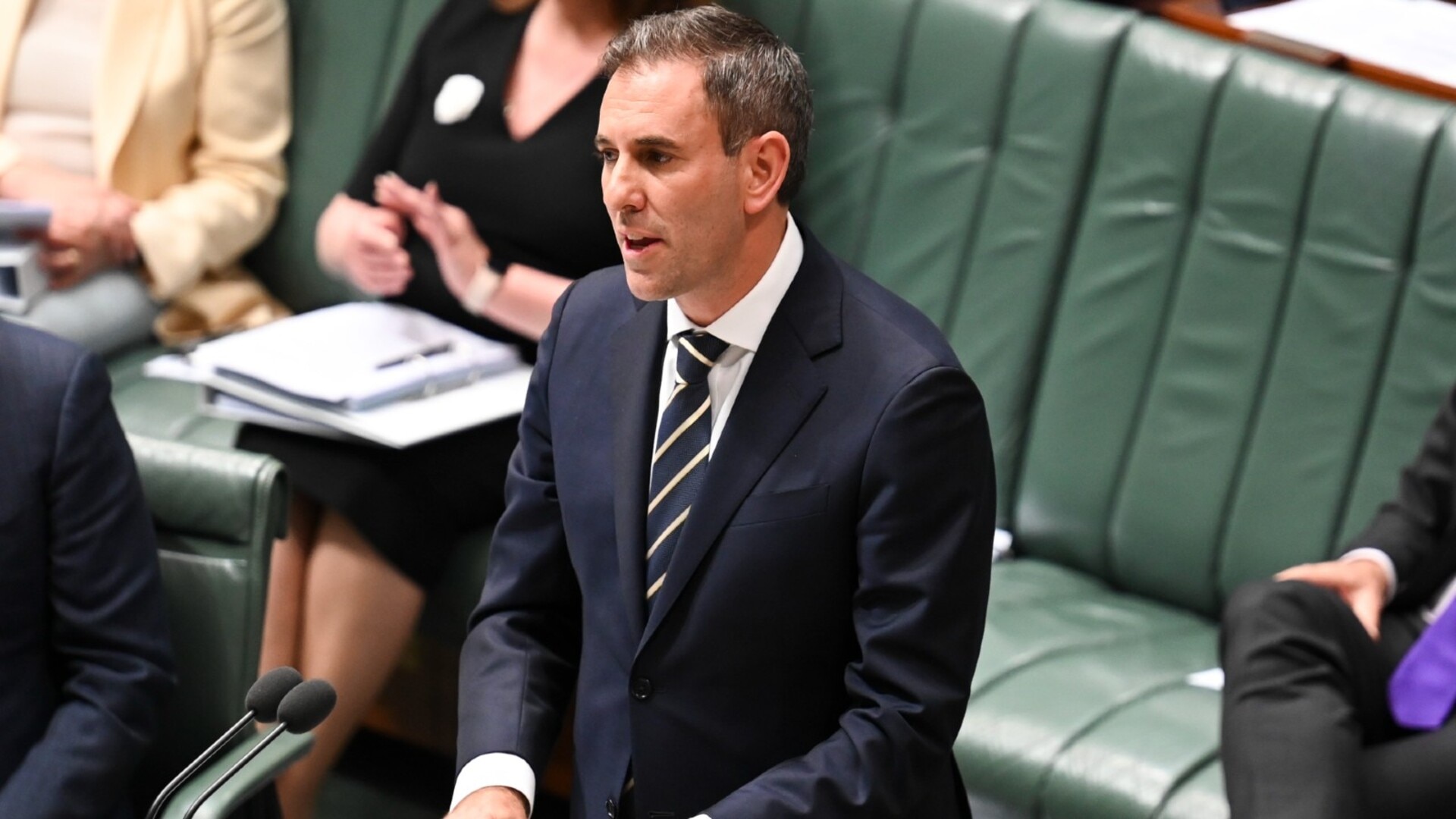
There is a reason why Jim Chalmers is unpopular among baby boomers.
Those with long memories who can remember the reforming treasurers of the late 20th century transformed the lives of working people.
They have lived experience of the days when entering retirement was a ticket to poverty.
In April 1990, between 85 and 90 per cent of retirees relied on the state pension for their income either in full or in part.
The allowance was just $141 a week for a single pension, or $356 adjusted for inflation.
Like Chalmers, Labor’s great reforming Paul Keating set equity as his goal.

Yet unlike Chalmers, he believed the best way to achieve this lofty goal was to get the government out of people’s lives and allow them to become wealthy.
Equity for Keating was to put the dignity of a self-funded retirement in everyone’s reach, not just public servants, politicians and professionals whose generous defined benefit pensions were subsidised by the rest of us.
Compulsory superannuation savings would free working Australians from the tyranny of the state pension, he argued in 1991.
The political system would no longer determine “how they live and in what circumstances”.
They could “preserve the dignity and independence each has enjoyed in their pre-retirement years”.
“It will make Australia a more equal place, a more egalitarian place and, hence, a more cohesive and happier place.”
Keating’s vision of a country where the accumulation of personal wealth was a virtue contrasts sharply with the dismal rhetoric of the current Treasurer.
Those who grow independently wealthy are not to be admired but taxed.
Chalmers’ loaded term, intergenerational equity, signals a new, divisive class war. The era of bipartisan economic reform is well and truly over.
We are well and truly back to the politics Robert Menzies criticised in the 1940s, where the votes of the thriftless are used to defeat the thriftless, a world where “the provision made by a man for his own retirement and old age is not half as sacrosanct as the provision the State would have made for him had he never saved for it at all”.
Keating’s compulsory superannuation scheme was supercharged by John Howard, who encouraged working people to invest in property and shares.
It was spectacularly successful.
Median household wealth is over $1.5 million, making Australians some of the wealthiest retirees in the world.
Today, 37 per cent of retirees are self-funded.
At some 2.6 per cent of GDP, Australia spends less on government pensions than any other developed country.
In France, Italy and Greece, spending is 14 per cent or more.
Denmark, Sweden, Japan and Germany are either just under or at 10 per cent.

The UK spends about five per cent.
Spending as a proportion of wealth is expected to increase in many countries as populations age.
In Australia, it is expected to decline still further to 2.1 per cent by 2060.
Australia’s extraordinary expansion in household wealth over the past four decades was not an accident, nor merely the result of a speculative property boom.
It was the product of deliberate institutional reforms that broadened capital ownership, encouraged long-term saving, stabilised the economy and enabled ordinary households to accumulate assets at scale.

Chalmers’ language of “intergenerational inequality” implies that wealth accumulation by one generation necessarily impoverishes the next.
It reflects a false zero-sum understanding of economics, assuming wealth is fixed rather than created.
Australia’s experience since the 1980s suggests the opposite: mass household wealth can expand dramatically when economic institutions encourage productivity, saving, investment and asset ownership.
Compulsory superannuation was particularly transformative.
Before superannuation became universal, financial asset ownership outside a narrow affluent class was limited.
The superannuation guarantee changed this fundamentally by converting part of wage income into long-term invested capital.
It was one of the largest expansions of mass capital ownership in modern history.
Millions of ordinary Australians thereby became indirect owners of banks, infrastructure, mining companies and global equity markets.
John Howard and Peter Costello consolidated this model through fiscal discipline, tax reform, private health incentives and support for asset ownership.
Their language emphasised aspiration, self-reliance and reward for effort.
The implicit social contract became simple: Australians who worked, saved, bought homes and invested should be able to accumulate capital and economic security.
The intergenerational inequality argument contains an important observation but often reaches the wrong conclusion.
It is true that younger Australians face high housing costs and delayed asset accumulation.

But it does not follow that wealth growth itself is the problem.
Nor does it follow that one generation’s wealth necessarily prevents another generation from becoming wealthy.
Australia’s household wealth boom was not simply the transfer of a fixed stock of assets from young to old.
It reflected rising productivity, expanding superannuation balances, growing participation in capital markets, and decades of uninterrupted economic growth.
There were public benefits as well as private.
The capital stock was deepened, and fewer demands were placed on the state.

Every self-funded retiree is one less pension recipient that future generations of taxpayers will be obliged to fund.
Which means that penalising savings by increasing taxes would be perversely counter-productive, forcing retirees who would otherwise be able to look after themselves back on the pension.
The attacks on property investors by reducing capital gains tax and negative gearing concessions are merely the start.
Chalmers says his mission is to rebalance the “very generous treatment of assets and less generous treatment of labour income of workers”.
Which assets?
Any assets, superannuation savings included.
The rebalancing we need is not between the accumulated wealth of baby boomers and younger Australians.

It is between the Treasurer’s passion for redistributing wealth and the policies that encourage wealth creation.
The central lesson of the reform era is not that future generations must inherit wealth from previous ones.
It is public policy that can create the conditions under which ordinary households build wealth for themselves.
The real policy challenge is not how future generations reclaim existing wealth through redistribution, but how Australia recreates the conditions under which ordinary future generations can become wealthy themselves.
Nick Cater is a senior fellow at Menzies Research Centre and a regular contributor to Sky News Australia