
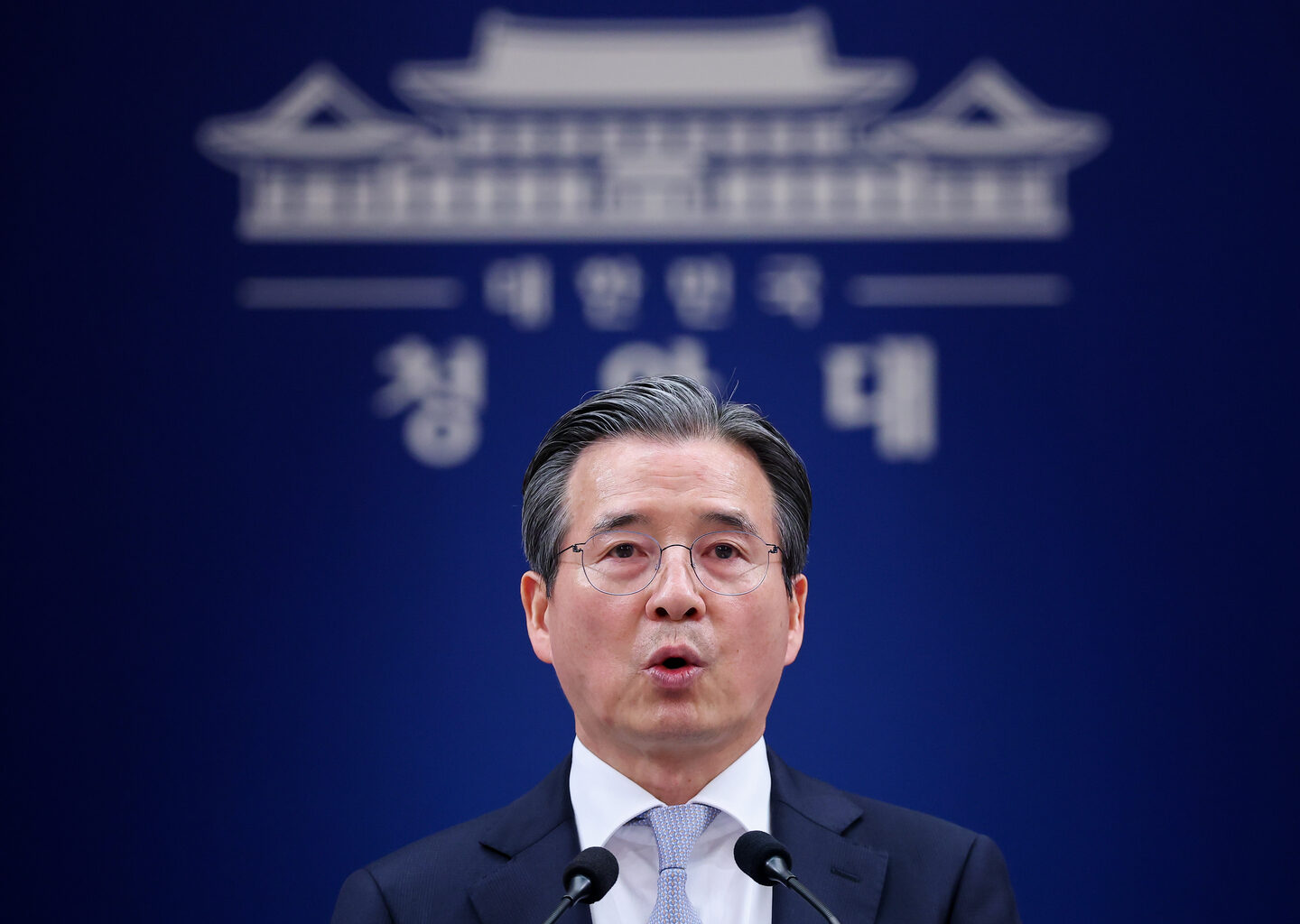
![Presidential office policy chief Kim Yong-beom briefs reporters at the Blue House on April 27 regarding President Lee Jae Myung's meeting with Google DeepMind CEO Demis Hassabis. [YONHAP]](https://www.newsbeep.com/nz/wp-content/uploads/2026/05/c1572b01-7758-416c-ab47-a2f3a1cf741a.jpg)
Presidential office policy chief Kim Yong-beom briefs reporters at the Blue House on April 27 regarding President Lee Jae Myung’s meeting with Google DeepMind CEO Demis Hassabis. [YONHAP]
A series of Facebook posts calling Korea’s credit score system “cruel” has rattled the financial sector — not least because the author helped design it.
Kim Yong-beom, the presidential policy chief who helped design the credit scoring system in a previous position, published four posts under the title “Financial Structure Series” from May 1 to Tuesday, arguing that the current system is flawed and that financial institutions are systematically shutting borrowers with mid-to-low credit scores out of the loan market. He called for “inclusive finance” to bring those borrowers into the mainstream financial system.
The statements drew attention as much for their source as for their content. Kim previously served as head of the banking systems division at the Ministry of Finance and Economy and later as director general of financial policy and vice chairman at the Financial Services Commission (FSC) — making him one of the key architects of the very system he is now criticizing.
“I am someone who designed, operated and justified this cruel system,” Kim wrote. “I am clearly an accomplice.”
Kim wrote in the posts that when President Lee Jae Myung once asked why the most desperate people must pay the highest interest rates, he had dismissed the question with a hollow laugh, thinking it showed a basic misunderstanding of how credit works. He soon came to believe otherwise.
“It was a question that struck at the heart of the very ‘premise’ we had taken for granted in finance,” Kim wrote. “Who is finance protecting, after all?”
![A staff member at a resident center in Gangseo-gu, western Seoul, distributes a relief card on April 27 as part of the first round of payments for high oil price relief funds. [YONHAP]](https://www.newsbeep.com/nz/wp-content/uploads/2026/05/f58d560a-4f4f-4fb4-9e2a-de12ad4e82f7.jpg)
A staff member at a resident center in Gangseo-gu, western Seoul, distributes a relief card on April 27 as part of the first round of payments for high oil price relief funds. [YONHAP]
The critique has struck a chord.
“The fact that Kim raised these issues — given that he is not someone unfamiliar with the realities of the financial sector — is itself significant,” Lee Sung-bok, a senior research fellow in the financial industry division at the Korea Capital Market Institute, said. “The problems he identified clearly exist in the financial market.”
The researcher distilled Kim’s critique into two core arguments: that the current credit scoring system is an outdated measure that evaluates only an individual’s past and is therefore unfair, and that the financial market has become a “donut market” that excludes borrowers with mid-range credit scores from lending.
The Korea Credit Bureau (KCB) currently calculates credit scores based on historical data, including loan repayment records, debt levels and the length of credit history. Academics have long argued that such backward-looking metrics have limits as a measure of actual repayment capacity. The central question is whether it is appropriate for a self-employed person who earns more than a salaried worker to receive a lower credit score.
Kim Yong-sun, a former professor at the Bank of Korea’s economic education department, wrote in a 2020 paper titled “A Study on Determinants of Credit Constraint in Korean Household” that temporary workers and the self-employed had a significantly higher probability of credit constraints — defined as being unable to borrow a sufficient amount at a reasonable rate — than permanent employees.
KCB data from 2023 raises broader questions about whether the current system is scientifically valid. Borrowers with scores above 950 — the highest tier — accounted for more than 25 percent of the population, while those from 800 to 849 made up only about 5 percent and borrowers scoring between 700 and 749 accounted for about 15 percent.
“If Korea were a high-credit score society, the distribution from high to low credit should decline in a straight line — but mid-range score borrowers are conspicuously underrepresented,” Lee Seong-bok said. “That may indicate a problem with the credit rating system itself.” The pattern is one of the structural forces behind the donut market.
![A person receives consultation at a bank in Seoul on Jan. 2 as commercial banks resume household lending after a freeze from total lending management controls. [NEWS1]](https://www.newsbeep.com/nz/wp-content/uploads/2026/05/db56661b-10a0-4fe1-9803-d3eca7a5df81.jpg)
A person receives consultation at a bank in Seoul on Jan. 2 as commercial banks resume household lending after a freeze from total lending management controls. [NEWS1]
The presidential policy chief also pointed to the lending behavior of commercial banks, saying their practices are “trapped in the safe greenhouse of high-credit score borrowers.” Because banks function as “quasipublic institutions,” he argued, they have an obligation to reform their credit rating approaches so that borrowers with mid-to-low scores can access loans at reasonable rates.
Parts of the financial sector and academia, however, question whether the banks alone are to blame. A former economic official, speaking on condition of anonymity, pointed to a structural dynamic.
“When the spread between deposit and lending rates widens, the government treats that bank as if it were a loan shark,” the official said. “Under those conditions, would banks really expand lending to borrowers with mid-range credit scores — who already carry higher rates?”
![Personal revolving credit lines at five major banks reached a three-year high on Dec. 11, 2025, driven by tightened mortgage lending limits that push borrowers toward credit lines. [YONHAP]](https://www.newsbeep.com/nz/wp-content/uploads/2026/05/cb7f3ed4-729a-4467-9da7-4cbe66c453b4.jpg)
Personal revolving credit lines at five major banks reached a three-year high on Dec. 11, 2025, driven by tightened mortgage lending limits that push borrowers toward credit lines. [YONHAP]
Others pointed to capital adequacy regulations that have been in place for nearly 30 years. Following the 1997 financial crisis, the government required banks to hold more capital against higher-risk loans and to maintain minimum capital ratios. The consequence has been a shift by commercial banks away from lending to clients with mid-to-low credit scores and toward safer mortgage lending.
On Kim Yong-beom’s call to overhaul the credit rating system itself, a financial sector source was skeptical.
“There has been plenty of talk about the need for an alternative credit scoring system, but has any such approach actually succeeded in Korea?” the source said.
“Internet banks, which have been researching financial innovation for years, have wrestled with this problem for a long time and haven’t found a solution either.”
The FSC will launch an “inclusive finance” task force this month to push reforms to Korea’s credit rating and lending systems, responding to President Lee Jae Myung’s call for banks to play a stronger public role.
This article was originally written in Korean and translated by a bilingual reporter with the help of generative AI tools. It was then edited by a native English-speaking editor. All AI-assisted translations are reviewed and refined by our newsroom.
BY YOON SUNG-MIN [[email protected]]