
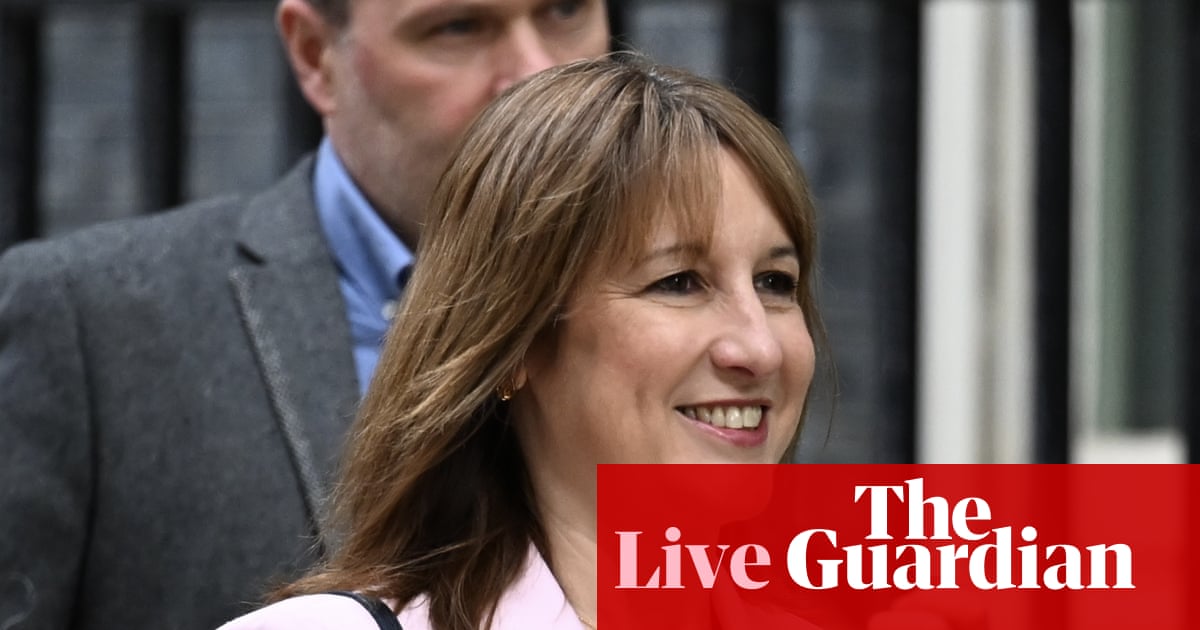
Reeves: GDP figures show we have the right economic plan
Chancellor Rachel Reeves can be forgiven for tooting her own trumpet this morning, after the UK economy grew faster than forecast in March.
Following the news that GDP rose by 0.3% in March, and by 0.6% in the first quarter of the year, Reeves says:
double quotation markToday’s strong growth figures show the Government has the right economic plan.
The choices I have made as Chancellor mean our economy is in a stronger position as we deal with the costs of the war in Iran.
Now is not the time to put our economic stability at risk.
That last sentence sounds like a reproachful glare towards her colleagues who are trying to push prime minister Keir Starmer out of Downing Street (which could lead to a change of chancellor too…)
Updated at 02.19 EDT
Key events
Show key events only
Please turn on JavaScript to use this feature
Experts: Q1 growth spurt may be as good as it gets in 2026
Several analysts are warning that Britain’s pick-up in growth in January-March may be the best we see this year.
Ruth Gregory, deputy chief UK economist at Capital Economics, says she would be very surprised if growth doesn’t weaken from May, adding:
double quotation markGDP rose by a bumper 0.6% q/q in Q1 (consensus and CE forecast 0.6%), but this will be the high point for the year given the effects of the war in Iran will sap growth from Q2. In our baseline scenario, the economy doesn’t grow at all in Q2 and Q3. Prolonged political instability is an extra downside risk to our forecasts.
Michael Brown, senior research strategist at brokerage Pepperstone, also suspects the 0.6% jump in GDP in Q1 will mark the peak in terms of UK growth this year:
double quotation markRisks remain clearly tilted to the downside moving forwards, principally as a result of the ongoing Middle East conflict, and subsequent surge in energy prices, which will in turn impact the economy in the manner of a significant negative demand shock, over the next couple of quarters.
Added to which, renewed political uncertainty in Westminster is also likely to act as a significant headwind to the economy at large, not only delaying major investment decisions, but with said uncertainty having also resulted in considerably tighter financial conditions as a result of the recent sell-off in Gilts across the curve.
Raj Badiani, economics director at S&P Global Market Intelligence, predicts the UK economy will shrink slightly later this year:
double quotation mark“The UK economy outperformed in the first quarter of this year with growth reaching 0.6% quarter over quarter, despite being at odds with lacklustre survey indicators during this period. This continues the recent pattern of unexpectedly strong growth in the first quarter of the year, while stockpiling of some goods ahead of anticipated shortages arising from the Iran war lifted demand in March.
“Nevertheless, recession risks have risen, and we now expect the UK economy to contract mildly in the second and third quarters of this year. The main driver is a prolonged energy price shock pushing headline inflation above 4.0% in the coming months, and the resulting pressure on the Bank of England to raise interest rates to counter emerging “second-round” effects.
ShareComputer programming and advertising had strong growth in Q1
Here’s ONS Director of Economic Statistics Liz McKeown on today’s UK GDP report:
double quotation mark“Growth picked up in the first quarter of the year, led by broad-based increases across the services sector. Within that wholesale, computer programming and advertising performed particularly well.
“Production also grew slightly, while construction returned to growth, though only partly reversing weakness at the end of last year.”
ShareReeves: GDP figures show we have the right economic plan
Chancellor Rachel Reeves can be forgiven for tooting her own trumpet this morning, after the UK economy grew faster than forecast in March.
Following the news that GDP rose by 0.3% in March, and by 0.6% in the first quarter of the year, Reeves says:
double quotation markToday’s strong growth figures show the Government has the right economic plan.
The choices I have made as Chancellor mean our economy is in a stronger position as we deal with the costs of the war in Iran.
Now is not the time to put our economic stability at risk.
That last sentence sounds like a reproachful glare towards her colleagues who are trying to push prime minister Keir Starmer out of Downing Street (which could lead to a change of chancellor too…)
Updated at 02.19 EDT
Construction sector surged in March
Output across the UK’s construction output increased by 1.5% in March, the ONS reports, thanks to new building work and repairs.
This morning’s GDP report says:
double quotation markThe increase in monthly output in March 2026 came from increases in both new work, and repair and maintenance, which grew by 2.0% and 0.8%, respectively. At the sector level, the main contributor to the monthly increase was private housing new work, which grew by 2.8%.
That follows a fall in new building work in the second half of last year.
ShareUK quarterly growth rises to 0.6%
UK economic growth picked up on a quarterly basis, the ONS reports.
UK GDP rose by 0.6% in the January-March quarter, up from 0.2% in October-December.
All three major sectors of the economy grew; services output grew by 0.8%, production output grew by 0.2%; and construction output grew by 0.4%.
ShareUK economy beats forecasts with growth in March
Newsflash: The UK economy kept growing in March, despite the economic damage caused by the Iran war.
UK GDP rose by 0.3% in March 2026, the Office for National Statistics has reported, beating forecasts of a contraction of 0.2%.
That follows growth of 0.4% in February and no growth in January (revised down from growths of 0.5% and 0.1% previously estimated).
The ONS adds.
double quotation markServices and construction output both grew, by 0.3% and 1.5%, respectively – these growths were partially offset by a 0.2% fall in production.
Updated at 02.03 EDT
Bank of England deputy governor Sarah Breeden has declared that interest rates do not need to rise in June or July.
In an interview with the Financial Times, published this morning, Breeden said:
double quotation mark“We’ve got time to understand firstly the size of the shocks and secondly, how the economy is evolving.”
“You’re obviously correct that we can’t wait forever, but we don’t need to do it in June or July.”
Breeden, a member of the Bank’s monetary policy committee (which sets interest rates) added that the BOE was “in a good place to be able to watch what’s happening in the economy,” saying:
double quotation mark“We don’t need to rush to act.”
Updated at 01.56 EDT
Housing market in England and Wales weakening due to Iran war, say estate agents
The Iran war, and the resulting jump in borrowing costs, is dampening the UK housing market.
My colleague Tom Knowles reports:
double quotation markFears of higher mortgage rates and rising inflation as a result of the Middle East conflict are leading to a subdued and downbeat housing market, according to estate agents.
Demand from potential homebuyers across England and Wales has shown a “noticeable softening” recently, according to a monthly survey of estate agents by the Royal Institution of Chartered Surveyors (RICS).
Members have told the professional body that buyers and sellers are becoming more cautious, and many agents have cited clients who are worried about whether inflation and interest rates will rise in the coming months, leading to slower sales, fewer homes on the market, and more price-sensitive buyers.
ShareIntroduction: It’s UK GDP day
Good morning. We’re about to learn how much economic damage the UK suffered in the early weeks of the Iran war.
The first estimate of UK gross domestic product (GDP) in March, and for the first quarter of the year, is due to be released at 7am.
Economics fear the Middle East conflict, which began at the end of February, will have hit activity in the UK. The consensus is that GDP may have fallen by around 0.2% in March, a reversal of the 0.5% growth recorded in February.
For Q1 as a whole, City experts predict growth of 0.6%, up from 0.1% in October-December 2025.
But the outlook for 2026 looks tough, as economies are hit by rising energy prices, with food inflation set to jump too.
Fergus Jimenez-England, associate economist at the economic forecasting body NIESR, fears the UK economy faces “a year of weak growth and high inflation.”
double quotation mark“The UK economy is in a state of transition. It began the year with some momentum, as business sentiment recovered following the Autumn Budget, but conflict in the Middle East has since stifled that momentum.
As businesses adjust to this latest energy shock, leading indicators are sending mixed signals. Input price inflation has picked up sharply and job vacancies continue to fall, pointing to softer demand conditions ahead. At the same time, retail sales and PMIs have held up, although some of this strength may reflect firms and households bringing forward spending in anticipation of further price rises.”
The agenda
7am BST: UK GDP report for Q1 2026
7am BST: UK trade report for Q1 2026
9.30am BST: Survey of economic activity and social change in the UK
10.30am BST: Resolution Foundation event: Resetting Government economic priorities for the remainder of the Parliament
1.30pm US retail sales for April
1.30pm US initial jobless claims