
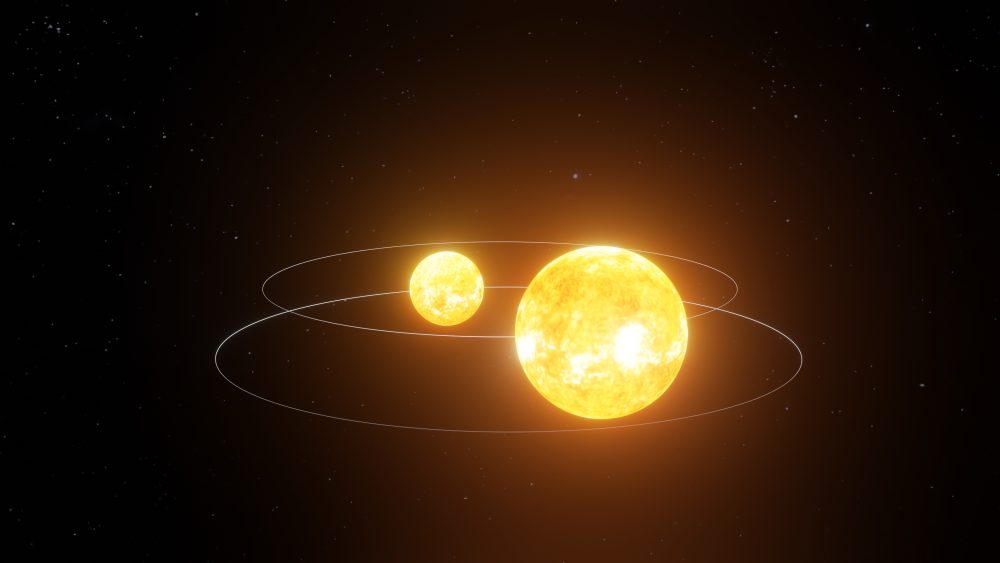
Just when astronomers think they understand how planets form, another strange world shows up and changes the conversation. This time, the surprise comes from planets that orbit not one star, but two.
These worlds are called circumbinary planets. They move around twin stars that are locked in orbit with each other, creating skies that would look nothing like Earth’s.

For years, these planets felt rare and almost fictional. After all, the most famous example is Tatooine from Star Wars. But scientists may just have opened the door to finding many more of them.
Circumbinary planets are uncommon
A new study identified 27 possible circumbinary planets at once using a different way of searching the sky. Until now, only 18 confirmed circumbinary planets had ever been discovered, compared with more than 6,000 planets found around single stars.
“Most of our current knowledge on planets is biased, based on how we’ve looked for them,” said Ms Margo Thornton, lead author of the study, astronomer and Ph.D. candidate at UNSW. “We’ve mostly found the easiest ones to detect.”
“This new method could help us uncover a large population of hidden planets, especially those that don’t line up perfectly from our line of sight. It could help reveal what the true population of planets in our universe might look like,” she added.
A blind spot in planet hunting
Most planets are discovered using something called the transit method. Scientists watch a star and wait for a planet to pass in front of it. When that happens, the star’s light dims slightly for a short time.
That method works well, but it has limits. A planet has to cross the star from Earth’s exact viewing angle. If its orbit tilts differently, astronomers may never notice it. And this becomes even trickier in systems with two stars.
“We’re missing a huge part of the architecture for these systems,” said Scientia Associate Professor Ben Montet, astronomer and senior author on the study.
New method locates circumbinary planets
Instead of looking for tiny dips in starlight, the new method studies how two stars orbit each other over long periods.
Scientists tracked subtle timing changes in the stars’ eclipses using data from NASA’s Transiting Exoplanet Survey Satellite, known as TESS.
If the stars behave differently than expected, another object may be pulling on them gravitationally. That hidden object could be a planet.
The technique is called apsidal precession. Astronomers have used it before to study binary stars, but not as a large-scale planet search tool.
“I’m excited about the potential for how many planets we could find with this method,” said Montet. “I wasn’t expecting to find 27 already at this point from the pilot study.
“Now we get to start the really fun project of figuring out which ones are real planets.”
Strange worlds around twin suns
The possible planets vary wildly in size. Some may be close to Neptune’s mass. Others could be up to 10 times larger than Jupiter.
The nearest candidate sits roughly 650 light-years from Earth. The farthest is about 18,000 light-years away. One light-year equals about 5.9 trillion miles (9.5 trillion kilometers).
“The candidates are scattered across both our southern and northern skies,” said Montet.
“This means that any time of the year, no matter when you’re looking, at least one of these star systems is out there, visible for you to look towards – as long as you have a telescope.”
Circumbinary planets may not be unusual
Even though those distances sound enormous, they still place these systems within the Milky Way neighborhood that astronomers regularly study.
The numbers also hint that circumbinary planets may not be unusual after all.
“We found 27 planet candidates out of 1590 binary star systems, which is an almost 2 percent rate of binary systems that could potentially host planets,” said Associate Professor Montet.
This implies that there could be thousands, or tens of thousands, of possible planets to be found with data from the Vera C. Rubin Observatory’s new 10-year sky survey.
“So it’s a really exciting first step – and it also shows that there’s going to be a lot of work to do over the next few years,” said Montet.
Why this matters beyond Star Wars
More than half the stars in the Universe belong to binary or multiple-star systems. That means solar systems like ours may actually be less common than people once thought. Yet most known planets orbit single stars because those are easier to study.
“We’ve painted half a picture, and the other half of the canvas is completely blank,” said Montet.
Scientists still do not fully understand how planets form around two stars. The gravity in those systems is more chaotic, which could affect how planets grow, move, and survive over billions of years.
New understanding from circumbinary planets
“With this method so far, we have 27 strong planet candidates in environments completely unlike our own solar system,” said Ms Thornton, who made these findings just one year into her Ph.D. research.
“By learning more about different types of planets, we can better understand how planets form and evolve, especially in these complex environments with two stars.”
Researchers are especially interested in whether some of these planets could support life.
“We can start asking questions like how common these planets are overall and if they could be habitable,” said Associate Professor Montet.
“If circumbinary planets do turn out to be habitable, that means life could be anywhere. Life could be everywhere. The sheer numbers are really exciting.”
One discovery leads to another
Right now, the 27 objects are still considered candidates. Scientists need more observations before confirming whether they are truly planets.
The research team plans to study the stars’ light signatures using the Anglo Australian Telescope in Coonabarabran. They will also work with researchers in the United States, the United Kingdom, and China.
Those follow-up observations could rule out other explanations, including brown dwarfs, white dwarfs, black holes, or hidden stars.
Many more Tatooines out there
The new method has proved very effective at locating potential new circumbinary planets. “I was surprised by how effective the method was and how small of a signal we could pick up on using the TESS data,” said Ms Thornton.
The method could even help astronomers locate objects as small as Earth.
“I’m excited for what’s to come next with this project. The Universe is a lot more complex than we can directly see,” concluded Ms Thornton, “and there could be a lot more of these real-life Tatooines out there.”
The full study was published in the journal Monthly Notices of the Royal Astronomical Society.
—–
Like what you read? Subscribe to our newsletter for engaging articles, exclusive content, and the latest updates.
Check us out on EarthSnap, a free app brought to you by Eric Ralls and Earth.com.
—–