
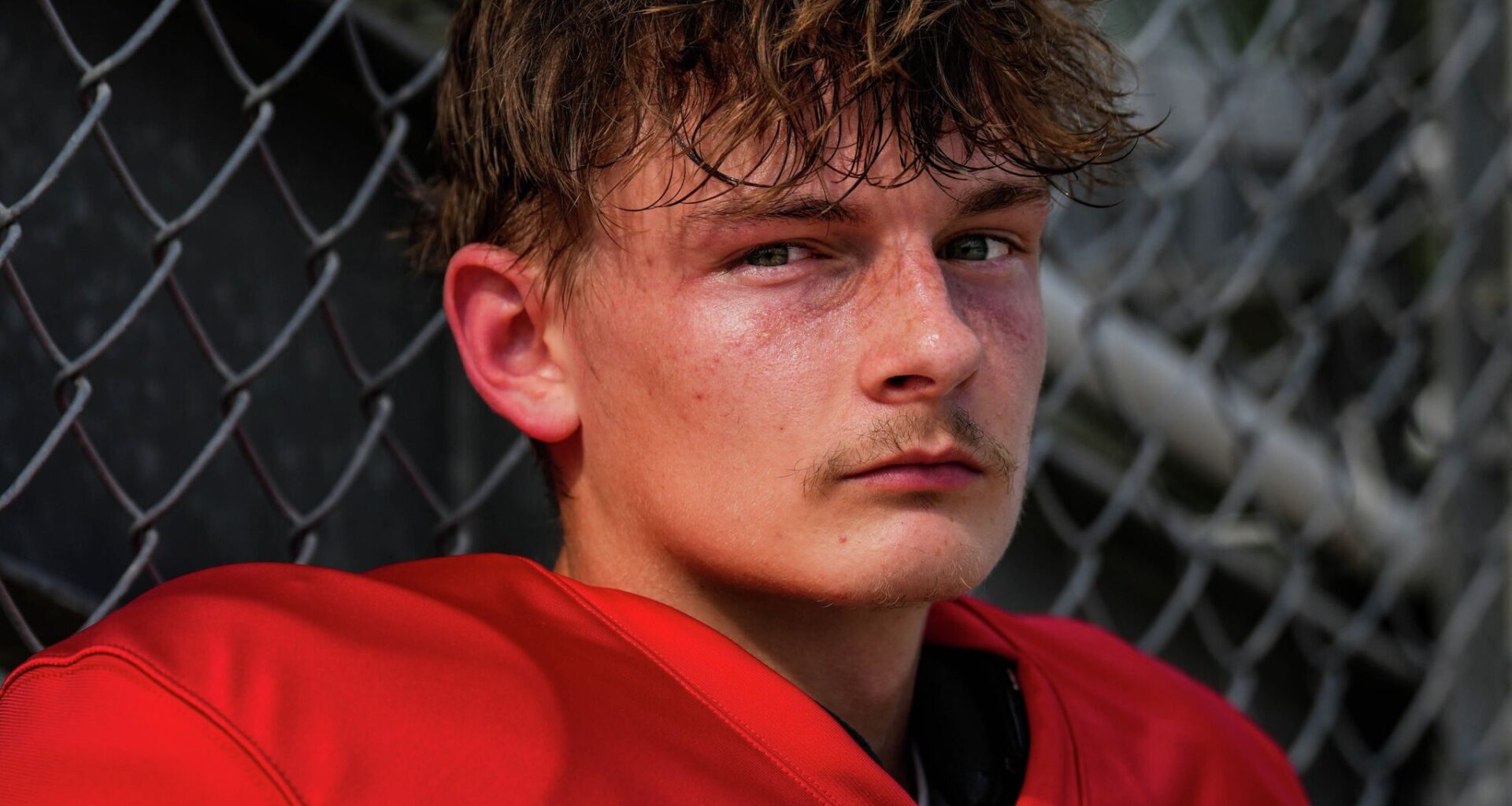
Atascocita football kicker Phoenix Sosnowicz is photographed at football practice at Atascocita High School in Humble, Wednesday, April 29, 2026.
Raquel Natalicchio
As Phoenix Sosnowicz jogs across the field under the late-afternoon sun, he’s found his reprieve. Football has become an escape for the 18-year-old Atascocita High School junior, who’s already endured some major challenges in his young life.
Sosnowicz has dealt with significant family issues. His parents are drug addicts and alcoholics, he says. Those circumstances at home, combined with the pressure that comes from keeping up with school work and performing as a kicker for the football team, has been nearly crippling at times.
Now living with his grandparents, Michelle and Robert Spradling, and his 16-year-old sister, Athena, Sosnowicz is in a better place. But he’s had some help to get there. He’s seen a therapist and spoken at length about his emotions, his troubles and the kind of life he wants to build as he embarks on his final year of high school in Humble ISD.
Article continues below this ad
NFL: Mental health efforts expand but gaps still persist
Sosnowicz is focused on healing, but he also wants to help others who may be facing similar situations. He took the first step in that process on April 1, posting on social media about what he’s been going through.
“Lately I’ve been dealing with some mental health issues,” he wrote. “A lot has been going on in my life, and I’m coming here to say that your mental health matters. If something is bothering you, please talk to somebody. I’m not going to let this define who I am.”
Sosnowicz isn’t alone. As conversations surrounding mental health become more common in sports, experts say high school athletes are facing unprecedented pressures — from recruiting and social media scrutiny to burnout and the demands of balancing sports, academics and life outside of school.
Article continues below this ad
“I know other people also struggle with that stuff,” Sosnowicz told the Chronicle before a recent spring football practice. “I’ve been told by a bunch of people that I should speak up about it and see that it has an impact on people. I can make sure they know that they’re not alone. I want them to have courage and talk with somebody.”
HOUSTON TEXANS: How one team is changing the narrative on mental health
Atascocita head football coach Kyle Coats, who took over the program in February, has tried to hit the ground running when it comes to establishing his culture. One of his main objectives is building relationships with players and parents and connecting on a level that extends beyond the football field.
Coats said when Sosnowicz posted about his struggles, it set an example for the rest of the players in the program.
“I think there’s a big piece of mental toughness that it takes to be that vulnerable,” Coats said. “We ask a lot of our kids to get up and just share about themselves — rip your heart out of your chest and just show it to everybody, show them who you are. So I think that was a really cool thing to see, just for him to be that open and honest about what he was going through.
Article continues below this ad
“I think sometimes football is looked at as, ‘Oh, I’m a tough guy. I never have any problems.’ But a lot of us go through a lot of stuff, coaches and players alike.”
Pressure to perform
May is Mental Health Awareness Month, first established in the United States in 1949. In the 77 years since, conversations surrounding the subject have shifted significantly, mental health experts told the Chronicle. Perhaps the most meaningful progress, however, has been made over the past decade or two, especially when it comes to its impact on athletics.
According to a 2023 study published in Health Psychology Research — which surveyed 200 high school athletes between the ages of 16 and 17 — 91% said they experience some level of stress associated with balancing academics and athletics. While a third of those athletes claimed the stress positively impacted performance, self-pressure and fear of failure were the most common causes. Furthermore, 58% reported experiencing moderate to severe stress, and only about 27% of those athletes wanted, but did not receive, help from a professional. Of all the participants who reported some level of stress, only 18% believed receiving professional help would be beneficial for them.
“It’s hard to separate mental health and performance because they’re essentially one and the same,” said Cortnee White, a mental performance coach and therapist based in the Houston area. “If we are not taking care of ourselves or we are taking on a stress load or anxiety load or an injury load, we are going to carry that onto the court, onto the field. We can’t just turn it off, right? I can’t just be stressed outside of my sport, at home or in my academics, and then walk in and perform at my highest level.”
Article continues below this ad
JUSTIN BRITT: How former NFL player found peace
White, who competed as a high school and collegiate athlete and holds a master’s degree in clinical mental health counseling, said young athletes often face a “perfect storm” of factors that can impact both their well-being and performance.
“This is one of the most vulnerable times of growth and development, just in general,” White said. “What’s happened to youth sports, 9-18 (years old), is that the structure has really changed. We’ve professionalized it. It’s more expensive. It’s more outcome driven. We’re talking earlier and earlier about recruiting, and NIL has come into play. For these kiddos, it feels less like play and more like a path we have to get right.”
High school athletes today are also more exposed to social media than ever before, White said, which can create an additional layer of pressure for athletes who constantly feel watched, compared and evaluated.
“Mistakes feel more permanent, and stats feel heavier than they ever were,” White said. “So that’s putting on an extra layer of pressure, which turns into fear of failure and this consistent need for perfectionism.”
Article continues below this ad
Atascocita football kicker, Phoenix Sosnowicat, is photographed at football practice at Atascocita High School in Humble, Wednesday, April 29, 2026.
Raquel Natalicchio/Houston Chronicle
Atascocita football kicker, Phoenix Sosnowicat, is photographed at football practice at Atascocita High School in Humble, Wednesday, April 29, 2026.
Raquel Natalicchio/Houston Chronicle
Atascocita football kicker, Phoenix Sosnowicat, is photographed at football practice at Atascocita High School in Humble, Wednesday, April 29, 2026.
Raquel Natalicchio/Houston Chronicle
Atascocita football kicker, Phoenix Sosnowicat, is photographed at football practice at Atascocita High School in Humble, Wednesday, April 29, 2026.
Raquel Natalicchio/Houston Chronicle
Atascocita football kicker, Phoenix Sosnowicat, is photographed at football practice at Atascocita High School in Humble, Wednesday, April 29, 2026.
Raquel Natalicchio/Houston Chronicle
Burnout is another growing concern, White said, especially as more athletes specialize in one sport at an early age and compete year-round without enough time to recover mentally or physically.
“I think we have to create more recovery time,” White said. “We’re playing year-round. We’ve lost multi-sport athletes. We’re burnt out. Kids are chronically stressed. We have to make sure that it’s OK for kids to take a break, to step away for a minute. Not just physical rest, but mental space.”
Puja Patel, director of pediatric psychology at Dell Children’s, said adolescence is already an emotionally intense period of life because the brain is still developing. Patel noted that suicide is the second-leading cause of death among adolescents and that depression rates have been on the rise for several years.
“In the moment, when they have those big feelings or those pressures, it feels like this is the moment that’s going to last forever,” Patel said. “And then if you add in athletics to that, high school athletes have an added component of practices and just pressure for performance. It’s this constant juggle between all of these things, when the brain is still learning how to plan and how to problem solve.”
Changing the conversation
White said one of the biggest challenges surrounding athlete mental health for a long time was the stigma attached to speaking openly about personal struggles. But that dynamic has shifted significantly in recent years, particularly as prominent professional athletes have shared their own experiences publicly.
From Olympic legends Simone Biles and Michael Phelps to NBA All-Star Kevin Love, Dallas Cowboys quarterback Dak Prescott and PGA Tour golfer Gary Woodland, athletes across several sports have become more vocal advocates for mental health awareness.
“It does wonders,” White said. “It has an immediate effect when these big-time athletes — who we think are untouchable, who we think don’t have any challenges — come forward and say, ‘I’m human.’ I think it’s been one of the biggest shifts in younger athletes getting the care that they need.”
According to the National Federation of State High School Associations, more than 8 million high school students participated in athletics in 2024-25, including more than 879,000 in Texas alone. Organizations like the Texas High School Coaches Association have increasingly recognized mental health as an issue that requires greater attention and education.
The THSCA announced in 2023 that it was partnering with Ascension through Dell Children’s Medical Center in Austin to provide coaches with mental health resources and training.
Libby Pacheco, a former volleyball coach who is now the COO of the THSCA Education Foundation, said one of the organization’s main goals is helping coaches identify athletes who may be struggling.
“From an association standpoint and from a coach’s standpoint, the biggest issues are really trying to identify and help not only the athletes that might in crisis, but also identifying those athletes that are struggling in ways that we maybe don’t see,” Pacheco said. “The behind the scenes kind of stuff. Our biggest focus for our coaches right now is talking, just from an education standpoint, about how do you have those conversations about mental health? How do you identify athletes, and then what do you do once they are identified? The other piece is maybe to prevent athletes from even getting to the point where they might be in crisis.”
White said coaches and parents are often on the front lines when it comes to recognizing changes in athletes’ behavior and emotional well-being.
“I think coaches need more education on what to look for and what to notice in these young athletes,” White said. “But when I speak to parents, they’re under more pressure than ever, too. I see parent anxiety just as much as I see athlete anxiety. I always tell parents and coaches that they have to regulate first. We have to remember that our athletes are essentially mirroring our states. In other words, if my parent is so anxious about my performance, how am I supposed to feel? If my coach can’t handle the stress of the game or the emotions of the game, how can I?”
Patel said coaches can play a critical role in creating supportive environments for athletes by focusing on growth and well-being, not just performance and results.
“I think in particular, coaches are so well positioned, not only to bring out the confidence and support for high school athletes, but they’re also another adult figure that is there and has eyes on their athletes to notice if they’re struggling or if they need additional support,” Patel said. “So they’re there as this resiliency factor in another human that cares and is part of their safety net.”
Patel also said it’s important for young athletes to develop identities outside of sports.
“When we think about athletics, it is such an important thing to be a part of a team and a community, but it’s also important for adolescents to expand their identity so that can’t just be the only thing they’re doing,” Patel said. “Because if we have an injury or we have a setback, if we put all our eggs in that basket, then it’s even harder to move on.”
For Coats, one of the simplest and most effective solutions to battling mental health concerns is building trust between coaches and athletes. He’s shared some of his own hardships with players and wants them to know they can come to him with off-the-field issues.
“I feel like if we can be open and honest and have open lines of communication, you don’t get into situations where a kid does something rash that he can never come back from,” Coats said. “I want you to come in and be open and honest and trust that I’m here to help guide you not just as a football player, but also as a young man.”
For Sosnowicz, speaking publicly about his own struggles was difficult, but he hopes it encourages other athletes to seek help when they need it.
“Just don’t keep it inside,” he said. “Talk about it with someone else. Even if it hurts, it will be way better than keeping it inside.”