
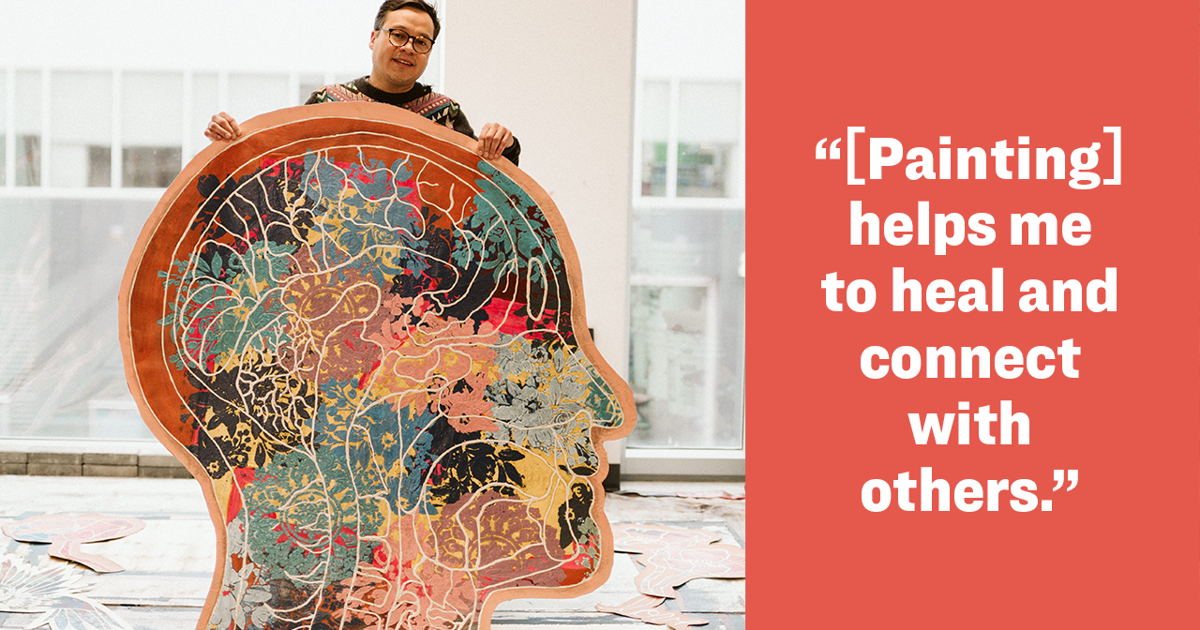
In his studio at the Arts + Literature Laboratory building in downtown Madison, Richie Morales paints from late afternoon into the night, listening to everything from folk music to Spanish rock. The large space is filled with bright splashes of color. Finished pieces — bold, geometric interpretations of everyday objects and images — hang on the walls. Morales’ in-progress works are scattered across the floor.
Music helps Morales focus his emotions and intentions while he paints.
“It’s something very sacred for me to paint,” Morales says. “So when I am painting, I would like to be there, present for my piece.”
Morales worked in carpentry and construction while growing up in Antigua, Guatemala. The city — world-renowned for its Spanish colonial architecture — and his work as a craftsman allowed him to develop an artistic aesthetic. Morales remembers being fascinated by everything around him, from spilled concrete drying in the sun to the techniques used to make furniture.
He moved to the United States in 2019 and continues to draw from his memories of Guatemala. “I think [my city] gave me a big, big, big experience in terms of the textures, the colors,” he says.
Morales uses primarily acrylic paint, which allows him to build layers and create interesting textures. While he draws inspiration from a variety of sources, like current events, politics, history and philosophy, he says memory is the “core” of his art.
“I am very curious about what memory means and how we remember — and how I can put those ideas and questions in colors,” he says.
From the Artist: Richie Morales

Photo by Christine Dopp
Speaking Through Art
I didn’t know until later in my life that I suffer [from] dyslexia. So that was really, really hard for me in terms of expressing myself through words. I discovered when I was a child that drawing or painting was a way to communicate with others.
Happy Accident
I fell in love with [acrylic paints]. But it happened by mistake. I found some house paint, and somebody provided me [with] a piece of cloth. When I started using the house paint, I just found that the possibilities of the acrylic textures … was something that I was looking for.
The Beginning
I start with the blank canvas and a lot of emotion. … Those pieces are made with a lot of intensity, in terms of what I’m experiencing in that moment. That doesn’t mean the end result is going to be sad or happy. It’s just a cathartic moment.
Close
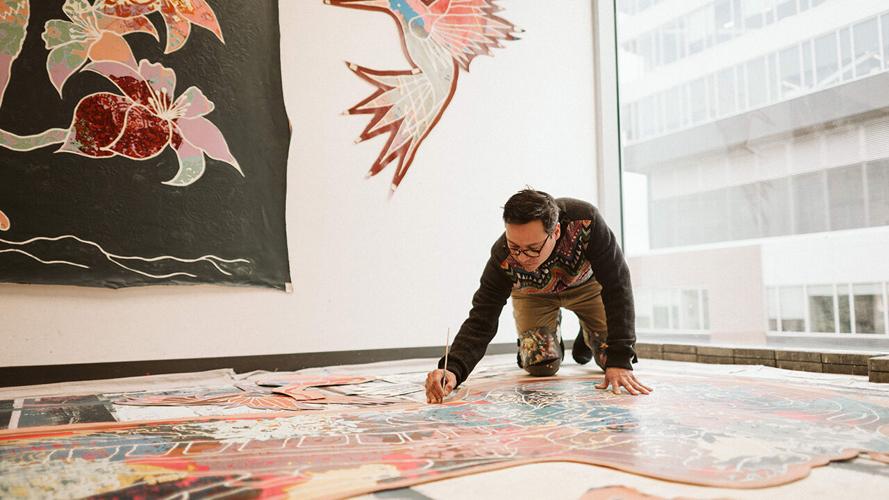
Instead of planning each piece before starting, Morales follows his intuition and emotion to paint the first layers. “In the beginning, I don’t have any plans,” he says. “I just let go.” Once the initial layers of paint have dried, he’ll start planning, sketching and sanding those layers to shape the final piece.
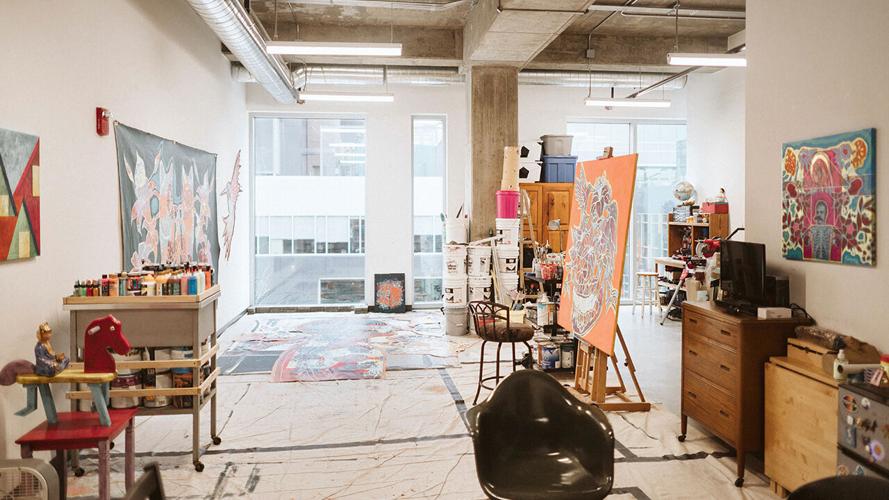
Inside Morales’ studio, a bookshelf is filled with philosophy texts by Byung-Chul Han, Bruno Latour, Frederick Nietzsche and more. He doesn’t always agree with the ideas, but reading philosophy prompts new ways of thinking and ideas for his paintings. “It’s beautiful because it’s a dialogue with them, right?” he says.
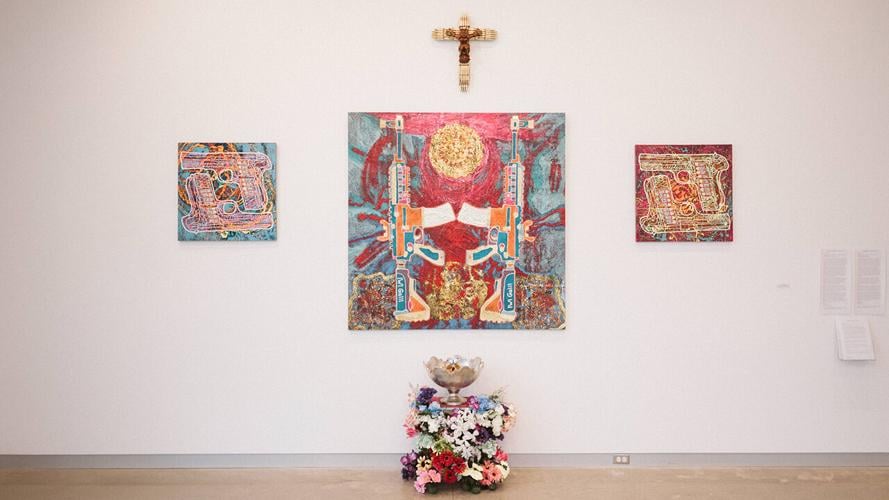
Morales draws inspiration from artists like Anselm Kiefer and Antoni Tapies, who experiment with texture and create art shaped by social context and history. Morales confronts and interprets current events and issues in his work, too. “Postmodern Gods,” which exhibited at Arts + Literature Laboratory earlier this year, is a reflection on hypermilitarism.
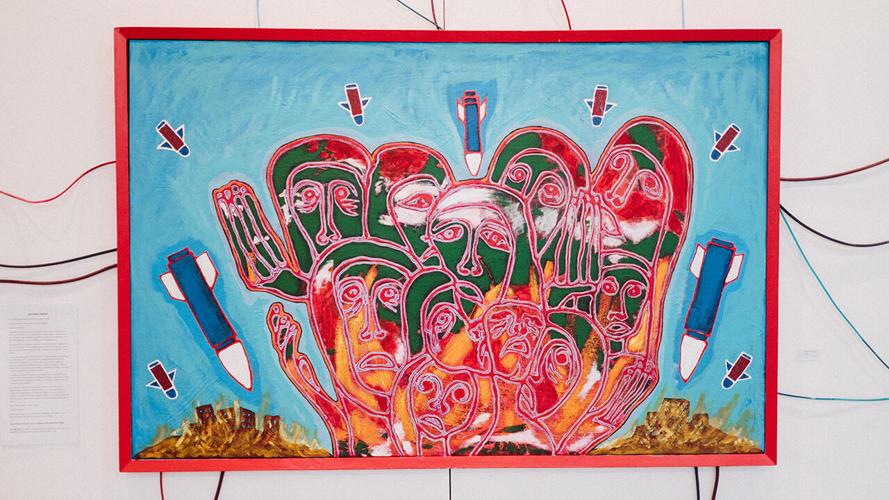
“The colors [I use] are a representation of the place I come from,” says Morales, referring to the bright and varied colors he remembers seeing in Guatemala.
Instead of planning each piece before starting, Morales follows his intuition and emotion to paint the first layers. “In the beginning, I don’t have any plans,” he says. “I just let go.” Once the initial layers of paint have dried, he’ll start planning, sketching and sanding those layers to shape the final piece.
Inside Morales’ studio, a bookshelf is filled with philosophy texts by Byung-Chul Han, Bruno Latour, Frederick Nietzsche and more. He doesn’t always agree with the ideas, but reading philosophy prompts new ways of thinking and ideas for his paintings. “It’s beautiful because it’s a dialogue with them, right?” he says.
Morales draws inspiration from artists like Anselm Kiefer and Antoni Tapies, who experiment with texture and create art shaped by social context and history. Morales confronts and interprets current events and issues in his work, too. “Postmodern Gods,” which exhibited at Arts + Literature Laboratory earlier this year, is a reflection on hypermilitarism.
“The colors [I use] are a representation of the place I come from,” says Morales, referring to the bright and varied colors he remembers seeing in Guatemala.
Abigail Bures is a freelance writer.
COPYRIGHT 2026 BY MADISON MAGAZINE. ALL RIGHTS RESERVED. THIS MATERIAL MAY NOT BE PUBLISHED, BROADCAST, REWRITTEN OR REDISTRIBUTED.