
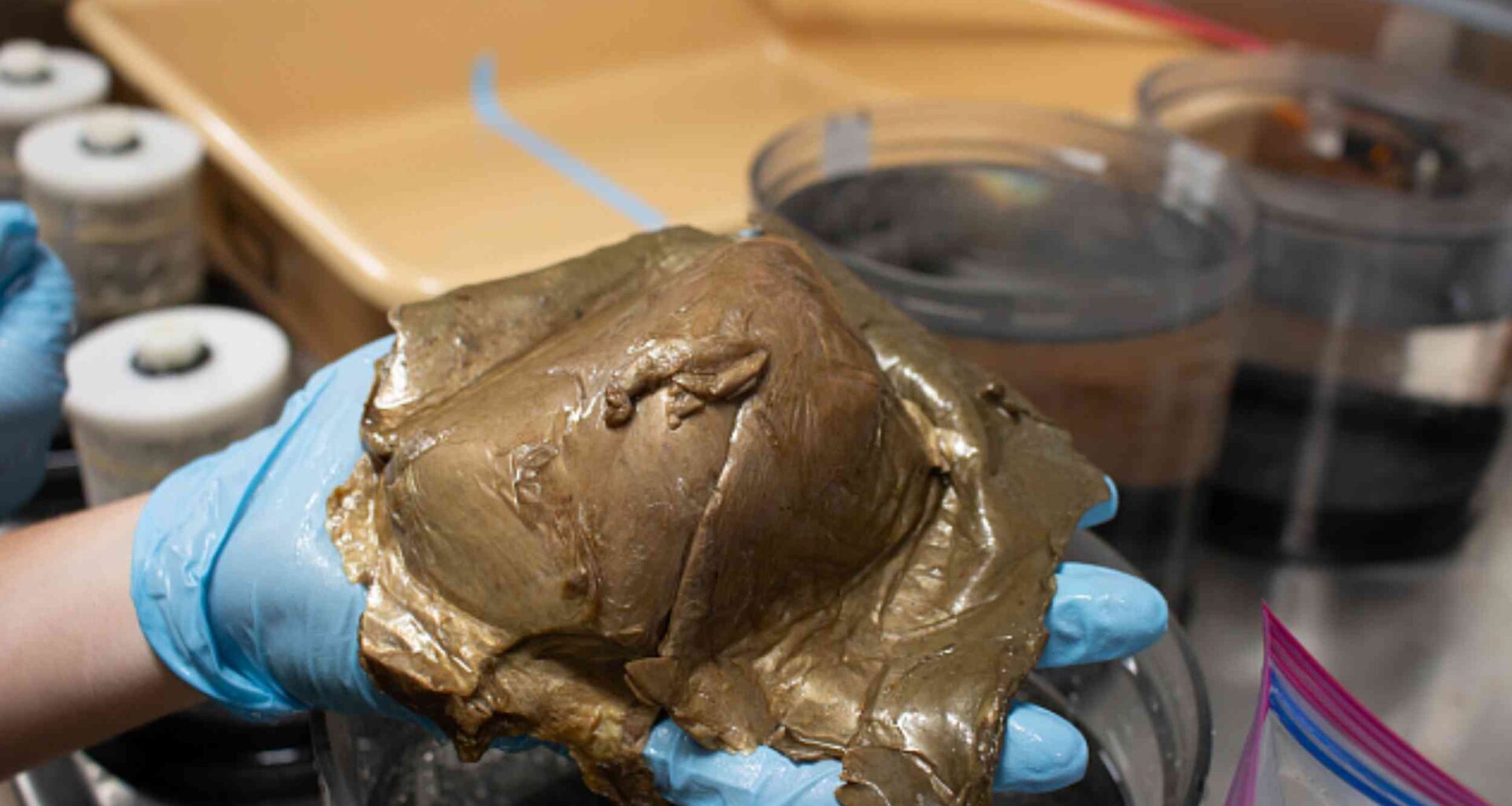
When an ROV encounters something unrecognizable on the seafloor, the working assumption is that the sample is alive.
These objects are normally determined to be organisms waiting to be classified and catalogued. This was assumed from the first video of the golden orb that appeared on the ocean floor.

It glowed pale gold in the ROV lights and was roughly the size of a softball. It was sealed shut except for a small torn opening at the top. The scientists on the feed debated whether to poke it.
A two-year long puzzle
This happened during NOAA’s Seascape Alaska 5 expedition. The ROV Deep Discoverer was working near an unnamed volcanic feature southwest of Walker Seamount in the Gulf of Alaska.
The object was sitting among glass sponges on a slab of basalt. It was smooth and oddly metallic, with a hole near the top.
Crew members nicknamed it the golden orb but did not know what it was. Was it an egg case, or a dead sponge, or something that had hatched?
They suctioned it up with the ROV’s intake nozzle and shipped it to the Smithsonian.
Not a typical animal
The sample landed in the labs of NOAA Fisheries and the Smithsonian National Museum of Natural History (NMNH).
There, Dr. Allen Collins zoologist and director of the National Systematics Laboratory took up the puzzle.
Under a microscope, the object had no recognizable animal anatomy. No mouth, no gut, and no muscle tissue. Just a loose mass of fibers wrapped in a smooth, layered skin.
“I suspected that our routine processes would clarify the mystery. But this turned into a special case that required focused efforts and expertise of several different individuals,” Collins said.
Stinging cells appear
A scientist in the lab named Abigail Reft spotted the first real clue. The surface of the object was packed with cnidocytes.
These are stinging cells found only in jellies, corals, anemones, and their close relatives.
More specifically, she identified a type of stinging cell found only in sea anemones, true corals, and black corals, and appears in nothing else within the animal kingdom.
The same stinging cells turned up in a similar specimen collected in 2021 by a separate expedition.
DNA matches Relicanthus daphneae
The initial DNA testing failed. Too many microbes were living on the orb, and their genetic material likely overwhelmed the host animal’s signal.
The team escalated to a more comprehensive analysis that eventually yielded a complete genetic blueprint from the orb’s cells.
That blueprint matched Relicanthus daphneae, a giant deep-sea anemone, almost perfectly.
The 2021 specimen matched too. A previous paper had already placed this species in its own corner of the anemone family tree, and these new sequences confirmed it.
Meet the giant anemone
Relicanthus daphneae is not a typical anemone. Individual polyps can stretch about a foot wide, with pale purple or pink tentacles trailing 7 feet behind them.
The species lives between roughly 4,000 and 13,000 below the surface. It was first described in 2006, roughly 30 years after its first sighting.
Since the discovery, it has been reclassified into a brand-new genus in a 2014 study.
This occurrence is rare, as few specimens exist in any collection. Most known information comes from ROV footage.
The footage displays living animals perched on rocks or tentacles drifting in the current.
To sum it all up, the orb wasn’t an egg, or a sponge, or an animal at all. It was merely a piece of one. Specifically, it was part of the anemone’s base, the layer the animal secretes to attach itself to rock.
That layer was hidden beneath the polyp, which why is there so little information about it. The orb was, in a sense, a leftover, and the animal had disappeared, in one way or another.
What happened to the rest of the anemone? It could have died and decomposed.
Or, it may have detached and moved on. Deep-sea anemones are often observed crawling, rolling, even swimming. It may be evidence of relocation.
The answers remain murky. One possibility is pedal laceration, a form of asexual reproduction where bits of the foot tear off and grow into new individuals.
Another solution could be plain shedding during locomotion. The final answer remains a mystery.
Future discoveries to be made
Two and a half years later, scientists have new knowledge of discarded material at the bottom of the Pacific.
Physical examination paired with DNA sequencing can pin a structure to a species, even when the original animal is gone.
That changes how future expeditions will treat odd lumps on the seafloor. A blob with no obvious anatomy may still carry a complete genetic blueprint.
Other ships, including the Okeanos Explorer, are headed back out for deep-sea work this year.
“With advanced techniques like DNA sequencing, we are able to solve more and more of them,” said Captain William Mowitt, the acting director of NOAA Ocean Exploration.
The ocean is full of unnamed things that are yet to be discovered in the years to come.
The study is published in bioRxiv.
—–
Like what you read? Subscribe to our newsletter for engaging articles, exclusive content, and the latest updates.
Check us out on EarthSnap, a free app brought to you by Eric Ralls and Earth.com.
—–