
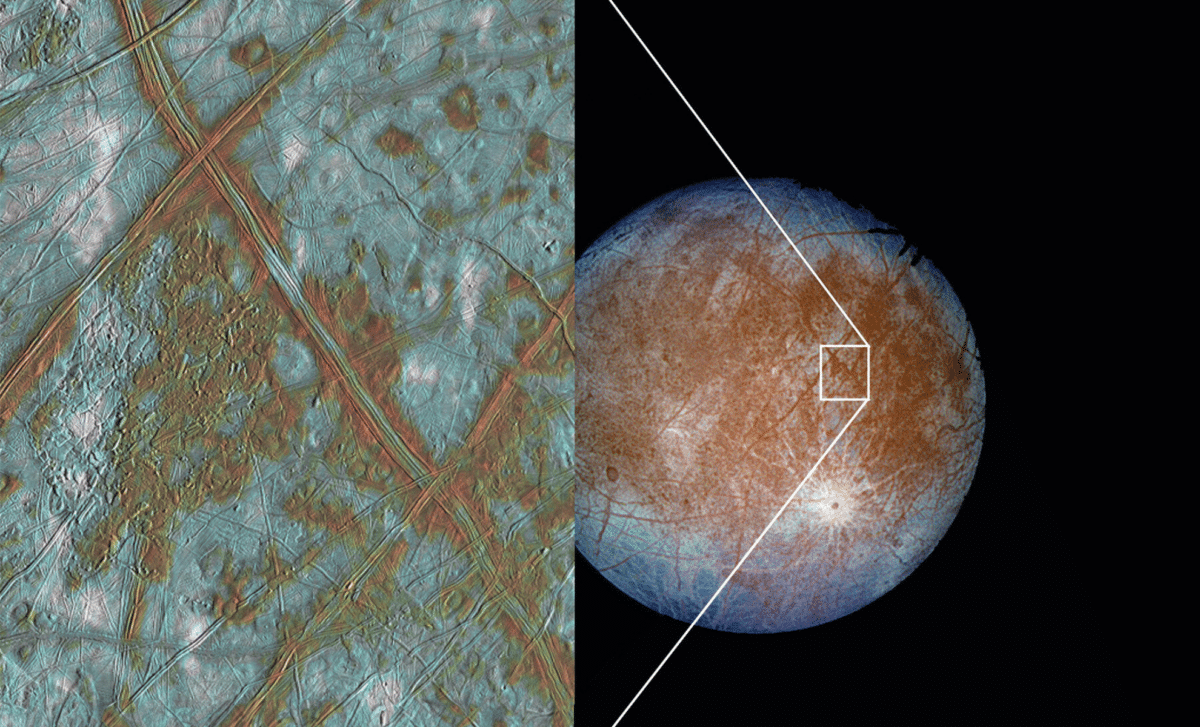
A fresh analysis of 14 years of Hubble Space Telescope data has cast doubt on previous claims that Jupiter’s icy moon Europa intermittently releases water vapor plumes. The research, published in Astronomy & Astrophysics, suggests earlier findings may have overestimated the certainty of these mysterious plumes, though the search for evidence continues.
Revisiting Europa’s Elusive Atmosphere
For nearly a decade and a half, scientists have studied Europa, fascinated by its icy crust and the potential subsurface ocean hidden beneath. Initial Hubble observations from 2012 suggested the moon might occasionally expel faint plumes of water vapor into space, raising hopes of studying Europa’s ocean without landing on its frozen surface. These plumes, if confirmed, could have significant implications for understanding the moon’s habitability.
“The evidence for water vapor plumes on Europa isn’t as strong as we first understood it,” said SwRI’s Dr. Kurt Retherford, one of the authors of the 2014 paper that initially reported the phenomenon. Retherford and his colleagues recently published a new paper reanalyzing the data, providing a more cautious assessment of Europa’s tenuous atmosphere.
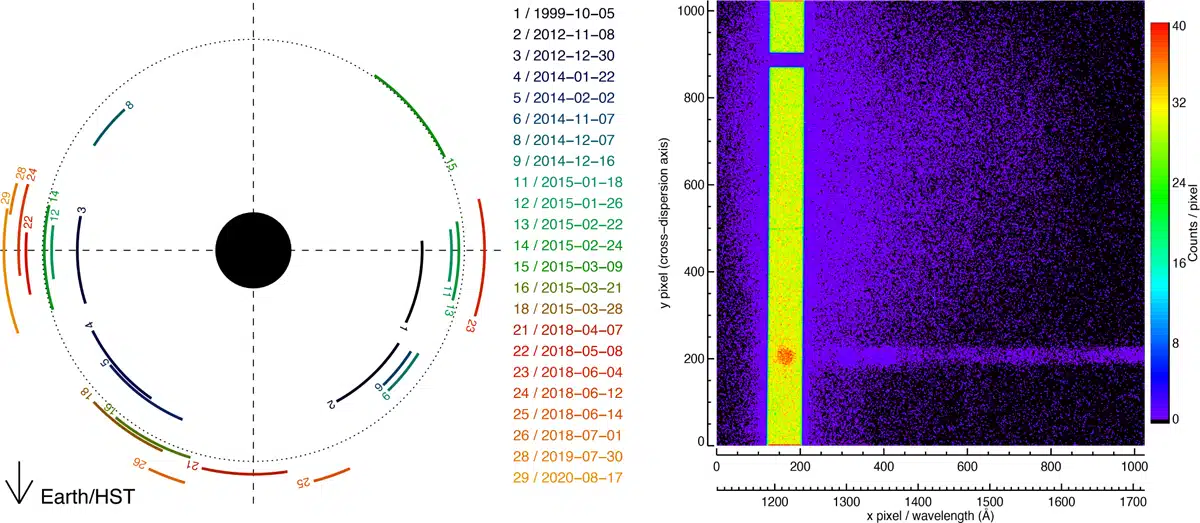 Overview of the analyzed HST/STIS observations. Left: orbital positions of Europa from the start of the first exposures to end of the last exposures for each of the 23 HST/STIS visits. Note: the gaps between exposures of a visit are not shown. Visit 21 combined exposures before and after transit. Right: complete STIS detector spectral image from visit 22. The Lyα signal from the geocorona and the interplanetary hydrogen fills the complete slit (yellow-green region). Reflected continuum sunlight from Europa’s surface forms the trace around row y=200. Atmospheric oxygen emissions are present at 1304 Å and 1356 Å, exceeding the surface reflection.
Credit: Astronomy & Astrophysics
The new study focused on Lyman-alpha emissions, ultraviolet light scattered by hydrogen atoms, which can indicate escaping water molecules. By reassessing Hubble’s positioning and calibration, the team revealed uncertainties that could have affected earlier interpretations.
“One of the difficulties in interpreting the data back then was determining where to place Europa within its context,” Retherford explained. “The way Hubble works left some uncertainty in terms of placement relative to the center of the image. If Europa’s placement was off even by just a pixel or two, it could affect how the data gets interpreted.”
Confidence Levels Drop, Questions Rise
The original research claimed a near-certain 99.9% confidence in the existence of water vapor plumes. The new analysis, detailed in Astronomy & Astrophysics, however, reduced that confidence to below 90%, which scientists say is insufficient to claim definitive evidence.
“Our reanalysis took our original 99.9% confidence in the plumes’ existence and reduced it to less than 90% confidence,” said Dr. Lorenz Roth of the Royal Technical Institute, Sweden, and lead author of the reanalysis. “That’s simply not enough evidence to support the certainty of claims we made at the time.”
The study does not rule out the possibility of plumes but highlights that prior data may have been misinterpreted. Retherford noted,
“The description of the phenomena just doesn’t hold up the same way anymore. The new data has made us reconsider the strength of the previous paper’s conclusion regarding water vapor plumes. The recent analysis also provides improved information about the neutral hydrogen atom component of Europa’s escaping atmosphere, originating from its water ice surface.”
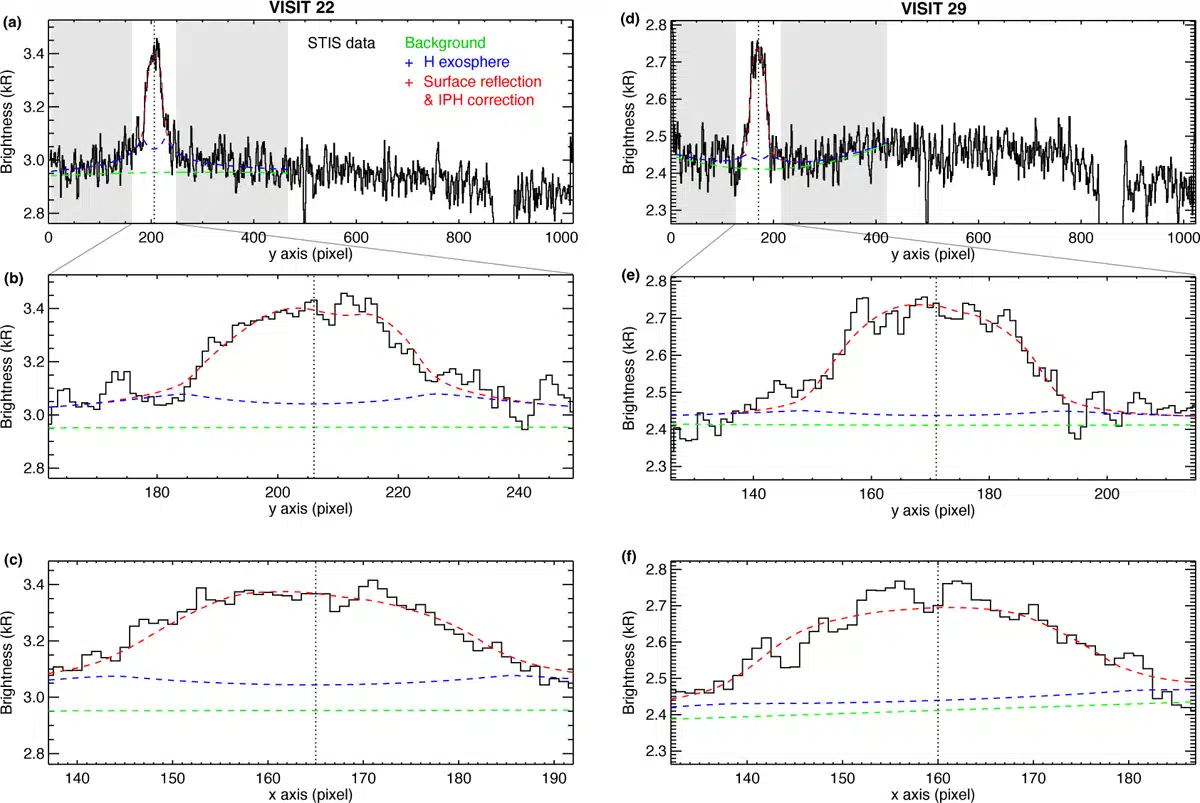 Data analysis and model fitting. Top: brightness for the entire Lyα slit along the y-axis, averaged over the x-axis (i.e., over the slit width). Middle: Zoom-in of the top panel. Bottom: brightness along the x-axis, averaged over a y range covering the disk diameter. The STIS data are shown as a black histogram. The fitted model is represented by dashed lines corresponding to different components: green for the background only, blue for the background plus H exosphere contribution, and red for the full model including surface reflection and IPH correction (see text). Note: the profiles are smoothed due to averaging over a detector axis (and, thus, across the disk), as well as by the convolution of the model image with the STIS point spread function. The vertical dotted lines indicate the disk center in all panels. The model was fitted within the central disk and the gray shaded regions (see top panel).
Credit: Astronomy & Astrophysics
Comparisons With Other Icy Moons
Europa is not alone in showing potential geologic activity. Saturn’s moon Enceladus has confirmed water vapor plumes, and Jupiter’s Io ejects sulfur dioxide into space. These moons provide a framework for understanding Europa’s possible activity and demonstrate that plumes can occur in different chemical and physical environments.
Scientists are particularly interested in Europa because of its vast saltwater ocean beneath the icy shell. Cracks in the ice could serve as pathways for water to escape, but confirmation will require direct observation. NASA’s upcoming Europa Clipper mission, scheduled to arrive in 2030, is expected to provide definitive measurements that will settle lingering questions about Europa’s atmosphere and plume activity.