
Dante’s Inferno describes Hell as a massive funnel-shaped pit, nine terraced levels deep, narrowing toward a frozen core where Satan sits trapped. Most readers treat that architecture as pure imagination – medieval theology dressed as geography.
One researcher has been reading the geometry differently. He thinks the funnel’s dimensions, the step-like levels, and Satan’s arrival at the center match something very specific: what happens when an asteroid-sized body hits a planet at high speed.
Satan as impactor

The argument comes from Timothy Burbery, a professor of English at Marshall University in West Virginia.
Burbery studies geomythology – the practice of finding real physical events encoded inside ancient stories – and he has spent years pulling geology out of literary texts.
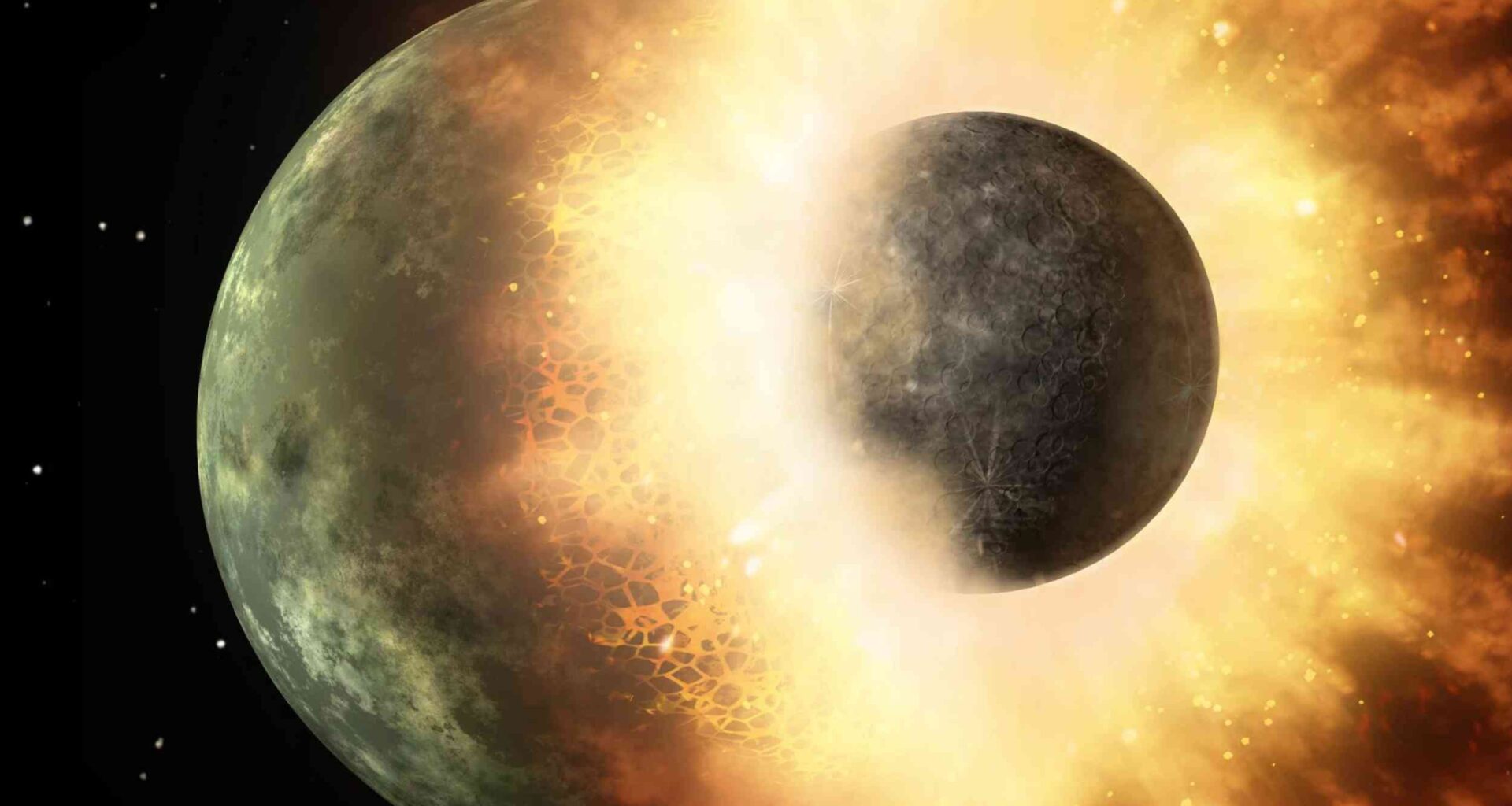
He reads Satan’s fall not as a quiet spiritual collapse but as a high-velocity strike on the Southern Hemisphere.
The devil, in his reading, is an asteroid-sized body that punches through the crust on the opposite side of the world from Jerusalem – and keeps going straight to the core.
In Dante’s telling, the displaced Earth erupts through the opposite hemisphere as Mount Purgatory – a central mountain left by the same blow.
A crater called Hell
Hell, in this reading, is what the impact leaves behind. It forms a bottom-up crater that opens widest at the surface and narrows step by step toward the center of the planet, where Satan sits frozen waist-deep in ice.
Each step of that descent is a terrace cut into the crater wall. The nine concentric rings of sin are not, in Burbery’s account, just moral categories.
They line up, he argues, with the layered, bowl-within-bowl structure found in large impact craters on the Moon and Venus. Planetary scientists have documented the same pattern across the solar system since the dawn of space exploration.
Compared to Chicxulub
Burbery places Satan’s fall in the same scale category as Chicxulub. That asteroid struck what is now Mexico roughly 66 million years ago and ended the reign of the dinosaurs.
The biggest comparison he reaches for is the Moon’s own origin story. A Mars-sized planet named Theia slammed into early Earth roughly 4.5 billion years ago.
The collision is thought to have rearranged the planet’s interior and thrown off the debris that became the Moon.
In Burbery’s reading, Satan plays a smaller-scale version of that role. The impactor is still large enough to redraw Earth’s architecture on its way to the core.
For physical form, Burbery reaches for two real-world analogs. Oumuamua – the cigar-shaped interstellar object that drifted through the solar system in 2017. And the Hoba meteorite, a 60-ton (54,000-kilogram) iron mass in Namibia that arrived intact rather than vaporizing on the way in.
Medieval views of space
Here is where the claim gets bolder. Dante wrote in the early 1300s. Meteoritics – the study of rocks falling from space – did not yet exist as a discipline. Nobody understood that rocks could fall from space at all.
For most of recorded history, meteors were treated as atmospheric weather, sparks in the upper sky.
The connection between those fireballs and actual stones on the ground was not made until a 19th-century study of the 1833 Leonids meteor shower.
Dante’s thought experiment
That gap is what makes Burbery’s claim interesting. Dante had no telescopes, no impact physics, no idea about deep time.
The Catholic worldview around him still ran on Aristotle’s notion that the heavens were perfect and unchanging.
And yet on the page, Dante worked through what now looks like an early version of the physics of a planetary impact: a massive object, terminal velocity, a breach in the crust, and a central peak. He arrived there by intuition, not data.
An emerging interpretation
The interpretation is not a peer-reviewed paper. Burbery is presenting it as a poster at the European Geosciences Union’s General Assembly in Vienna in May 2026, alongside other geomythology research.
“Although Dante was not a scientist, he was one of the first persons in history to think through the physical effects of a large mass slamming into the Earth at high speed,” Burbery wrote in his conference abstract.
Burbery argues this kind of literary-scientific reading has a practical use. The biggest obstacle to public action on asteroid threats is that they feel imaginary, far away, and almost impossible to take personally.
Modern impact research, including the study of the dinosaur-killing Chicxulub strike, still has to compete for attention against the older assumption that the sky is mostly safe.
A 700-year-old poem can carry the warning in a language people already understand.
Rethinking the Inferno
Until now, the Inferno has been read mainly as theology or political satire. Burbery’s contribution is to read it as a near-accurate description of what scientists now call a large impact basin.
That re-reading turns Dante into one of the first people on record to imagine an asteroid strike as a real physical event, not an omen.
It gives planetary defense educators a 700-year-old story for explaining what a major impact does to a planet.
The findings were presented at EGU General Assembly 2026.
—–
Like what you read? Subscribe to our newsletter for engaging articles, exclusive content, and the latest updates.
Check us out on EarthSnap , a free app brought to you by Eric Ralls and Earth.com.
—–