
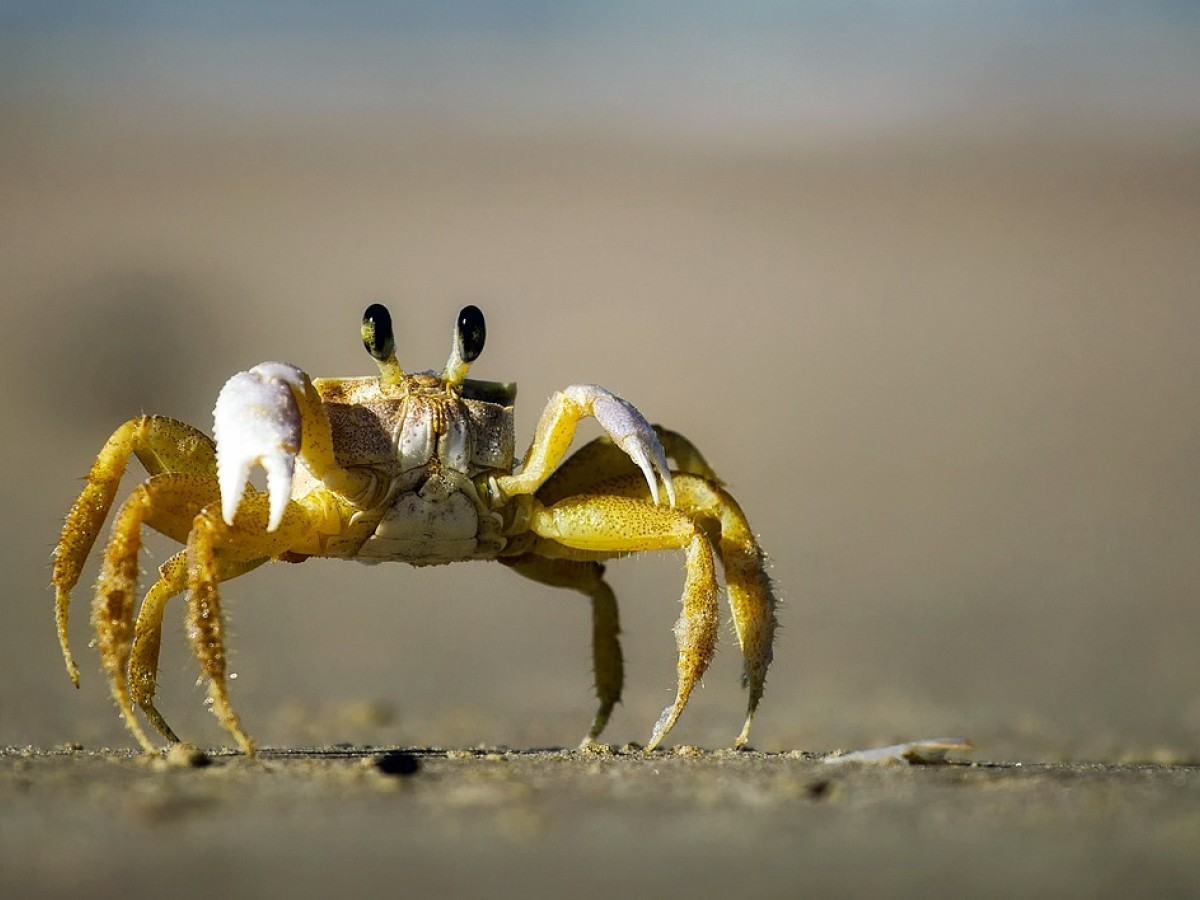
Now here’s a question: when – and why – did some crabs start walking sideways? Have they always done that, or did they start off moving forward and back and then shift to a sideways approach? And do the crabs that do actually still move forward and back do that because they always have, or did they evolve to do that having originally walked sideways? The answer is that no one actually knew. So, to find out, as Nagasaki University’s Yuuki Kawabata explains to Chris Smith, he set about recording how 50 different crab species – borrowed from beaches, aquaria, and even fish markets – move naturally. By looking at the relatedness of the different species to each other, and how they walk, his results suggest that sideways locomotion emerged once as a key innovation favoured by natural selection by about 200 million years ago. This sideways walking fed into crab descendents, but some of them later reverted to walking forwards again…
Yuuki – Crabs move sideways. That’s a very typical movement style of the crab. So we are very interested in when this sideways movement starts in evolutionary history.
Chris – Do all crabs walk sideways, or do some go forwards and backwards?
Yuuki – Actually, some crabs move forwards. Not all of the crabs move sideways.
Chris – And what came first? Was it sideways walking that then turns into forward walking, or do you think that probably, or did you suspect before you did this study, that some crabs or ancestors of crabs were forward and backwards movers that then evolved to move sideways? Which way round did you suspect it might be?
Yuuki – So there are common ancestors of crabs and a hermit crab species that’s called Meira. We know that it should move forward. So we suspected that sideways movements should have evolved from the forward movers.
Chris – And when we look at evolution, how old are crabs? When did they first appear on the scene?
Yuuki – So the first crab appears around more than 250 million years ago.
Chris – And how did you do this study to try to understand the origins of the sideways locomotion?
Yuuki – What we have done is we collected 50 crab species locomotion data. We put one crab into the large tank and then recorded the behaviour for 10 minutes. We just calculated whether this one species is moving sideways or forward.
Chris – And how does that help us to understand by doing it species by species like that about the evolution of this behaviour?
Yuuki – There was recently a lot of work has been going on regarding the phylogeny, so the evolutionary tree of the crabs. And then using that crab tree, and then we collect the behaviour data and we integrate it and we can reconstruct the ancestral state of locomotion. So whether the ancestral two species, whether they are moving forward or they’re moving sideways.
Chris – Do any of the crabs evolve to move sideways and then evolve to move forwards again? So if you look along the timeline, do you get a crab species that will obviously have been a sideways mover based on its ancestors, but then it re-evolves forward and backward movement? So it’s almost like they’ve regressed back in time against evolution.
Yuuki – Yeah, some species did actually. What we found is the first sideways movers appeared around 200 million years ago. And then this is only one event from the forward movers to sideways movers evolution. And after that, most of the species retained the sideways moving, but some of the species, very specialised species, evolved back to the forward movers.
Chris – Why do you think they evolved to move sideways in the first place? Because it seems a bit counterintuitive. You’ve got eyes on the front and you have to move across your visual fields and you’re blind behind. Why would they do that in the first place?
Yuuki – That’s a very difficult question. Actually, we’re working on that right now. We have no clear conclusion about it, but one likely adaptive benefit of having sideways is they can move quickly. And also escaping from predators is unpredictable by having two directions. So if crabs move forward or the other animals move forward, then it’s kind of only one direction it can move. But walking sideways means you can have two favourable directions. And also it is known that it’s faster than walking forward.
Chris – Is there any asymmetrical bias in the sideways movers? In the same way that I know humans are not crabs, but 90% of us are right-handed. We favour one side. There are lots of other animals that favour one side. Do any of the crabs show a bias to moving when they move sideways to the right or to the left preferentially?
Yuuki – It’s an interesting question, but we haven’t actually tested. There are very few studies, only some specific crab species that are left-handed and right-handed crabs, but we haven’t actually tested anything about it.