
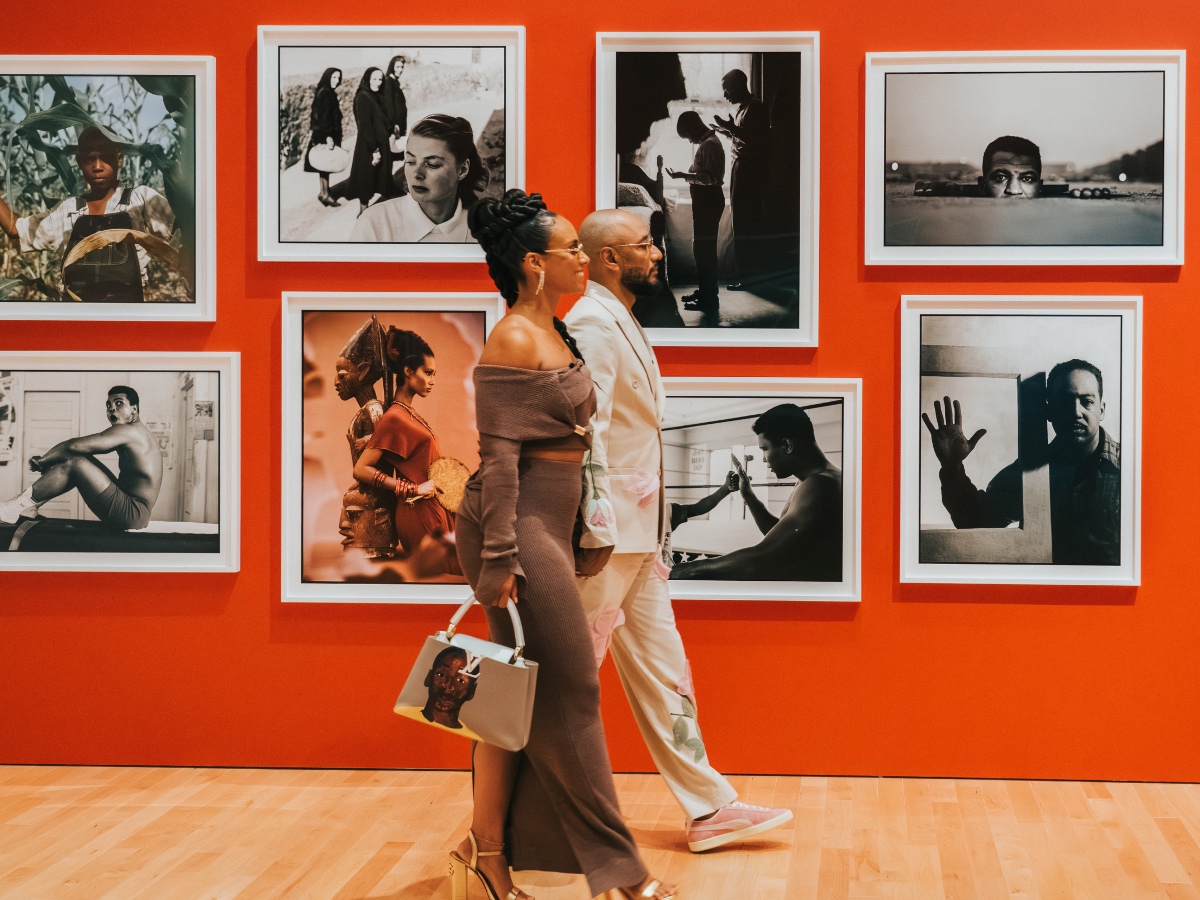
Photo Credit: Earl Manning

“Whoa,” Alicia Keys says, looking up at the wall-sized work in front of her. “This is crazy.”
Keys has just stepped into the first floor gallery at the Museum of Contemporary Art San Diego. Her reaction is directed at Mickalene Thomas’ large-scale creation, Le Dejeuner sur l’herbe: Les trois femmes noires. It’s her first time seeing it in person, though it’s something her husband, Swizz Beatz, immediately knew belonged in their collection. (“This feels really important for us,” she recalls Swizz telling her before deciding to acquire the piece.) He purchased it because he believed it was something people needed to experience, and Keys feels his decision reflects exactly what their traveling exhibition has come to represent.
“This is the reason why this has been so special because when [Swizz] says, by the artist for the artist—with the people, there is a connection that we have together with the artists because we’re all artists,” she says.
As individuals, Swizz Beatz and Alicia Keys are two of the most recognizable faces in music. One, is an iconic record producer and DJ with a unique eye for visual aesthetics. The other is a 18x GRAMMY Award-winner, and a classically-trained pianist. Together, they’re known as The Deans, one of the most influential families in the art world. Today, they’re in La Jolla for the opening party of for Giants: Art from the Dean Collection of Swizz Beatz and Alicia Keys, which has been making its rounds across the country.
Following a brief walkthrough of the exhibition, Swizz, Alicia, and I make our way to the museum’s third floor for our interview. Along the way, we pass works like Titus Kaphar’s A Puzzled Revolution (2021), one of Nick Cave’s Soundsuits (2016), and Arthur Jafa’s Big Wheel I (2018). The scale of the collection is striking, but what resonates even more is the fact that the Deans have chosen to share these works with the public instead of keeping them tucked away behind closed doors. “Well, we designed Giants for it to feel like people are walking into our home,” Swizz explains. “And we want people to feel like they’re welcome here,” Alicia adds. “Because they’re supposed to be here.”
Giants originally debuted at the Brooklyn Museum in 2024, a fitting starting point for a show created by two New York natives. Since then, it has traveled to cities including Atlanta, Minneapolis, Richmond, and now San Diego, drawing more than half a million visitors along the way. While each stop has adapted to its surrounding community, one constant throughout the exhibition’s run has been Dr. Kimberli Gant, the Brooklyn Museum’s Curator of Modern & Contemporary Art, who has helped guide Giants as it continues to evolve from city to city.
Article continues after video.
Gant’s relationship with the Deans began through the museum, where Swizz and Alicia were patrons of over the years. As conversations around their collection continued, the idea for a formal exhibition gradually took shape, and was strengthened by the shared understanding of what the project could be. From there, Gant worked closely with the couple to help shape the vision for Giants, balancing the ambitions of the Deans with those of each venue they would eventually visit. “There were several conversations about what their goals and hopes for the show were, same with mine and the institutions,” Gant tells me during our video chat. “Then, we brought together some ideas and as you can see, it worked out.” Even after being involved from the very beginning, she’s still surprised by how much the exhibition continues to reveal about itself.
“For me, every time I see the show, I notice something about different works that maybe I didn’t notice before,” Gant says. I agree, having previously experienced Giants during its Atlanta stop in the fall of 2024, I found myself drawn to entirely different works at MCASD. During my conversation with the Deans, I mentioned that despite the scale of what surrounded us, one piece in particular really stuck.
“There are a lot of amazing pieces in this collection, but the one that speaks to me the most is the Barkley L. Hendricks upstairs.”
“The landscape?!” Alicia responds. I nod in agreement. Casual admirers of Barkley L. Hendricks are often more familiar with his portraiture—works like Lawdy Mama (1969), What’s Going On (1974), or Sir Nelson, Solid! (1970) are typically the first images attached to his name, but the landscape hanging inside Giants is different. Part of a 14-work series inspired by the annual trips Hendricks and his wife began taking to Jamaica in 1983, these works feel far removed from the portraits that made him famous. The selection also says a great deal about Swizz’s eye as a collector, especially considering the story behind how the work entered the Dean Collection in the first place.
“I’ve been a big fan of Barkley for a long time,” Swizz notes. “I’ve met him, and spent time with him—I was looking to acquire his work for our collection.” The specific piece he had his eye on, Photo Bloke (2016), had already been sold when he was ready to purchase it, but the situation ultimately led to something more meaningful. Following a gathering at Jack Shainman Gallery in New York, Swizz had dinner with Hendricks and his wife, and the artist invited him to visit his studio and select other works because he appreciated what he and Alicia Keys were building their collection. Not long after, Hendricks passed away. “We never really get to go see his studio,” Swizz says. “But then I remembered his wife always saying that he has landscapes that no one wants—everybody only wanted the figurative work. When he passed away, I thought, Man, we still have to have Barkley in our collection. So, the landscape piece came to my mind.”
The exhibition itself is remarkable because of the artwork on display, but just as important is the response it continues to draw from the communities in every city it visits. “It’s been wonderful to experience that people are really excited to see this show,” Gant says. “I think they’re really excited not only to see this show, but to bring other people to see it as well.” Over the course of its national run, Giants has attracted celebrities, collectors, and major figures from across the art world, but its biggest success may be the way it’s also pulled in everyday visitors who might not normally step inside a museum. Also, the afterparties surrounding Giants have developed a reputation of their own, and the California stop was no different. (Lou Lou’s, which sits alongside the famed Lafayette Hotel in San Diego, was the site of the Giants post-opening shindig. Swizz, as usual, took over DJ duties late into the night—and let me tell you, it was unforgettable.)
On the morning of the exhibition’s opening, I was invited to have coffee at Por Vida, a café and art gallery located in the heart of San Diego’s Barrio Logan neighborhood. Owned by Carolina Santana, the business is not only the site of some phenomenal pastries, it’s also the place that sparked the idea for the locally-themed exhibition that opened alongside Giants this past April. The story, in a nutshell, is simple but powerful, nonetheless—Swizz went to Por Vida one day, saw the Neighborhood Visualz exhibition inside, and decided to purchase the entire show.
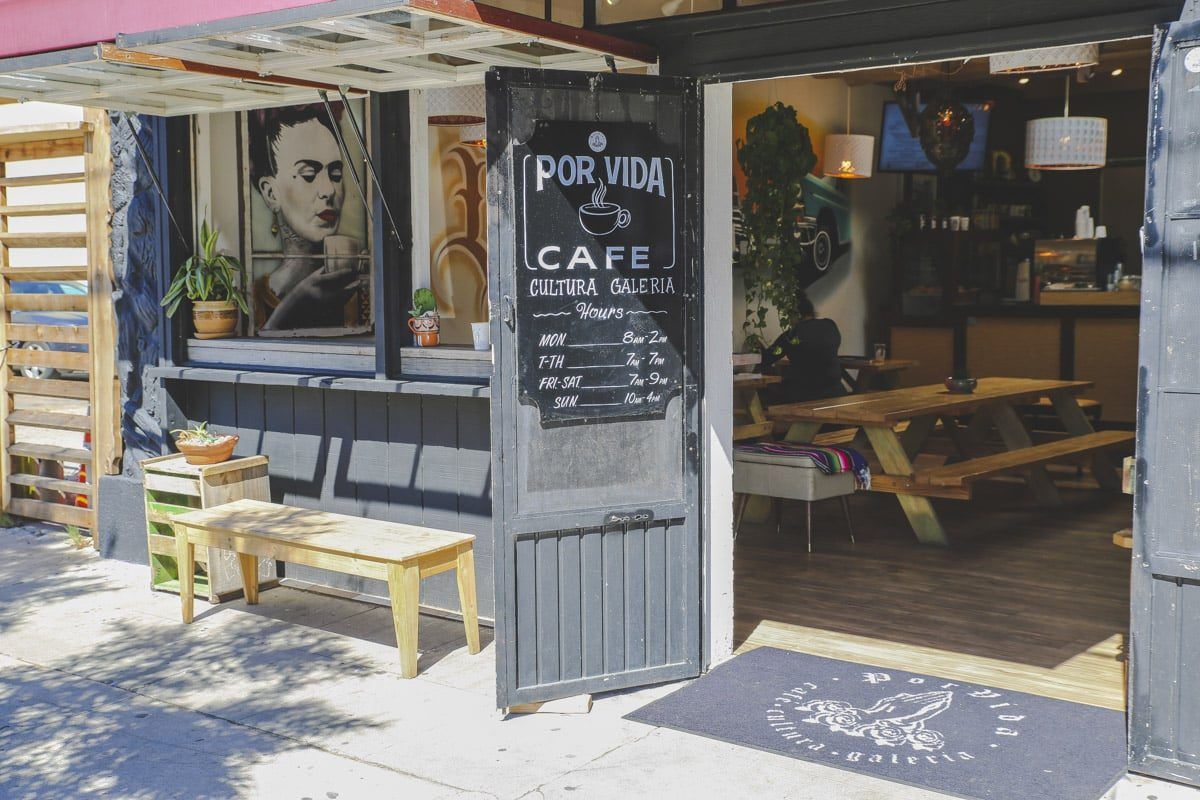 Por Vida Café in Barrio Logan, San Diego.
“Going to that coffee shop in Barrio Logan, and being able to feel the energy—I instantly wanted to support them and put their works in The Dean Collection,” Swizz explains. “A few days later, I started getting texts, and phone calls, and I realized that one move touched so many people here in San Diego where we’re bringing our art show. Now, how are we really including the energy of the people that built this space creatively? So, we decided to do something different and call it Hometown Heroes.” Alicia, excited that I had seen Por Vida firsthand, mirroring her husband’s statement. “The photography there was outrageous,” she says. “It’s so good, it’s so beautiful, so raw, it’s so organic. You really feel the spirit—and that’s what happens with all of these works.”
Curated by MCASD Associate Curator Amy Crum, Hometown Heroes features photographers MJ Pimentel, Oscar Cruz, and Chata alongside regional artists Andrea Chung, Esteban Cabeza de Baca, and Fox Maxy. The exhibition explores the city through themes of gentrification, Chicana/o/e activism, and community pride, while highlighting the perspectives of BIPOC people. The Deans also celebrated the exhibition’s opening with a performance and blessing from Danza Mexi’cayotl, one of the oldest Chichimeca-Azteca dance groups in San Diego County. “I think it’s just our job to make a reintroduction to these places when we go there, and make people feel welcome in their own home,” Swizz says.
For the Deans, Giants isn’t just about showing off their second-to-none collection of art; it’s about making people feel invited into environments that have historically felt closed off. Alicia points to the couple’s “no commission” platform as an early extension of that philosophy, explaining that too many young people grow up believing the art world is reserved for the wealthy or well-connected. “The masterful work that we’ve created is unbelievable,” she says. “You can’t believe how beautiful it is and what stories it tells and what it means; that’s why it’s so important because we belong everywhere.” From a collector’s perspective, Swizz reveals that many of the works with now Giants were initially difficult to acquire because major pieces were often reserved for elite collectors or museums. “Our answer was like, ‘Okay, well, let’s put the artists in all the goddamn museums since the reason why we can’t get work is because it’s going to a museum,’” he says with a laugh.
Part of the reason Giants continues connecting with folks in every city is because the exhibition removes the feeling that upscale events like these are only meant for a select few. The Deans want visitors—especially young Black and Brown visitors—to see themselves when they walk through. “We really wanted to make sure that our culture was on the walls of these institutions and spaces, to show the greatness that we are,” Alicia says. Swizz believes that the exhibition can also spark something for the next generation of artists stepping into the galleries that may have once felt out of reach. “We hope that the youth come here and get motivated and say, ‘You know what? I’m going to be on those walls and bigger ones,’” he says. “That has always been our goal.”