
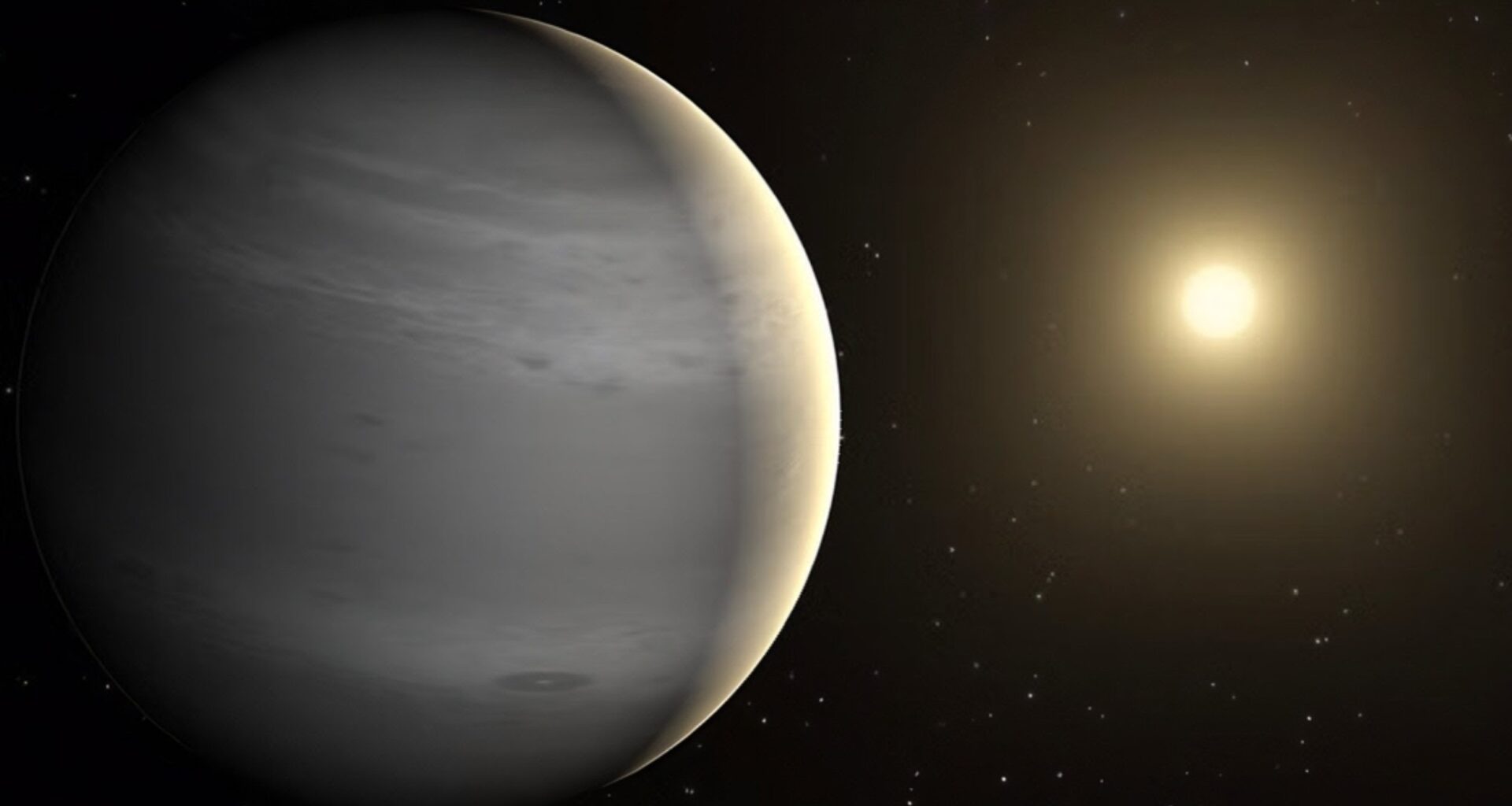
Most exoplanet atmospheres NASA’s James Webb Space Telescope has analyzed belong to worlds where iron evaporates.
Hot Jupiters – giant planets orbiting within days of their stars – have become well-mapped over time, their broad chemistry understood.

Giant planets farther out, circling on hundred-day schedules in cooler, quieter orbits, remain almost entirely unknown.
Models had predictions for that unexplored category. One of them said that if you could peer inside, you’d find methane.
Whether the models were right was another question entirely – until now.
A planet between extremes
TOI-199b is the world in question. It’s about the size of Saturn but only a fraction of its mass, and it orbits a sun-like star more than 330 light-years away.
One full loop takes roughly a hundred days.
The basic properties of TOI-199b had already been measured and documented in an earlier paper.
The current study was led by Renyu Hu, an associate professor at Penn State (PSU).
At roughly 175 degrees Fahrenheit, the planet is much cooler than the thousand-degree worlds that dominate most exoplanet studies.
Only a handful of these temperate worlds are even known, and this is the first one to have its atmosphere pulled apart in detail.
Reading light through air
Working out what an exoplanet‘s air is made of takes patience.
Astronomers wait for the planet to pass in front of its star, then watch as starlight filters through its outer layers.
Certain wavelengths get swallowed by whatever gases sit in the way, leaving a fingerprint embedded in the light that reaches the telescope.
The technique has a clinical name – transmission spectroscopy – but the idea is simple.
Webb’s instruments separate the incoming light into its component colors, one wavelength at a time. Subtle dips in the spectrum reveal which molecules are present.
A patient observation
The transit itself stretched for about seven hours, far longer than the breakneck passes of hot Jupiters that can wrap up in under an hour.
Around that, Webb sat on the star for close to 20 straight hours, building a clean baseline of what its light looked like with the planet out of the way.
Comparing those two records revealed exactly which colors the planet quietly absorbed.
Aaron Bello-Arufe, a postdoctoral researcher at NASA’s Jet Propulsion Laboratory (JPL), was first author of the study.
What the spectrum showed
Once the two records were aligned, one absorption pattern jumped out: methane.
The atmosphere had soaked up the exact wavelengths that gas is known to absorb – a fingerprint no other common molecule mimics at those colors.
“When we compared the spectra during the transit to the baseline, we saw that the atmosphere blocked the wavelengths of starlight absorbed by methane,” Bello-Arufe said.
Models had long predicted as much for temperate gas giants.
Until this study, no one had observed that match directly in a planet of this kind. The confirmation gives modelers a real-world test in a temperature range they’d never sampled.
Chemical clues beyond methane
The data also showed a smaller, less certain feature in a different part of the spectrum.
The team’s models suggest it may indicate ammonia or possibly another nitrogen-bearing compound.
Both molecules interest planetary chemists, since their relative concentrations could reveal how much circulation occurs between the deep interior and the cooler upper atmosphere.
Pinning down that connection will take additional data. Faint hints of carbon dioxide appeared too.
None of these secondary signals carries the same weight as the methane detection, and sorting them out will take more observing time on Webb.
An echo of home
What turned up around TOI-199b looks distantly related to the atmospheres of Saturn and Jupiter, where methane and ammonia are familiar players.
Methane has also been spotted by Webb in a smaller, cooler world called K2-18b, in an earlier study that drew wide attention because that planet sits in its star’s habitable zone.
That pattern suggests methane shows up reliably in the atmospheres of temperate worlds with light, hydrogen-rich air.
This is something the field had suspected for years but couldn’t confirm without instruments this sensitive.
Further observations are needed
The observation wasn’t perfect. A pointing misalignment reduced the precision of the spectrum below what the team had originally planned.
Even so, the methane signal came through strongly.
Researchers also tested whether the atmosphere might contain hazes – suspended particles that could blur some absorption features – using models based on the chemistry of Saturn’s moon Titan.
The preference for haze models over a clear atmosphere was weak. Whether TOI-199b actually has clouds or hazes will take a longer look to settle.
Future research directions
For decades, the chemistry of giant planets that aren’t blazing hot or solar-system-cold has been a blank space on the map.
Hu’s team has filled in a single data point in that gap.
Methane sits in the atmosphere of a temperate gas giant in roughly the amounts the models predicted.
That tells researchers their underlying chemistry holds up when tested against a real planet in this temperature range.
With more Webb time, the team can pin down relative amounts of methane, ammonia, and carbon dioxide on TOI-199b and compare them against other temperate giants.
A sharper picture of how Earth’s own atmosphere fits into the broader story of planetary chemistry should follow.
The study is published in The Astronomical Journal.
Image Credit: NASA/JPL-Caltech
—–
Like what you read? Subscribe to our newsletter for engaging articles, exclusive content, and the latest updates.
Check us out on EarthSnap, a free app brought to you by Eric Ralls and Earth.com.
—–