
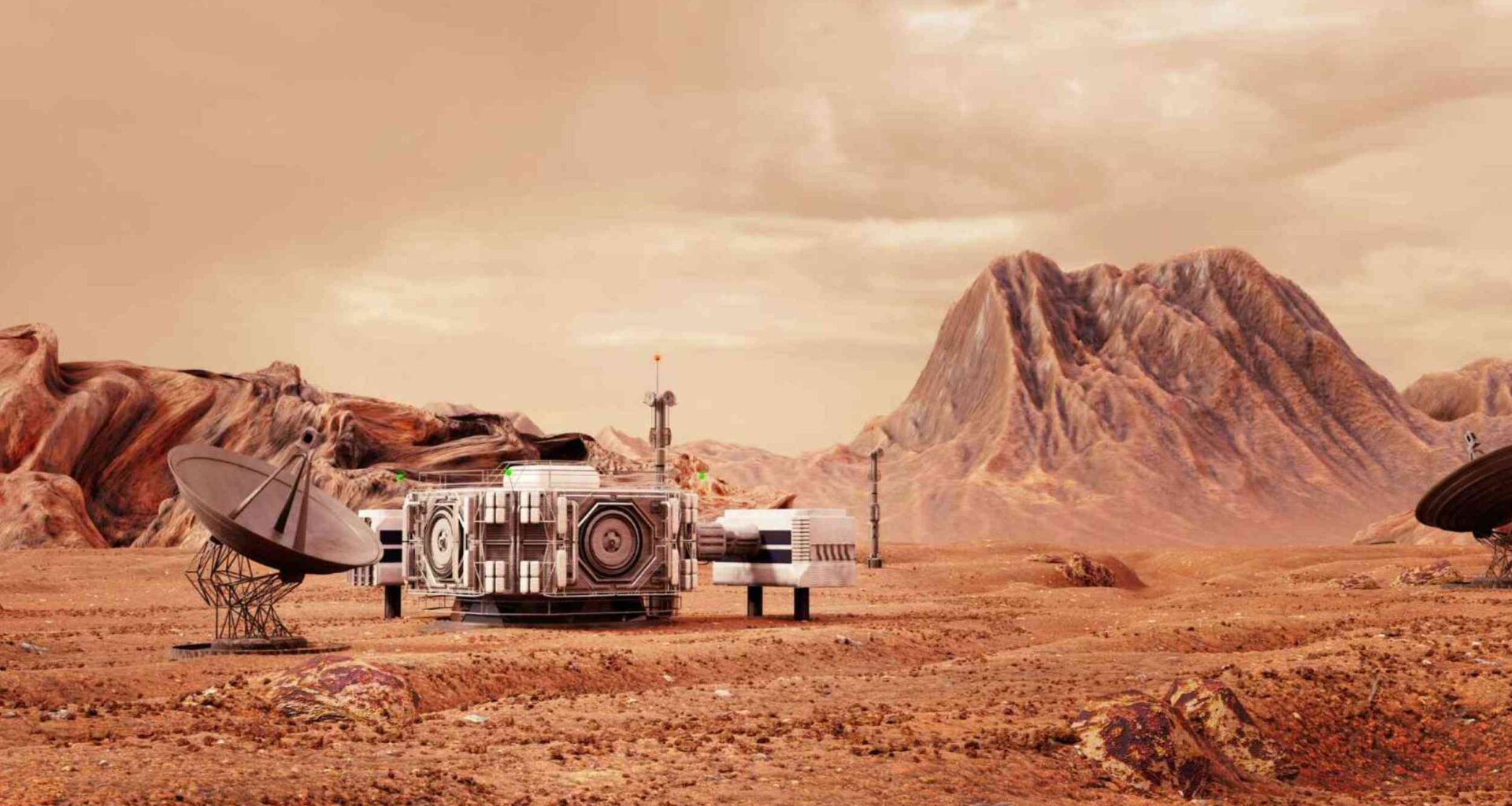
From space, Mars resembles a construction site. Iron oxide, the same basic chemistry as rust, blankets the surface in red.
Rovers have been photographing it for decades. That made it easy to assume the metal supply problem on Mars had already been solved.

It had not. Mars doesn’t appear to have had the geology that concentrated metals into dense, minable deposits.
A city there would need to import its structural materials from elsewhere in the solar system, and a new study ran the numbers to show how.
Researcher Serena Suriano of the Swiss Federal Institute of Technology Lausanne (EPFL) conducted a feasibility study.
The team asked what a self-supporting Mars colony would consume in metals and where those metals could realistically come from.
The Red Planet’s surface is genuinely iron-rich. But scattered iron oxide dust is not a minable ore body, and local extraction would demand enormous energy for meager returns.
Some industrial elements are scarce. Boron and molybdenum, used in high-performance alloys, are either trace-level on the surface or have not been pinned down at all in the data.
Earth shipping falls short
The obvious workaround is to fly metals in from Earth. However, a single cargo run takes six to nine months depending on planetary alignment.
Each ton of payload still costs tens of millions of dollars to launch. That bill might cover a few resupply missions, but it cannot sustain a city.
Their answer points outward. Millions of asteroids orbit through the inner solar system.
A subset, M-type asteroids, are essentially mountains of iron and nickel, with trace amounts of precious metals mixed in.
Some of these objects are thought to be the exposed cores of small planets that broke apart in the early solar system.
This is why NASA’s Psyche probe is currently flying out to one for a closer look.
Traveling from the asteroid belt to Mars demands far less fuel than launching off Earth. That makes asteroids a plausible source in a way Earth itself is not.
The barrier of fuel
Getting there is the hard part. The team modeled a mining ship based on Starship specs, requiring 120 tons of dry mass, 115 tons of payload, and 1,100 tons of propellant.
A full tank gives the ship a fixed energy budget for the whole trip.
That might sound generous, but when compared with asteroid routes, the number shrinks fast.
Every metallic asteroid the team examined requires roughly twice that fuel budget for a complete round trip from Mars. There are no exceptions.
Turning asteroids into refueling stations
The proposed fix is a multi-stop run.
A mining ship would haul to a metallic asteroid, load up on iron and nickel, then divert to a different kind of rock to brew fresh propellant on site.
The second stop would be at carbonaceous asteroids, ancient rocks rich in hydrocarbons.
When the right minerals are processed correctly, the propellant chemistry takes care of itself.
The trick is producing the rocket fuel locally on the asteroid itself. NASA has spent years developing versions of this technology through Mars-focused research and testing.
No full return tank is required. The propellant would be manufactured then carried on to Mars.
A decade per delivery
The catch here is time. A two-stop journey – to a metallic asteroid, then a carbonaceous one, and finally back to Mars – could take a decade.
Orbital alignments determine that schedule. Asteroids and Mars have to be in the right positions before a transfer window opens up.
Slow propellant production extends it even further. Current estimates run around four pounds per day.
This is fine for keeping a small base supplied, but not for filling a 1,100-ton tank.
Resupply would need to happen roughly every two years, syncing with Earth-Mars launch windows.
This would be cheaper than constant shipments from Earth. The cadence would slowly cut the colony’s dependence on home-planet logistics.
Future endeavors on Mars
The main finding is not that asteroid mining solves the Mars problem tomorrow. Engineers are still decades away from a working asteroid mining operation.
What the paper does, for the first time, is map a full supply chain end to end and show how the numbers work in practice.
Scaling up propellant production means asteroid metal becomes the cheaper option for a growing colony.
Mining the belt stops being a science-fiction premise and becomes a logistics problem with solvable equations.
That changes what a future settlement on Mars could be. It would no longer be a fragile outpost tethered to Earth, but the anchor of its own industrial backyard.
The study is published in arXiv.
—–
Like what you read? Subscribe to our newsletter for engaging articles, exclusive content, and the latest updates.
Check us out on EarthSnap, a free app brought to you by Eric Ralls and Earth.com.
—–