
Astronomers studying a distant exoplanet’s atmosphere have one persistent problem: clouds. They scatter light, muddle readings, and tend to be everywhere on the hot gas giants that are easiest to study.
The standard workaround has been to average everything together and interpret the resulting signal.

A new set of James Webb Space Telescope (JWST) observations suggests that strategy has been producing significantly inaccurate numbers.
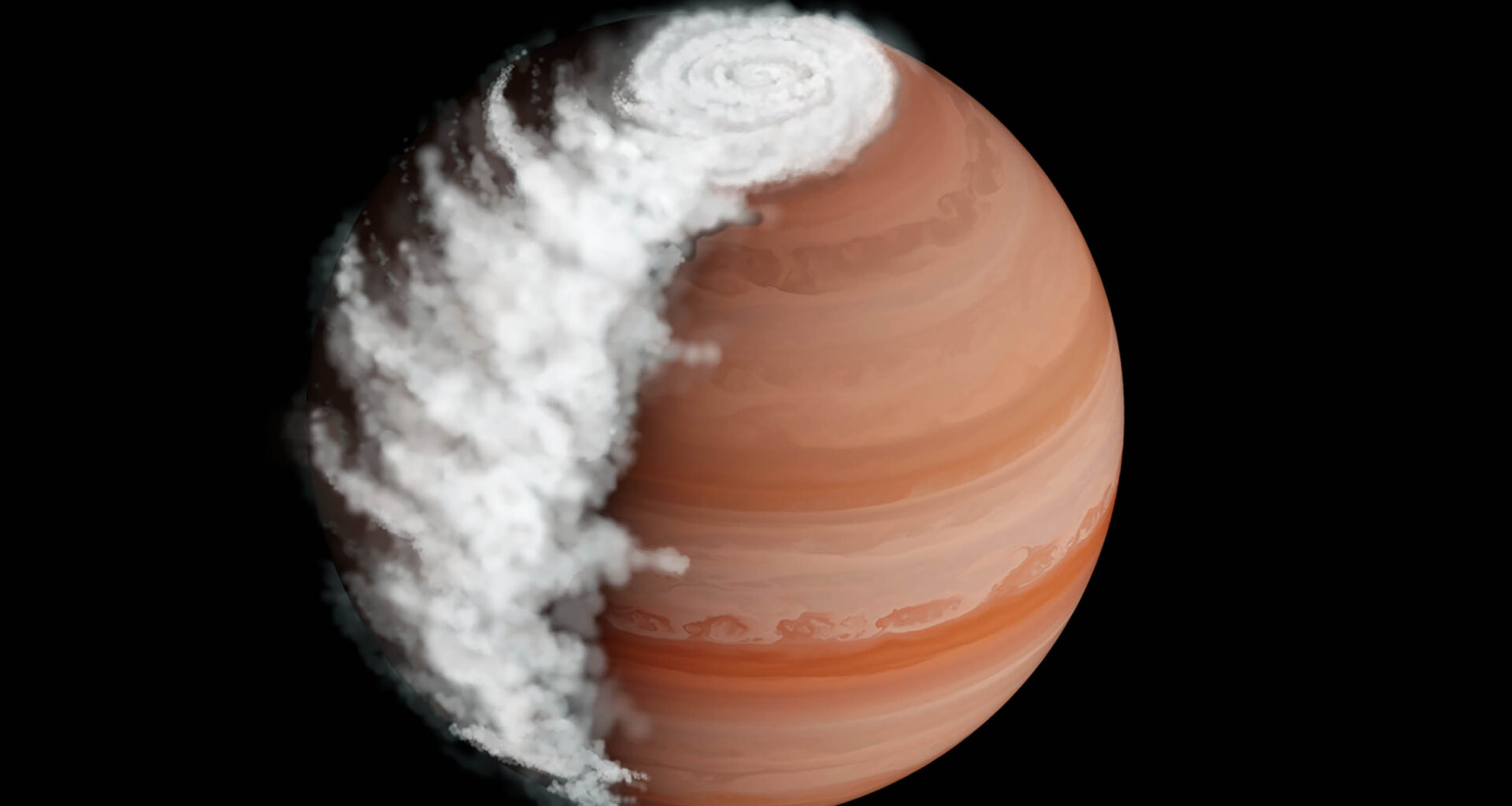
On a gas giant 700 light-years away, the morning side is buried in thick mineral clouds, while the evening sky is almost completely clear.
Scientists had never confirmed this split before, and it appears to have skewed chemical readings for over a decade.
Finding WASP-94A b
The planet is called WASP-94A b. It belongs to a class known as Hot Jupiters – gas giants that orbit so close to their stars that daytime temperatures push well past 1,000°F.
Many are tidally locked, with one face permanently turned toward the heat and the other in permanent darkness.
Until this study, planets like these read as a single blurred mass. Starlight filtering through during a transit carried morning and evening signals smeared together. Astronomers got an average, not a portrait.
David Sing has spent 20 years navigating cloudy exoplanet data. As a Bloomberg Distinguished Professor of Earth and Planetary Sciences at Johns Hopkins University (JHU), he led the team behind the new measurement.
Using JWST, Sing’s team measured the planet’s leading and trailing edges separately as it crossed its star.
Separating morning from evening
This technique exploits transit geometry. As WASP-94A b crosses in front of its star, its leading edge appears first – the morning side, where air flows from the cool night side into the hot day side. Its trailing edge, which vanishes last, represents the evening side.
The Hubble Space Telescope couldn’t separate these regions. Its readings averaged the whole disk, leaving clouds and clear skies blurred together. JWST’s sharper instruments let researchers measure each half separately.
“What we saw was a real dichotomy between the weather on both sides of the planet, and huge differences in cloud coverage, and that changes our whole picture of the planet,” Sing said.
Weather made of rock
Thick clouds in the morning. Clear skies by evening. The temperature difference between the two halves reached at least 500°F – large enough to drive completely different chemistry on each edge.
Nothing like Earth’s water vapor. The clouds on WASP-94A b are made of magnesium silicate – the same mineral family found in most of Earth’s surface rock – along with iron and magnesium sulfide.
The clouds likely formed from vaporized rock that cooled and rose into the atmosphere. The morning air is full of it. Free of those clouds, the evening side showed strong water vapor signals, and the planet’s chemical makeup came through clearly for the first time.
Where the clouds vanish
Why morning brings clouds while evening clears on the exoplanet remains an open question. Researchers have identified two possible explanations, and either could be contributing.
One possibility is wind. Strong vertical currents could lift cloud particles high above the morning side, then plunge them downward into the hot day side – burying them deep before they reach the evening edge.
The other possibility is heat. Either mechanism would produce the same sharp split.
Rewriting the planet’s chemistry
The clear evening sky also reshaped scientists’ understanding of this planet’s chemistry. Earlier Hubble readings had suggested WASP-94A b was wildly enriched in oxygen and carbon – hundreds of times more than Jupiter’s measured levels.
That estimate defied existing theories of how giant planets form.
Taken from the unobstructed evening side, the new measurement puts the enrichment at about five times Jupiter’s level – well within the expected range for a gas giant of this type.
Researchers traced the apparent 100-fold error back to clouds that muddled earlier data – an issue that a later study also identified on other exoplanets.
Sagnick Mukherjee, the study’s first author and now a postdoctoral fellow at Arizona State University, said the difference came down to looking at one side at a time. The earlier numbers weren’t wrong, exactly. They were unreadable.
Clouds across alien worlds
WASP-94A b isn’t alone. The team applied the same technique to eight other hot gas giants and found two more with the same morning-evening split: WASP-39 b and WASP-17 b.
Astronomers had long debated whether the airborne particles on these planets formed from condensed minerals or from chemical reactions driven by starlight.
Three planets now point to the same answer: condensed minerals, not photochemical smog.
Smaller worlds face the same problem even more severely. Clouds may play an even larger role on rocky and Neptune-sized exoplanets in the habitable zone – the orbital range around a star where liquid water may be possible.
Any search for chemical signs of life will first have to get past airborne particles that block the signal.
The team plans to apply this approach to a wider range of planets next, including a gas giant orbiting within its star’s habitable zone. A foggy view of distant atmospheres is finally starting to clear.
The study is published in the journal Science.
—–
Like what you read? Subscribe to our newsletter for engaging articles, exclusive content, and the latest updates.
Check us out on EarthSnap, a free app brought to you by Eric Ralls and Earth.com.
—–