
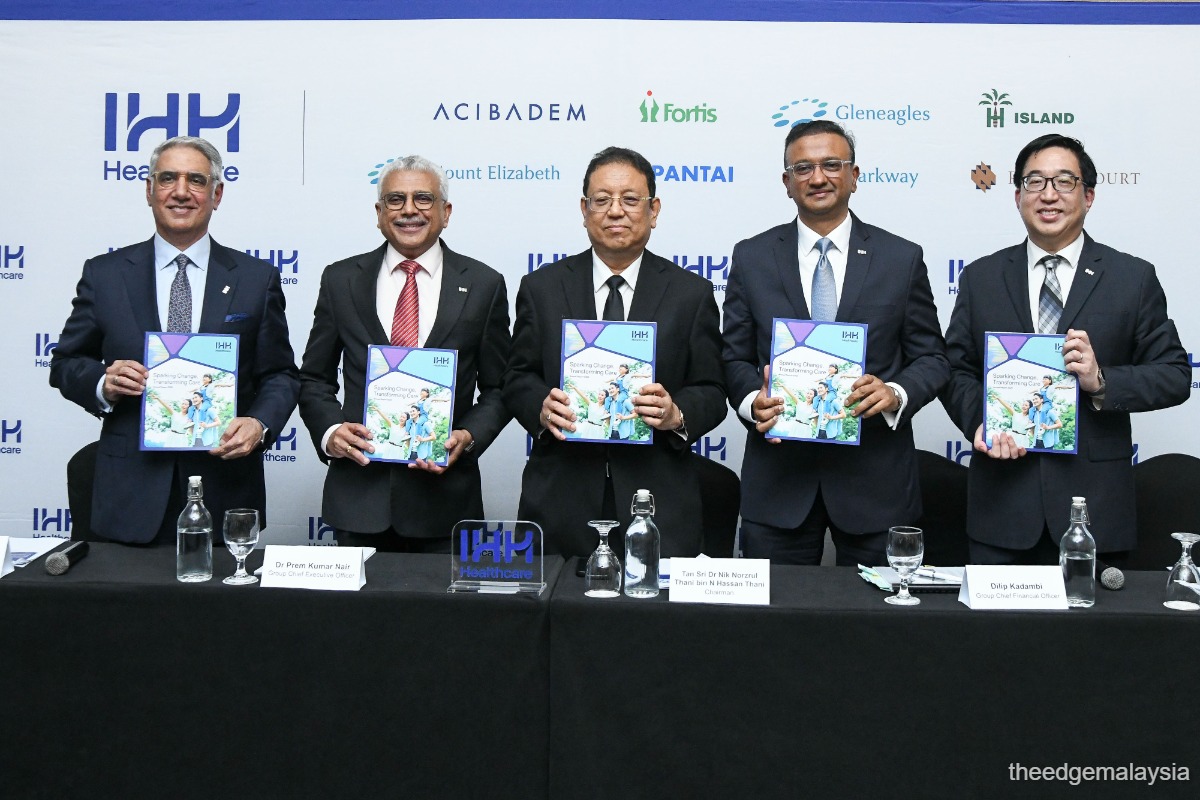
KUALA LUMPUR (May 25): IHH Healthcare Bhd (KL:IHH), one of the world’s largest private hospital providers, is doubling down on technology to manage rising costs, as its ability to pass these on to patients remains limited, said group chief executive officer Dr Prem Kumar Nair.
Medical inflation across key markets, including Malaysia and Singapore, remains elevated, compounded by higher costs linked to ongoing tensions in the Middle East. However, fee increases for patients are largely capped at low single digits of about 2% to 3%, he said at a press conference following the group’s annual general meeting on Monday.
“We are not increasing prices in line with inflation…that’s an important point. Any increase would be capped maximum at around 2% to 3%,” he said.
“Our performance comes down to efficiency, from medical innovations and better procurement to technology adoption and improved staff productivity,” he added.
IHH has yet to release its results for the first quarter ended March 31, 2026. For the financial year ended Dec 31, 2025 (FY2025), its net profit margin declined to 10.1% from 13% in FY2024, reflecting mounting cost pressures.
These were led by higher staff expenses, which rose 7% year-on-year to RM9.92 billion, alongside an increase in finance costs, up 2% to RM1.09 billion.
To address this, Prem said the group is leveraging artificial intelligence in radiology to generate preliminary readings for computed tomography (CT) scans and magnetic resonance imaging (MRI), speeding up diagnoses and improving patient throughput, with radiologists providing final verification.
In addition, administrative workflows are also being streamlined, including AI-driven nurse rostering that reduces time spent on scheduling and frees up staff for patient care.
The group is also shortening hospital stays through enhanced recovery protocols and minimally invasive procedures, enabling faster bed turnover and better capacity utilisation, he said.
Generic drugs to manage costs
IHH group chief medical officer Keith Lim said the group is increasingly turning to generic drugs — lower-cost alternatives to branded medications compared to proprietary drugs — as part of its cost management strategy.
This comes amid rising production and logistics costs for medicines, partly driven by higher fuel prices linked to the ongoing Middle East conflict. However, the Health Ministry has said manufacturers have largely absorbed these pressures, keeping medicine price increases within a modest range of about 1% to 2%.
Lim said IHH advocates the use of generic drugs where they are approved by regulators and proven to be effective, noting that switching from proprietary drugs to generics can deliver “meaningful cost savings for both the group and patients”.
“We prioritise cost-effective treatments where possible. If a generic alternative is available and clinically appropriate, that is the preferred option,” he said.
At the same time, he noted that newer drugs tend to be more expensive due to research and development costs.
“We recognise that newer drugs tend to be more expensive, as pharmaceutical companies need to recover research and development costs.
“For example, new antibiotics are often expensive. We are encouraging our clinicians to be more judicious, starting with standard treatments where appropriate, rather than moving straight to newer, high-cost drugs. That is a key part of our antimicrobial stewardship programme (AMS), prioritising effective, lower-cost options before resorting to more expensive treatments,” he added.
Shares of IHH Healthcare closed unchanged at RM8.96 on Monday, giving it a market capitalisation of RM79.17 billion. Year to date, the counter has risen over 4%.
Read also:
IHH CEO: Turkiye operations unaffected by Middle East conflict, growth intact